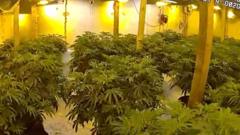
The headlines are predictable. A barn in the countryside, a "sophisticated" hydroponic setup, and a neatly stacked pile of 1,100 cannabis plants displayed like war trophies. The police department gets its photo op. The local news gets its clicks. The public is led to believe the streets are safer.
It is a lie.
If you are still celebrating thousand-plant busts as a win for public safety, you are misreading the entire economic and social map of the modern black market. This isn't a "shattering blow" to organized crime. It is a rounding error. It is a symptom of a broken regulatory system that incentivizes shadow economies while punishing transparency.
The Myth of the Sophisticated Operation
Every time a barn is raided, the word "sophisticated" gets tossed around. Let’s be clear: 1,100 plants in a barn is not sophisticated. It is a mid-tier industrial basement project.
True sophistication in the modern botanical trade doesn't happen in a leaky barn with bypassed electricity meters. It happens in high-tech facilities with pharmaceutical-grade climate control, genetic mapping, and integrated supply chains. When the police find a barn full of plants, they haven't found a kingpin. They have found a low-level subcontractor.
I have spent years watching the intersection of illicit trade and emerging legal markets. The "barn bust" is the low-hanging fruit of law enforcement. These operations are often noisy, smell like a skunk for three miles, and put immense strain on local power grids. Finding them doesn't require "elite detective work." It requires a thermal camera and a basic understanding of electricity bills.
The Economic Vacuum Effect
When 1,100 plants are removed from a market where demand remains constant, the "victory" lasts exactly forty-eight hours.
Basic economics tells us that when supply drops and demand holds, prices tick up. That price increase doesn't deter users; it merely increases the profit margin for the next person willing to fill the void. By removing a single decentralized production node, the state inadvertently increases the ROI for the remaining operators.
We are playing a game of whack-a-mole where the mallet is made of taxpayer money and the moles are incentivized by a massive tax-free upside. The "success" of this raid is actually a marketing campaign for the competitors who weren't caught.
Why the "War on Plants" is a Resource Drain
Let's look at the math of a raid.
- The Surveillance: Hundreds of man-hours.
- The Raid: Dozens of officers, specialized equipment, transport.
- The Processing: Forensic teams, evidence storage, chemical testing.
- The Prosecution: Legal fees, court time, potential incarceration costs.
All of this for a plant that is legal in half the civilized world. While officers are counting leaves in a barn, actual predatory crime—fentanyl distribution, human trafficking, and violent assault—continues unabated. We are prioritizing the optics of a large green pile over the reality of community safety.
The "lazy consensus" suggests that these busts stop the flow of money to organized crime. In reality, the most dangerous gangs have already moved on. They’ve diversified. They are in cybercrime, synthetic opioids, and white-collar fraud. The "barn grower" is a relic. Chasing them is like trying to stop the internet by seizing a few dial-up modems.
The Regulatory Failure
The existence of a 1,100-plant illicit grow is proof that the legal market is failing.
In regions where cannabis is legalized but over-regulated, the black market thrives. When you slap a 40% tax on a product and bury the producers in three years of red tape, you don't eliminate the "barn grow." You fund it.
The illicit market exists because it is more efficient, more agile, and cheaper than the state-sanctioned alternative. If the government truly wanted to "bust" the barn growers, they wouldn't use handcuffs. They would use tax breaks and streamlined licensing. They would make it so cheap to grow legally that no one would risk a prison sentence to do it in a shed.
The Real Cost of "Safety"
The competitor article focuses on the "success" of the seizure. What they don't mention is the environmental impact. Illicit grows often use unregulated pesticides and fertilizers that leach into the local water table. Because the operation is hidden, there is no oversight.
By forcing production into the shadows, we create the very environmental and safety hazards we claim to be fighting. A legal, taxed, and inspected facility doesn't bypass the meter. It doesn't dump chemicals in the woods. It pays for the local school's new gym.
The Wrong Question
People always ask: "How much was the haul worth?"
That is the wrong question. The "street value" cited by police is a fictional number based on the highest possible price for the smallest possible unit. It’s an accounting trick designed to make the bust look bigger than it is.
The real question is: "What did we lose to get this?"
We lost the opportunity to focus on violent crime. We lost the tax revenue that a legal operation would have provided. We lost the chance to dismantle the actual structures of organized crime by replacing them with a functional, transparent economy.
Stop clapping for the photos of police standing next to plants. It’s a performance. It’s a distraction from the fact that we are losing a war we should have stopped fighting decades ago.
Stop measuring success by the weight of the evidence and start measuring it by the reduction of the shadow economy. Until you fix the market, the barn will always be full.
Go find the people selling poison in the city center. Leave the farmers alone.