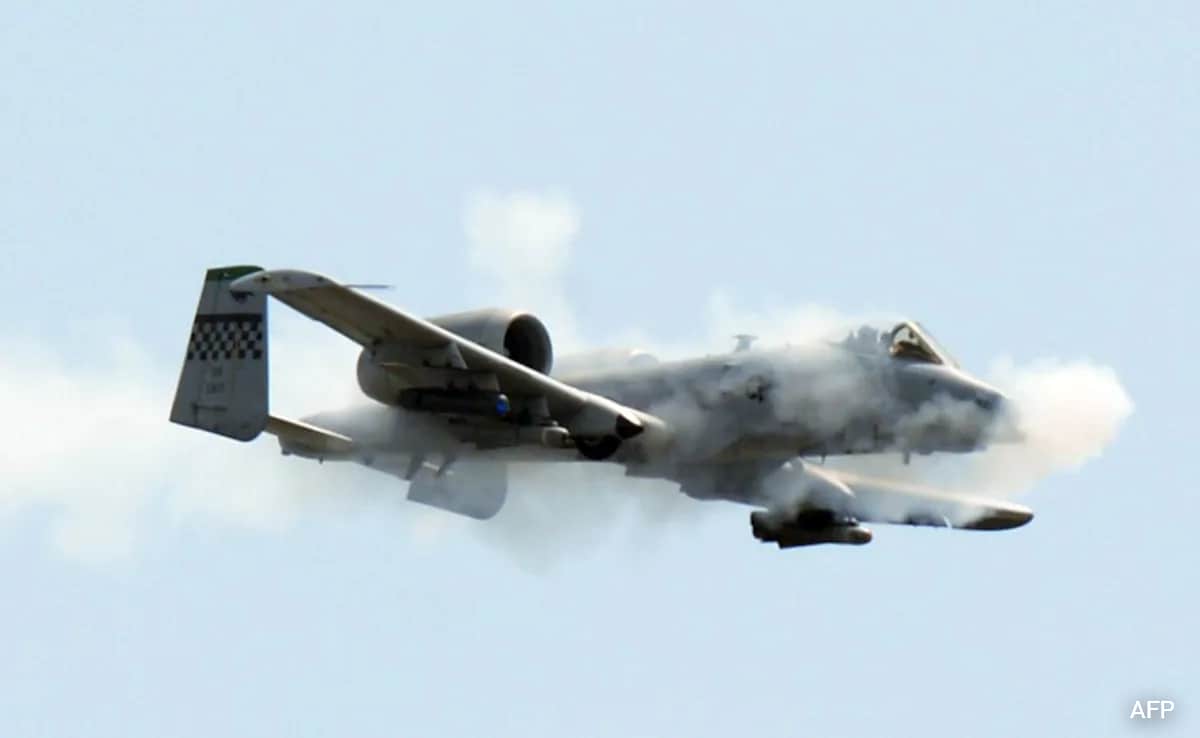
The defense establishment is currently obsessed with a fairytale. It involves a rugged, titanium-tubbed relic from the 1970s swooping low over the Strait of Hormuz to save global shipping from Iranian fast boats. The "Flying Tank," they call it. The "Warthog." To the sentimentalists and the armchair generals, the A-10 Thunderbolt II is a gritty hero that the Pentagon tried to "wrongfully" retire.
They are dead wrong. In other updates, we also covered: Europe and the Fusion Trap.
What you are witnessing in the Middle East isn't a triumphant return of a legend. It is a desperate, budget-driven recycling of an obsolete platform because the Air Force is too terrified of its own procurement failures to admit the truth. The A-10 isn't "shining" in the Hormuz missions. It is being babysat in low-threat environments because it would be a flaming wreckage within ten minutes of a real peer-to-peer conflict.
The Myth of the GAU-8 Avenger
The backbone of the A-10 worship is the 30mm GAU-8/A cannon. It’s the stuff of internet memes—a gun with a plane attached to it. The "BRRRRRT" sound is treated like a religious hymn. The Verge has provided coverage on this important issue in extensive detail.
But let’s look at the physics, not the YouTube clips. Against modern Main Battle Tanks (MBTs), that gun is a kinetic pepper shaker. Even during the Cold War, the Air Force’s own tests showed that the GAU-8 struggled to penetrate the frontal armor of Soviet T-62s and T-72s. To get a kill, pilots had to hit the thin armor on the top or the rear, which required a specific, suicidal dive angle that exposed the aircraft to every man-portable air-defense system (MANPADS) on the battlefield.
In the Strait of Hormuz, the A-10 is hunting Iranian speedboats. Using a $10 million aircraft and a massive 30mm cannon to sink a glorified jet ski is not "efficiency." It is an admission that we have no better way to utilize a plane that has been structurally compromised by decades of service. If a target is small enough to be killed by the GAU-8, it’s small enough to be killed by a $30,000 APKWS laser-guided rocket fired from a drone that doesn't require a pilot’s life as collateral.
The Survivability Delusion
The "Flying Tank" moniker comes from the 1,200-pound titanium bathtub that protects the pilot. The fans love to point at the A-10s that returned to base with half a wing missing during Desert Storm.
I have seen the internal damage assessments. I have talked to the maintainers who had to stitch those planes back together. Yes, the A-10 can take a hit from a 23mm anti-aircraft gun and stay in the air. But we aren't living in 1991 anymore.
Modern integrated air defense systems (IADS) like the S-400 or even older S-300 variants don't "poke holes" in wings. They hit with proximity-fused warheads that turn the entire airframe into a sieve. The A-10 is slow. It is loud. It has a heat signature the size of a small sun. It lacks the electronic warfare (EW) suites necessary to jam modern radar.
In a contested environment—think the South China Sea or Eastern Europe—the A-10’s "survivability" is zero. Its cruising speed is roughly 300 knots. A modern surface-to-air missile travels at $Mach$ 4. You do the math. $v_{missile} \gg v_{aircraft}$ is a recipe for a very expensive funeral.
The Opportunity Cost of Nostalgia
Every dollar spent keeping the A-10 fleet "mission capable" is a dollar stolen from the Collaborative Combat Aircraft (CCA) program or the F-35 supply chain. The Air Force is currently forced to maintain a massive, specialized logistics tail for an aircraft that only does one thing: Close Air Support (CAS).
And it doesn't even do CAS the best anymore.
The argument that "only the A-10 can do CAS" is a lie pushed by people who don't understand modern targeting pods. An F-15E or a B-1B Lancer can loiter at 25,000 feet, out of reach of MANPADS, and drop precision-guided munitions with a circular error probable (CEP) of less than three meters. They can do this in bad weather, at night, and through clouds—conditions that often ground the A-10 because its pilot needs to see the target to "get into the weeds."
The sentimental attachment to "danger close" strafing runs is costing us the next generation of air dominance. We are prioritizing the feeling of a pilot seeing the whites of the enemy's eyes over the reality of destroying the enemy before they even know an aircraft is in the AO.
The Hormuz "Success" Is a Managed Performance
Why is the A-10 in the Middle East right now? Because it’s a low-stakes theater. The Iranian Navy—specifically the IRGCN—is a nuisance, not a peer threat. They have fast boats and naval mines. They do not have a sophisticated, layered air defense network over the water.
Sending the A-10 to the Strait of Hormuz is a PR move. It allows the Pentagon to say, "Look, we're still using them!" while they quietly try to convince Congress to let them scrap the fleet. It’s a retirement home with a nice view.
If the mission was actually about lethality and maritime interdiction, we would be flooding the region with MQ-9 Reapers or the new Mojave STOL drones. These platforms have longer loiter times, smaller signatures, and—most importantly—no human heart inside to be stopped by a lucky shot from a ZU-23-2 mounted on a barge.
The Truth About the "Pilot Shortage"
The A-10 is often cited as a tool for pilot retention because "pilots love flying it." This is an emotional argument masquerading as a strategic one. We are facing a massive pilot shortage across the Air Force, and we are wasting talented aviators by sticking them in a cockpit that has no place in a high-end fight.
Every hour a pilot spends mastering the A-10 is an hour they aren't spending learning the systems of a 5th-generation fighter or commanding a swarm of autonomous loyal wingmen. We are training the best pilots in the world to fight a war that ended in 1945.
Stop Asking if the A-10 Works
The question isn't whether the A-10 can still kill a truck. Of course it can. The question is: Should it?
When we look at the cost per flight hour, the risk to the pilot, and the total inability to survive against any nation with more than a 1960s-era radar, the answer is a resounding no. The A-10 is a liability. It creates a false sense of security for ground troops who believe a Warthog will always be there to save them. In a real war with a near-peer, that Warthog will be shot down before it even crosses the Forward Line of Own Troops (FLOT).
We need to stop celebrating the "Flying Tank" and start mourning the fact that we are still tethered to it. The A-10 isn't a symbol of American might; it's a symbol of our inability to let go of the past even when the future is trying to kill us.
Burn the fleet. Move the funding to high-attrition drones. Tell the pilots to get into a simulator for a platform that actually matters. If you want to see a "Flying Tank," go to a museum.
Stop pretending that nostalgia is a weapon system. It's just a way to get good people killed for a headline.
Order the F-35s. Fund the CCAs. Let the Warthog die before its inevitable slaughter in a real sky makes us regret every cent we spent keeping it on life support.