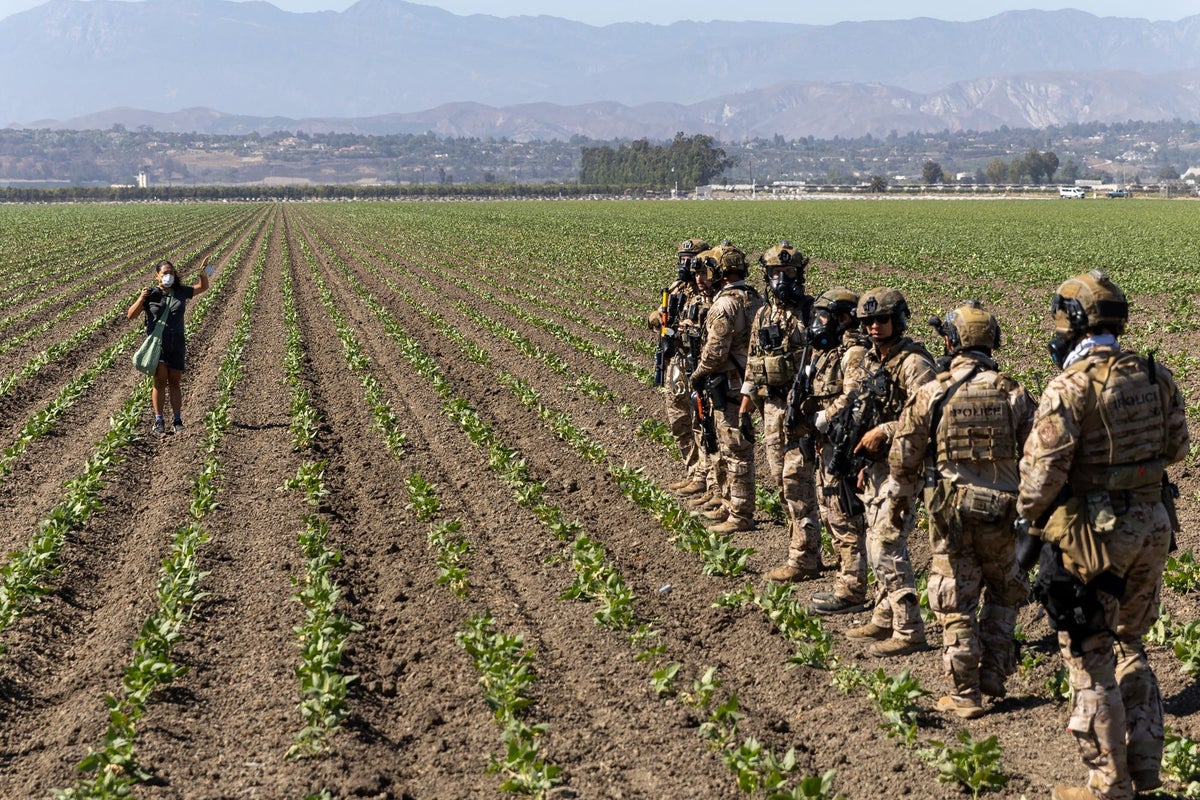
The United States agricultural sector operates on a fundamental structural contradiction: it requires a high-volume, low-cost labor force that domestic demographics cannot supply, yet it exists within a political framework that prioritize border hardening. The recent shift in policy—coupling aggressive interior enforcement with proposed streamlined work authorizations for undocumented farmworkers—is not a reversal of ideology. It is a transition toward a Controlled Access Labor Model. This model attempts to decouple the economic utility of the migrant from their legal residency, aiming to solve the "harvest-gap" while maintaining the political optics of a closed border.
To understand the mechanics of this shift, one must analyze the agricultural production function and how labor volatility triggers systemic shocks across the food supply chain.
The Three Pillars of Agricultural Labor Dependency
The survival of high-value crop production in states like California, Florida, and Washington rests on three specific variables that domestic labor markets fail to meet.
- Seasonality and Peak-Load Volatility: Unlike manufacturing, which can level-load production, agriculture faces biological deadlines. A crop must be harvested within a 7-to-14-day window or it loses 100% of its market value.
- Geographic Displacement: Most large-scale farming occurs in "labor deserts"—low-population density areas where the local headcount is mathematically insufficient to meet harvest demands.
- Physical Attrition and Skill Specialization: While often categorized as "unskilled," manual harvesting requires high-speed caloric output and specific tactile knowledge to prevent crop damage. Domestic workers consistently exhibit higher turnover rates and lower efficiency metrics in these specific roles.
Current policy maneuvers attempt to resolve the friction between the National Security Mandate (deportation) and the Food Security Mandate (stable harvest). By targeting migrants in general raids while simultaneously proposing "easy-work" permits for those already in the fields, the administration is moving toward a utility-based immigration status. This creates a bifurcated class of migrants: those who are "economically essential" and those who are "socially redundant."
The Cost Function of Labor Instability
When interior enforcement increases without a synchronized expansion of legal work channels, the agricultural sector faces a Scarcity Premium. This is not merely an increase in wages; it is a systemic breakdown characterized by three specific failure points.
The Harvest Abandonment Rate
When labor supply drops below the critical threshold required for a 24-hour harvest cycle, growers are forced to prioritize specific fields. The "abandonment rate" represents the percentage of planted acreage that is never harvested due to a lack of hands. This represents a total loss of the "sunk costs" (seeds, fertilizer, water, and land prep), leading to immediate balance sheet insolvency for small-to-mid-sized operations.
The H-2A Compliance Tax
The H-2A visa program is the primary legal alternative, but it carries a heavy "Compliance Tax." Employers must provide housing, transportation, and guaranteed wages (the Adverse Effect Wage Rate). For many growers, the capital expenditure required to build H-2A compliant housing is a barrier to entry. The administration’s proposal to "make it easier" for migrants to work suggests a streamlining of these regulatory hurdles—potentially lowering the compliance bar to allow undocumented workers to transition into a "Provisional H-2A" status without the traditional employer-side overhead.
Market Share Erosion
Agricultural production is a global commodity game. If U.S. labor costs or availability fluctuate too wildly, retailers shift their procurement to Mexican or South American suppliers. Once a supply chain re-routes to a foreign competitor, the "switching costs" to return to U.S. growers are prohibitively high, leading to long-term domestic industry contraction.
Mechanical Realities of Selective Enforcement
The logic of "deport and then permit" functions as a crude market-clearing mechanism. By increasing the risk of staying in the U.S. without a permit, the government forces the migrant population into the specific sectors that offer legal "safe harbors." If the only way to avoid deportation is to hold a specific agricultural work card, the government effectively directs the flow of human capital into the fields.
This is a Monopsonistic Labor Strategy. By tying a migrant's legal safety to a specific industry, the government grants that industry immense leverage over the worker. The worker cannot "vote with their feet" and move to construction or hospitality if the conditions in the field are poor, because their legal status is tethered to the dirt.
The Logic of the Provisional Work Card
The proposed "ease of work" likely centers on a Provisional Work Authorization (PWA). Unlike a Green Card, which offers a path to citizenship and total labor mobility, a PWA would be:
- Sector-Specific: Valid only for NAICS codes related to agriculture and food processing.
- Time-Bound: Active only during peak harvest months.
- Biometrically Tracked: Allowing the state to maintain a "registry" of the undocumented population while extracting their economic value.
This creates a "just-in-time" labor force. From a data-driven perspective, this is an attempt to achieve the efficiency of a guest-worker program without the political "cost" of granting permanent residency.
The Efficiency Bottleneck: Why Simple Fixes Often Fail
The administration’s strategy assumes that the migrant population will trust the new "easier" work permits. However, the Trust Gap creates a significant bottleneck. When an administration leads with deportation raids, the target population retreats into the "shadow economy." This retreat decreases labor participation rates across the board, even in "safe" industries.
Furthermore, the "easier" permits do not address the Mechanization Lag. Many growers have resisted investing in harvesting robotics because human labor was historically cheap and flexible. Now, the sudden pivot toward high-risk labor forces a capital-intensive transition that many farms cannot afford. The result is a "middle-income trap" for farms: too large to rely on family labor, but too small to automate.
Strategic Forecast: The Shift to Corporate Agriculture
The net result of these policies will be the accelerated consolidation of the American farm. Large corporate entities have the legal departments to navigate complex "easier" permit systems and the capital to build H-2A housing. Small independent growers will be squeezed by the volatility of enforcement and the high cost of compliance.
We are moving toward a landscape where the U.S. government acts as a labor broker for industrial-scale farming. The "deportation-plus-permit" strategy is the first step in formalizing a temporary, mobile, and highly regulated migrant underclass that exists purely to sustain the domestic food supply without ever integrating into the domestic body politic.
Growers must now treat "Labor Procurement" as a high-risk regulatory department rather than a simple HR function. Success in the next five fiscal years will depend on the ability to integrate biometric compliance with automated harvest scheduling to minimize the "Total Human Hours" required per acre. The era of the "unregulated field" is over; the era of the "monitored harvest" has begun.
Identify the specific "Labor-to-Yield" ratio for each crop in your portfolio. If a crop requires more than 40% manual labor and cannot be transitioned to a H-2A or PWA-compliant model within 18 months, divest or pivot to mechanized row crops. The political risk of "informal" labor has officially exceeded the operational reward.