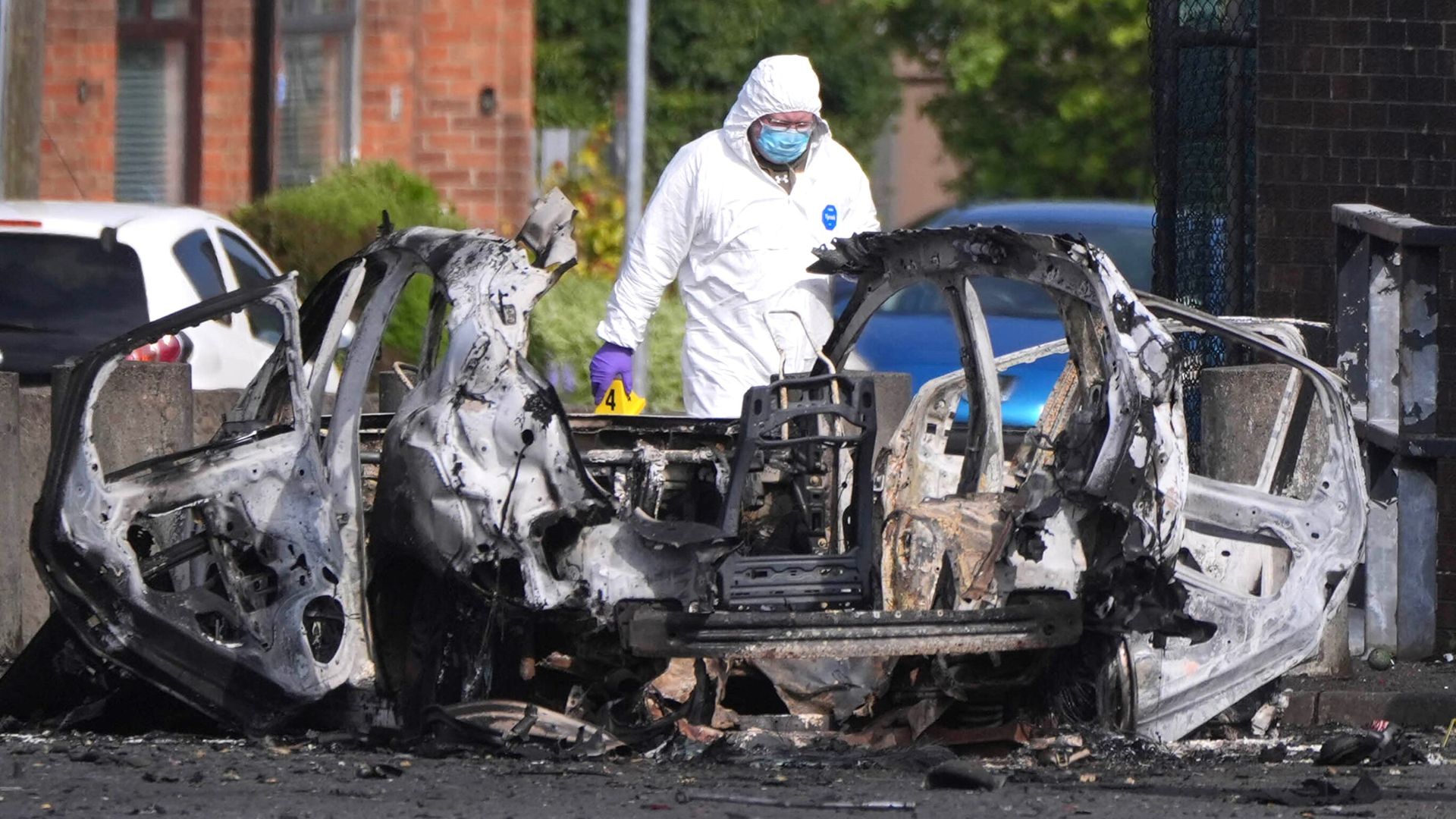
The siren does not fade quickly when the target is the law itself. A man sits in a cell, processed and charged, following the detonation of a vehicle outside a police station. Authorities describe it as an isolated incident, a singular act of madness, yet the smoke hanging over the precinct suggests something far more malignant. This is not merely a crime scene. It is a signal.
The arrest provides the illusion of closure. Society breathes a sigh of relief when the handcuffs click shut. We like the narrative of the lone actor, the deranged individual who snapped. It is clean. It is manageable. But the reality of a car bomb—the acquisition of precursors, the technical assembly of an improvised explosive device, the surveillance required to select a target—points away from madness and toward method.
The Technicality of Hate
Constructing an improvised explosive device capable of causing significant damage is not a skill picked up on a whim. While the internet acts as a library for those seeking destructive knowledge, the practical application requires nerves and a tolerance for risk that separates the amateur from the operative. To drive a vehicle rigged with high explosives to a fortified location indicates a high level of commitment.
When we examine the logistics, we see a failure that extends far beyond the individual in custody. Who sold the materials? Where was the device assembled? These questions often lead into dark corners of the web or, more frequently, into the mundane garages of suburban neighborhoods. Radicalization is a process, not an event. It feeds on grievances, real or imagined, and finds comfort in the echo chambers of encrypted messaging platforms.
The bomb maker does not start by wanting to kill. They start by wanting to be heard. They begin by isolating themselves from differing opinions, feeding on perceived injustices until the state becomes the enemy. By the time the fuse is lit, the individual has already mentally seceded from society. The car bomb is simply the physical expression of that secession.
The Mirage of Intelligence
Law enforcement agencies pride themselves on their ability to predict and prevent. They monitor watchlists, analyze threat vectors, and invest heavily in signal intelligence. Yet, a car bomb outside a station suggests the system is leaking. If a known individual or a monitored group managed to progress from ideological fervor to active domestic terrorism, the gaps in the grid are widening.
The focus on digital surveillance has created a blind spot in the physical world. We spend billions tracking metadata, emails, and social media interactions, assuming that terrorism will announce itself in the cloud. We forget that the most dangerous actors are often those who go dark. They stop posting. They stop engaging. They stop leaving a digital footprint. In our obsession with the online trail, we have neglected the old-fashioned art of human intelligence.
We need to return to the streets. We need to understand the social dynamics of the neighborhoods where these actors hide. An arrest is a victory for the forensic unit, but it is a defeat for the intelligence division. If the police are targeted, it means the deterrent effect of their uniform has evaporated. When the enforcers become the targets, the social contract is under heavy strain.
The Fortress Mentality
Following this attack, the natural instinct of the department will be to harden the target. Expect higher barriers, increased vetting for visitors, and armed guards stationed at perimeters. Police stations will turn into bunkers. While necessary for the immediate safety of the officers, this defensive posture carries a steep cost.
Community policing relies on accessibility. It requires the public to see the officer as a neighbor, a facilitator, and a protector. When that officer begins to peer out from behind bulletproof glass and concrete bollards, the distance between the state and the citizen grows. This isolation feeds the very resentment that radicalization requires. It creates an 'us versus them' dynamic that hardens over time.
The irony is that by protecting themselves, the police may inadvertently drive more people toward extreme ideologies. It is a vicious cycle. The threat grows, the police harden, the public feels alienated, and the extremists recruit more effectively. Breaking this cycle requires more than tactical gear. It requires a fundamental shift in how the state interacts with the communities it is sworn to protect.
The Myth of the Lone Wolf
There is a comfortable fiction in the term 'lone wolf.' It absolves the community, the family, and the institutions of any responsibility. It allows us to view the attacker as an aberration. However, a person who builds a car bomb is rarely truly alone. They are supported by a belief system that validates their violence. They are cheered on by anonymous figures in forums. They are enabled by the normalization of political violence in public discourse.
We must stop treating these attacks as freak occurrences. They are the predictable outcome of a society that has lost its ability to debate without dehumanizing the opposition. When political rhetoric centers on the destruction of opponents, when the law is viewed as a weapon rather than a arbiter, when the foundational institutions are treated as illegitimate, is it any surprise that someone decides to drive a bomb into a police station?
The suspect in custody is just the tip of the spear. The danger lies in the shaft—the broader cultural and social currents that allow such an act to be conceived and executed.
Assessing the Threat Horizon
We must accept that the threat is evolving. The traditional model of terrorist cells directed from abroad is fading, replaced by a decentralized network of individuals who share tactics and ideology but operate with complete autonomy. These individuals do not need a handler. They need a spark. And in a society where outrage is the primary currency, sparks are cheap.
The police station attack is a litmus test for the state. If the response is purely reactionary—if it is limited to more arrests and tighter surveillance—the frequency of these events will rise. The state must learn to identify the precursors of radicalization before they manifest as explosives. This means engaging with the communities that feel disenfranchised, not through intimidation, but through tangible support and representation.
It is a difficult task. It is expensive. It requires patience and political will, two commodities that are currently in short supply.
The Cold Reality of Surveillance
We cannot monitor our way out of this. You cannot secure every vehicle, every chemical supply shop, or every parking lot. The attempt to do so would create a surveillance state that would be indistinguishable from the authoritarian regimes we claim to oppose. The goal of the attacker is often to force this transition, to provoke the state into a repressive reaction that radicalizes more of the population.
When we overreact, we play into their hands. We grant them the very societal shift they desire. The objective of terrorism is to create terror, to make the public fearful, and to make the state paranoid. The most effective defense is not necessarily more armor, but a refusal to be broken. It is a resilient public that refuses to cower, and a police force that remains integrated with the community despite the threats.
The Final Reckoning
The investigation into the specific act will conclude. The suspect will face trial. Headlines will shift to the next crisis. But the temperature of the nation remains dangerously high. This attack is a reminder that the institutions we rely on are vulnerable to those who have abandoned the rule of law.
The sirens fade, but the warning remains. A car bomb outside a police station is a declaration that the state has lost its monopoly on fear. If we are to prevent the next one, we must look beyond the suspect in the cell and examine the fissures in the society that gave him the motive, the method, and the opportunity to strike. The time for reactive measures has passed. We are staring at a structural failure, and no amount of perimeter fortification will fix what is broken in the foundation.