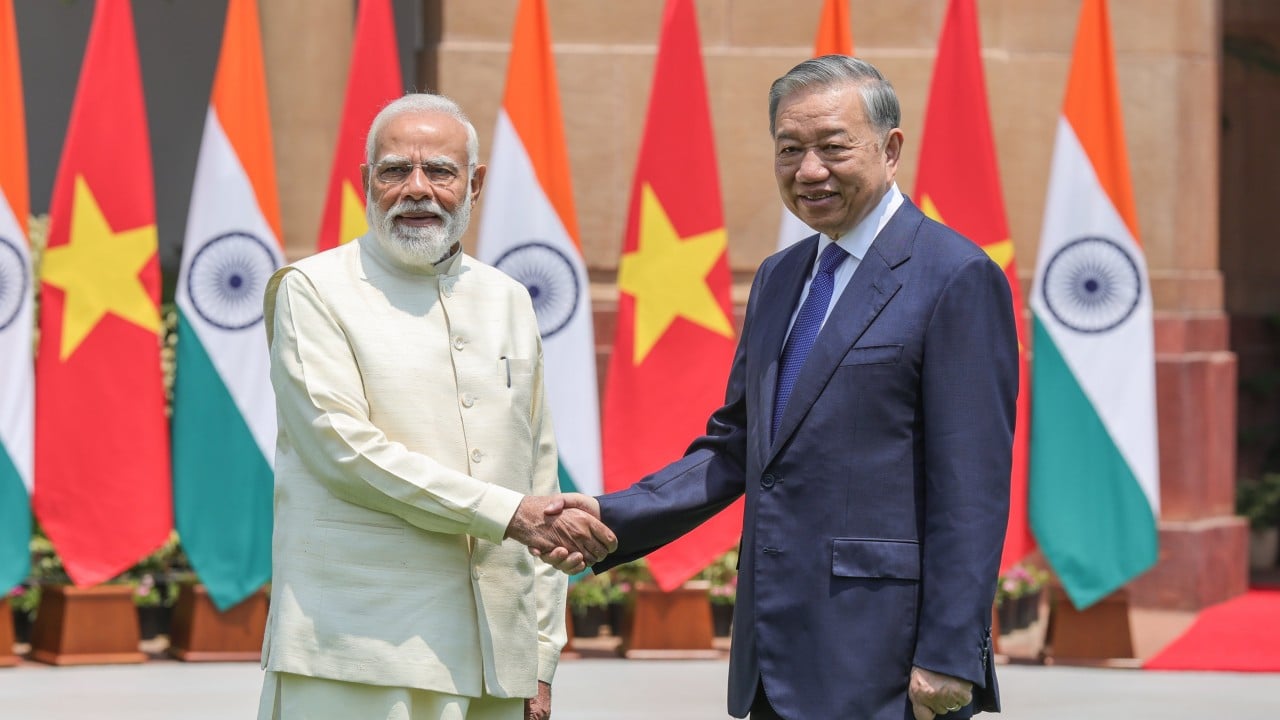
The shift from a unipolar or bipolar global hierarchy toward a fragmented multipolarity has forced middle powers to develop a specific variety of "Strategic Autonomy." For India and Vietnam, this is not a passive stance of neutrality but an active, resource-heavy hedge against the supply chain vulnerabilities and security risks inherent in over-dependence on the United States or China. The synchronization between New Delhi’s "Act East" policy and Hanoi’s "Four Noes" defense doctrine represents a calculated effort to build a localized power center that reduces the marginal cost of resisting superpower pressure.
The Tri-Lens Framework of Indo-Vietnamese Alignment
To understand why this partnership is accelerating, we must look beyond diplomatic platitudes and analyze the three distinct functional layers of their cooperation: the Security Buffer, the Supply Chain Hedge, and the Diplomatic Multiplier.
1. The Security Buffer: Reducing Asymmetric Vulnerability
Vietnam faces a massive power imbalance in the South China Sea. India faces a similar structural challenge along the Line of Actual Control. Both nations treat the Indo-Pacific not as a conceptual geography but as a theater of operational necessity.
The security relationship functions through a "Capacity-Building Feedback Loop." India provides Vietnam with credit lines for defense procurement—most notably the $100 million and $500 million packages—which Vietnam uses to modernize its coastal defense and naval capabilities. This is not charity; it is a strategic investment for India. By strengthening Vietnam’s ability to deny sea control to a common competitor, India forces that competitor to commit more assets to its eastern flank, thereby diluting the naval pressure in the Indian Ocean.
2. The Supply Chain Hedge: The "China Plus One" Industrial Logic
The economic incentive for closer ties is driven by the global reallocation of manufacturing capital. As multinational corporations seek to diversify away from Chinese production bases, India and Vietnam are often viewed as competitors. However, a structural analysis reveals they are actually complementary nodes in a regional value chain.
- Vertical Integration: Vietnam excels in final assembly and light manufacturing due to its proximity to East Asian logistics hubs and its aggressive Free Trade Agreement (FTA) network.
- Upstream Inputs: India possesses a massive labor pool and a growing capability in raw material processing and component manufacturing (e.g., chemicals, textiles, and electronics intermediates).
By integrating these two economies, they create a secondary manufacturing corridor that operates independently of the Beijing-centric model. This reduces the "systemic friction" companies face when trying to exit the Chinese ecosystem.
3. The Diplomatic Multiplier: Small-Group Minilateralism
Traditional multilateral organizations (like the UN or even ASEAN) often suffer from "consensus paralysis." India and Vietnam are bypassing these slow-moving structures by engaging in "minilateralism"—small, high-intensity partnerships designed for specific outcomes. This allows both nations to maintain their "strategic non-alignment" while effectively acting in concert on issues like maritime law and digital sovereignty.
Quantifying the Strategic Deficit
Despite the alignment of interests, significant "transactional friction" limits the full realization of this partnership. The current bilateral trade volume, hovering around $15 billion, remains significantly lower than their respective trade with the superpowers. This gap represents a "Strategic Deficit."
The deficit is caused by three primary bottlenecks:
- Infrastructure Lag: The lack of direct, high-capacity maritime and land-based connectivity between the two regions increases the landed cost of goods.
- Regulatory Disparity: Differences in digital governance, labor laws, and investment protections prevent the seamless flow of capital.
- Procurement Cycles: Defense deals often take years to move from "Letter of Intent" to physical delivery, a timeline that lags behind the rapid pace of regional security shifts.
The Cost Function of Over-Dependence
For Vietnam, the cost of over-dependence on China is a loss of sovereign control over its Exclusive Economic Zone (EEZ). For India, the cost of over-dependence on the West is a potential loss of policy independence regarding its internal markets and energy security.
By deepening their bilateral link, both countries are essentially buying an "Insurance Policy against Coercion." If superpower A threatens sanctions, or superpower B threatens a blockade, the India-Vietnam corridor provides a survival mechanism. This is the "Diversification of Geopolitical Risk," a principle identical to modern portfolio theory in finance. You do not eliminate risk; you distribute it across uncorrelated assets.
Mechanics of Defense Industrial Cooperation
The transition from "buyer-seller" to "co-producer" is the most critical phase of this relationship. India’s BrahMos supersonic cruise missile sale to Vietnam is a technical benchmark, but the true value lies in the "MRO" (Maintenance, Repair, and Overhaul) ecosystem.
By establishing MRO facilities in Vietnam for Indian-made hardware (and Soviet-legacy hardware used by both), the two nations create a self-sustaining defense infrastructure. This reduces the "logistics tail" that usually leads back to Moscow or Washington. It creates a localized technical loop where Vietnamese technicians and Indian engineers develop proprietary modifications to equipment, ensuring that neither superpower can "switch off" their defense systems during a crisis.
Data Points and Divergence: Where the Logic Fails
It is a mistake to assume India and Vietnam will always act as a unified bloc. Their interests diverge in two specific areas:
- ASEAN Centrality: Vietnam is deeply embedded in ASEAN and must navigate the internal politics of that bloc, which often favors a "neutrality" that can verge on passivity. India, as a subcontinental power, has the luxury of acting with more unilateral force.
- The Russia Variable: Both countries have historically relied on Russian military hardware. As Russia becomes more closely aligned with China, India and Vietnam face a "Technological Sunset." They must find a way to replace or upgrade these systems without alienating their primary supplier or falling into an exclusive dependency on Western platforms.
Structural Evolution of the Partnership
To move beyond the current plateau, the partnership must undergo a "Functional Upgrade." This requires moving from high-level summits to "Deep Integration" across three specific sectors:
Digital Sovereignty and 5G
Both nations are wary of the hardware backdoors associated with certain global vendors. By collaborating on "Open RAN" (Radio Access Network) technologies and cybersecurity protocols, India and Vietnam can build a "Digital Moat." This ensures that their critical infrastructure remains under national control, preventing the weaponization of the internet of things (IoT) by external actors.
Energy Transition and Rare Earths
Vietnam holds some of the world's largest unexploited rare earth deposits. India possesses a massive renewable energy market and a growing need for battery storage materials. A "Resource-for-Technology" swap—where Indian capital and processing tech help Vietnam extract and refine these minerals—would break the current monopoly held by a single global actor on the green energy supply chain.
Pharmaceutical Resilience
During global health crises, the fragility of the pharmaceutical supply chain becomes a national security risk. India, the "Pharmacy of the World," and Vietnam, a growing hub for biotech, can co-locate manufacturing plants to ensure that "active pharmaceutical ingredients" (APIs) are produced and distributed within a trusted circuit.
Strategic Forecast: The Emergence of the "Third Pole"
The trajectory of Indo-Vietnamese relations indicates the formation of a "Non-Ideological Pole" in the Indo-Pacific. Unlike the Cold War blocs, this alignment is not based on shared governance models (as one is a multi-party democracy and the other a one-party socialist state) but on shared "Survival Metrics."
In the 2024–2030 window, the success of this partnership will be measured not by trade volume alone, but by the "Substitution Rate"—the speed at which they can replace superpower-dependent systems with bilateral or localized alternatives.
The ultimate strategic play for both New Delhi and Hanoi is to create a situation where a conflict between superpowers is no longer an existential threat to their own development. This requires a rapid transition from diplomatic signaling to hard-coded industrial and military interoperability. The window for this transition is narrowing as regional tensions escalate; therefore, the current pace of high-level ministerial engagement is likely to shift toward permanent, working-level technical committees focused on the "hard" assets of sovereignty: semiconductors, missile tech, and deep-water port access.
Stability in the Indo-Pacific will increasingly depend on whether these two nations can successfully build this "Middle Corridor," providing a credible alternative for other regional states looking to escape the binary choice of superpower alignment.