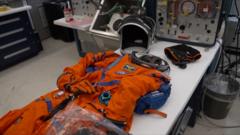
NASA is not delaying the Artemis II launch because of safety; they are delaying it because they are terrified of the math.
The standard narrative—the one you’ll read in every sanitized press release and echoed by uncritical "space enthusiasts"—is that these delays are the natural hiccups of a bold new era of exploration. They point to heat shield erosion and battery circuit issues as the noble hurdles of pioneers. This is a fantasy.
In reality, we are watching the slow-motion collapse of a 20th-century procurement model trying to survive in a 21st-century orbital economy. The Space Launch System (SLS) is a jobs program disguised as a moon rocket, and every day Artemis II sits in a hangar is another day the public doesn't realize we are spending $4 billion per launch on a vehicle that was obsolete before it left the drawing board.
The Heat Shield Fallacy
NASA’s official line on the Orion heat shield is that it charred "unexpectedly" during the Artemis I re-entry. Engineers saw material wearing away in a way their models didn't predict.
Let’s be clear: we have been sending capsules through the atmosphere since the 1960s. The physics of ablation—the process where a heat shield burns away to carry heat away from the craft—is not a mystery. When a modern agency "misses" the modeling on a heat shield, it isn't a scientific anomaly. It’s a symptom of a fragmented supply chain where components are built by different legacy contractors across 50 states to satisfy Senate subcommittees rather than aerodynamic efficiency.
The delay isn't just about fixing the shield. It's about the fact that Orion is too heavy and the SLS lacks the lift capacity to give it a proper margin of error. They are over-engineering a solution to a problem created by the rocket’s own inefficiency.
The $2 Billion Disposable Camera
Imagine buying a Ferrari, driving it once, and then pushing it off a cliff. That is the SLS flight profile.
The RS-25 engines powering the SLS are the same "Space Shuttle Main Engines" that were designed to be refurbished and flown dozens of times. Instead of honoring that engineering heritage, NASA is throwing them into the Atlantic Ocean after eight minutes of use.
- Cost per engine: Roughly $100 million.
- Engines per launch: 4.
- Outcome: Garbage at the bottom of the sea.
I’ve seen aerospace startups scrapped for failing to justify a $10,000 burn rate. Yet, here we are, nodding along while the government spends more on a single-use orange fuel tank than most nations spend on their entire space programs. To call this "progress" is a cognitive dissonance that would make George Orwell blush.
The Starship Elephant in the Room
The "lazy consensus" suggests that SLS and SpaceX’s Starship are complementary. They aren't. They are Darwinian rivals, and SLS is the Neanderthal.
While NASA spends years debating battery circuitry on a capsule that fits four people, private industry is iterating on a vehicle designed to carry 100 people and land back on the pad it started from.
The argument for SLS used to be "certainty." Proponents said, "Sure, it’s expensive, but it’s the only heavy-lift vehicle that exists." That certainty evaporated the moment the Starship prototypes started cleared the tower. If Starship hits its goals for orbital refueling, the entire architecture of Artemis II—the Lunar Gateway, the Orion capsule, the SLS itself—becomes an expensive, unnecessary detour.
Why We Aren't Going Back to Stay
People also ask: "Why is it taking longer to get to the Moon now than it did in the 60s?"
The answer is brutal: In 1969, we had a goal. In 2026, we have a budget.
The Apollo program consumed roughly 4% of the US federal budget. Artemis is a rounding error by comparison, but it’s an error that is being milked for every cent of "cost-plus" contracting. Under a cost-plus contract, the contractor gets paid for their expenses plus a guaranteed profit. There is zero incentive to be fast. There is every incentive to find a "safety concern" that requires another eighteen months of paid study.
If we actually wanted to be on the Moon, we wouldn't be building a single-use rocket based on 40-year-old Shuttle tech. We would be incentivizing a competitive market for lunar transit.
The Risk of "Safety-Is-First" Rhetoric
The most dangerous lie in aerospace is "Safety is our number one priority."
If safety were the number one priority, you would never put a human on top of a controlled explosion. The priority is, and always has been, mission success within an acceptable risk profile. By hiding behind safety delays, NASA is avoiding the hard conversation about the inherent flaws in the SLS design.
We are treating the Artemis II astronauts like fragile cargo because the system they are riding in is a fragile political compromise. We have traded the "Right Stuff" for the "Right Paperwork."
The Cold Reality of the Lunar Gateway
The Artemis II mission is a flyby. It doesn't land. It doesn't stay. It’s a high-altitude selfie.
To actually land, NASA needs the Lunar Gateway—a planned space station in lunar orbit. Critics within the industry have long called this the "toll booth" to the Moon. It serves no technical purpose that a direct-to-surface mission couldn't handle better. Its only purpose is to create a permanent infrastructure that is "too big to fail," ensuring that no future administration can cancel the program without looking like they are wasting a space station.
We are building a train station in the middle of a desert before we’ve even proven the tracks work.
Stop Cheering for Delays
The next time you see a headline about "Artemis II Launch Dates Shifting for Enhanced Safety," don't applaud. Don't fall for the "space is hard" trope.
Space is hard, but bureaucratic inertia is harder. We are currently subsidizing the slow death of the Old Space era. Every month of delay for Artemis II is a month where we aren't innovating, aren't lowering the cost to orbit, and aren't actually becoming a multi-planetary species.
We are just paying for the privilege of watching a 1980s rocket design die of old age on the launchpad.
Stop asking when it will launch. Start asking why we are still building it.
The Moon is waiting, but the SLS is a lead weight tied to our collective ankles. If we want the stars, we have to stop worshiping the anchors.