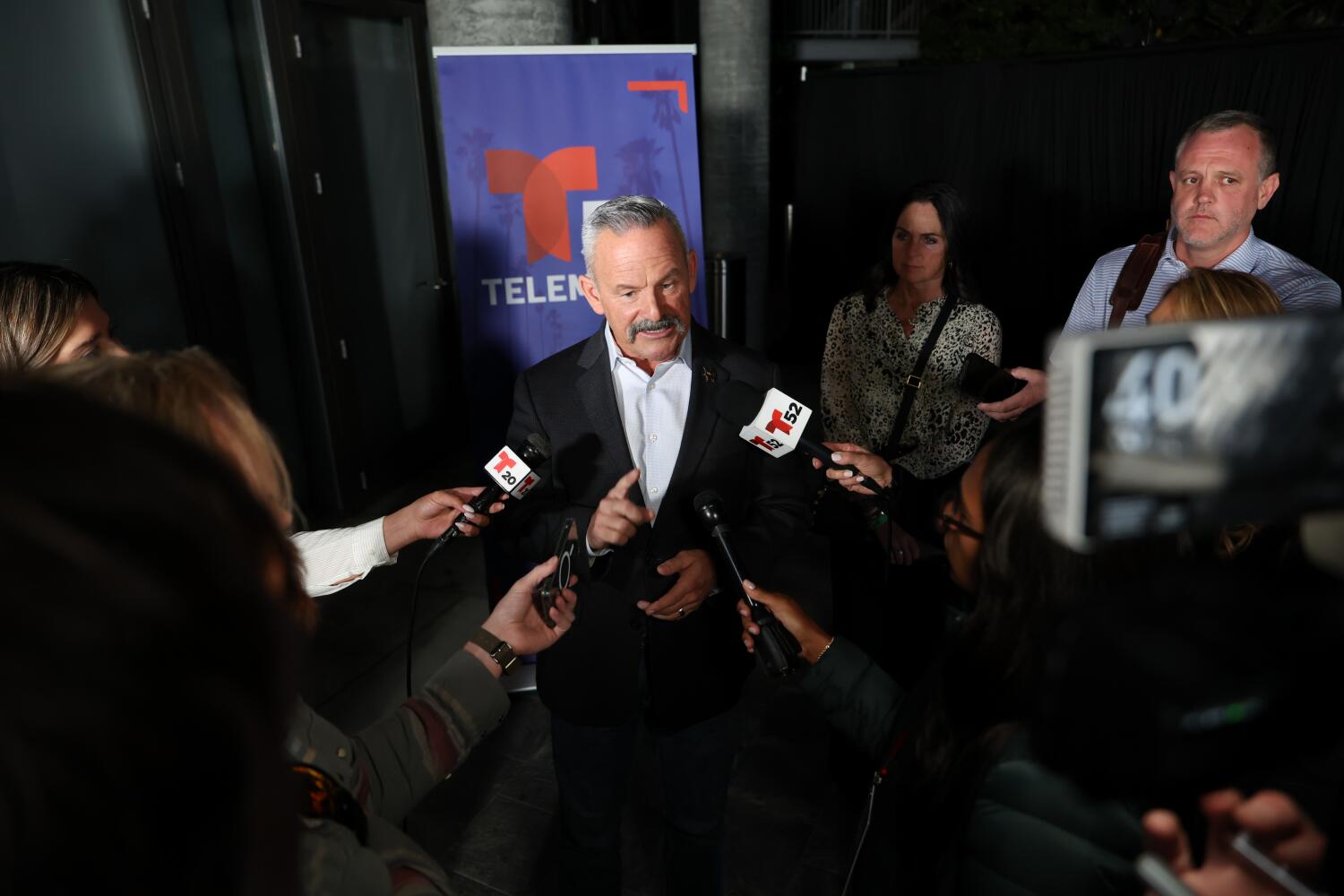
In Riverside County, the sun doesn’t just rise; it bakes the inland dirt until the air smells of sagebrush and hot asphalt. This is the kingdom of Chad Bianco. He isn't just a sheriff here. To his supporters, he is a firewall. To his critics, he is a lightning rod. But as the 2026 California gubernatorial primary approaches, Bianco is no longer content guarding the borders of a single county. He is looking at the entire state of California and seeing a house on fire.
The traditional path to the Governor’s Mansion in Sacramento usually runs through polished law firms, city councils, or the tech-heavy boardrooms of Silicon Valley. It involves calculated soundbites and a wardrobe of expensive, tailored suits. Bianco has a different uniform. He has the tan-and-green fatigue of the Riverside County Sheriff’s Department, a silver star pinned to his chest, and a holster on his hip. He doesn't speak in the cautious, vetted platitudes of a career politician. He speaks in the blunt, jagged language of a man who spends his days looking at crime scene tape.
This isn't just another campaign. It is a collision.
The Crack in the Blue Wall
For years, the political consensus in California was a one-way street. The state moved steadily toward progressive criminal justice reform, prioritizing rehabilitation over incarceration and loosening the grip of mandatory sentencing. Then the atmosphere changed. Walk down a street in San Francisco or a suburban strip mall in Fresno, and you’ll hear the same low-frequency hum of anxiety. People talk about the brazenness of retail theft. They talk about the tent cities that have become permanent fixtures of the California geography.
Bianco stepped into that anxiety like a man walking into a room he already owns.
He didn't start his rise with a policy white paper. He started it with a camera and a refusal to back down. When the state mandated lockdowns, he called them unconstitutional. When Sacramento pushed for stricter gun control, he doubled down on the rights of his constituents to arm themselves. He became the face of the "Constitutional Sheriff" movement, a philosophy that suggests the local sheriff is the ultimate authority on what is and isn't legal within their jurisdiction.
Think of it as a localized rebellion. While the rest of the state’s leadership looked toward global climate goals and high-speed rail, Bianco was filming videos in his office, looking directly into the lens, and telling the Governor exactly where he could put his mandates. It was theater, yes. But it was theater that played to a packed house of frustrated Californians who felt the state had stopped listening to them.
The MAGA Label as a Shield and a Sword
The "MAGA" tag is usually a death sentence in a California general election. The math simply doesn't add up for a hard-right Republican in a state where Democrats outnumber them nearly two-to-one. But the 2026 primary is a different beast. In a crowded field of traditional candidates, a singular, loud voice can carve out a massive chunk of the electorate.
Bianco wears the MAGA association with a shrug that looks a lot like defiance. He isn't trying to pivot to the center. He isn't trying to soften his edges to appeal to the wine bars of Santa Monica. Instead, he is betting that the "center" has moved. He is betting that even moderate voters—people who might have voted for Gavin Newsom twice—are now so exhausted by the sight of broken glass on their morning commute that they are willing to vote for a man who promises to swing a heavy hammer.
Consider a hypothetical voter: Sarah. She lives in a quiet neighborhood in Irvine. She recycles. She supported marriage equality long before it was trendy. But three months ago, someone smashed her car window in broad daylight while she was dropping her kids at soccer practice. Last month, the pharmacy down the street was looted. When she sees Chad Bianco on the news, she doesn't see a partisan ideologue. She sees someone who looks like he knows how to make the chaos stop.
That is the Bianco strategy. He isn't selling a Republican platform. He is selling the idea of "Order" in an era of perceived "Disorder."
The Shadow of the 2026 Primary
The primary is where the soul of the state will be contested. On one side, you have the establishment Democrats, likely a mix of high-ranking state officials and perhaps a celebrity or two, all vying to prove they can manage the California dream without letting it turn into a nightmare. They will talk about "strategic investments" and "holistic approaches" to homelessness.
Bianco will talk about handcuffs.
He has spent the last year touring the state, not as a candidate, but as a crusader. He shows up at rallies in the Central Valley, where the water rights are disappearing and the dust is thick. He speaks to crowds in the Inland Empire who feel like the coastal elites view them as an inconvenient footnote. His rhetoric is sharp. He calls the current leadership "enemies of the people." He speaks about the "destruction of the California way of life."
Critics point to his ties to extremist groups and his frequent appearances on far-right media outlets as proof that he is unfit for the highest office in the state. They argue that his brand of law enforcement is a throwback to an era of systemic overreach and that his "Constitutional Sheriff" stance is a dangerous flirtation with lawlessness in the name of the law.
But for Bianco, those criticisms are fuel. Every time a major newspaper runs a scathing editorial about his "radical" views, his fundraising numbers spike. He has mastered the art of the grievance economy. He knows that in 2026, being hated by the right people is just as valuable as being loved by the wrong ones.
The Invisible Stakes of the Inland Empire
To understand why Bianco is gaining traction, you have to look away from the coast. Drive east from Los Angeles until the palm trees give way to rocky hills and sprawling warehouses. This is the Inland Empire, one of the fastest-growing regions in the country and the heart of Bianco's power base.
For decades, this area was the "overflow" for the coast—the place where people moved when they couldn't afford a house in Orange County. Now, it is a political powerhouse in its own right. The people here are tired of being told that California is a paradise while they struggle with some of the highest utility costs in the nation and schools that feel like they are falling behind.
Bianco speaks to them as a peer. He speaks their language. He doesn't use the academic jargon of Sacramento. He uses the language of the dinner table. He talks about "common sense." He talks about "taking our state back." It’s a simple narrative, almost cinematic in its clarity: The Sheriff enters a town overrun by outlaws and cleans it up.
But governing a state of 39 million people is not the same as running a sheriff’s department. The Governor of California has to manage a massive bureaucracy, navigate a complex legislature, and oversee an economy that is the fifth largest in the world. Being a "disruptor" is a great campaign slogan, but it is a difficult way to manage a budget.
The Mechanics of the Surge
As the primary nears, the logistical reality of Bianco’s campaign is beginning to take shape. He is leveraging social media in a way that traditional candidates struggle to match. His videos go viral not because they are polished, but because they are raw. They feel authentic in an age of over-curation.
He is also benefitting from a fragmented field. If three or four traditional Democrats split the majority of the vote, a unified conservative and "law and order" block could easily propel Bianco into the top two. In California’s non-partisan primary system, the top two vote-getters, regardless of party, move on to the general election.
If Bianco makes it to the general, the state will face a choice unlike any it has seen in decades. It won't just be a choice between a Democrat and a Republican. It will be a referendum on the very identity of California. Are we a laboratory for progressive ideals, even when the experiments get messy? Or are we a state that has reached its breaking point, ready to hand the keys to a man who promises to restore the old ways through sheer force of will?
A Long Shadow in the Sun
The heat in Riverside is different today. It feels heavy, pregnant with the weight of what’s coming. Chad Bianco is standing on a stage, the glare of the sun reflecting off his badge, and he is telling a story. It’s a story about a California that used to exist—a place of safety, of opportunity, of clear lines between right and wrong.
He tells the crowd that the people in Sacramento have forgotten them. He tells them that the elites think they are smarter than the people who actually do the work. And then he stops, looks out at the sea of hats and flags, and smiles. It’s a confident smile. It’s the smile of a man who knows that fear is a powerful motivator, but hope—the hope that things can finally change—is even stronger.
Whether he wins or loses, Bianco has already shifted the gravity of the race. He has forced the conversation away from the abstract and toward the visceral. He has made the 2026 primary about the feeling of a deadbolt turning in a door at night.
Outside the rally, the traffic on the I-15 hums, thousands of cars moving toward a future that no one can quite see yet. In the rearview mirrors, the dust of Riverside rises, blurring the line between the lawman and the leader, until all that's left is the long, sharp shadow of a man waiting for his moment.