The arrival of a new Banksy installation in London is not merely an artistic event; it is a high-stakes deployment of intellectual property into an unmanaged physical environment. While traditional art markets rely on the controlled scarcity of the gallery, Banksy operates on a model of forced scarcity through geographic fixedness. When a new work appears, it triggers an immediate socio-economic chain reaction that involves municipal liability, private property valuation shifts, and the rapid mobilization of secondary market speculators. To understand the latest London piece is to understand the friction between public art and private equity.
The Triple Constraint of Urban Installation
The success of a Banksy work is governed by three primary variables: visibility, durability, and legal friction. Unlike studio-produced art, these installations are subject to an immediate decay function the moment they are "released" to the public.
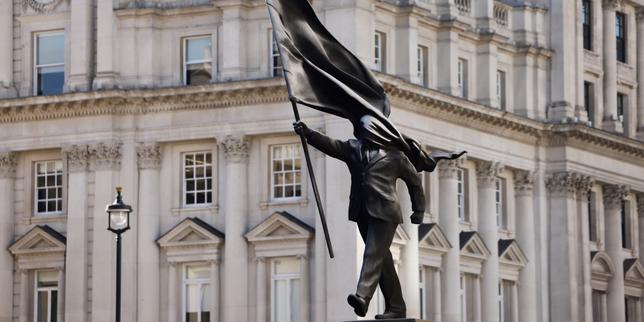
- Visibility and Traffic Density: The choice of a London site is rarely aesthetic; it is logistical. High-visibility locations ensure that the digital amplification—the primary vehicle for the artist's brand equity—happens before municipal authorities can intervene. The "new" London statue operates as a physical anchor for a global digital campaign.
- Material Durability: The shift from two-dimensional stencils to three-dimensional statues introduces new engineering risks. A statue requires structural integrity and weight-bearing considerations that a spray-painted wall does not. This increases the "cost of removal" for potential thieves or salvagers, effectively acting as a physical deterrent to unauthorized relocation.
- The Legal Friction Coefficient: Every Banksy piece exists in a state of legal limbo. It is technically an act of criminal damage (vandalism) that simultaneously adds significant appraised value to the underlying asset (the building or land). This creates a paradox for the property owner: to remove the work is to destroy an asset worth millions, but to keep it is to accept the liability of crowds, security costs, and structural maintenance.
The Economic Lifecycle of a Public Asset
The lifecycle of the latest London statue follows a predictable trajectory of value capture. Most observers focus on the art; analysts must focus on the transfer of value.
Phase I: The Value Injection
Upon authentication via the artist’s social media channels, the specific GPS coordinate gains a "brand premium." For a private property owner, this is an unearned capital gain. However, this gain is illiquid. The owner cannot easily sell the statue without also selling the land, or undertaking the complex engineering task of extracting the work.
Phase II: The Liability Surge
The immediate byproduct of the "Banksy Effect" is a spike in operational costs.
- Security Overhead: The need for 24-hour surveillance to prevent defacement or theft.
- Public Safety: Managing the "Instagram Effect," where high foot traffic creates bottlenecks and potential safety hazards on public sidewalks.
- Insurance Complexity: Most standard property insurance policies do not cover "accidental" high-value art installations. The owner must negotiate new riders to cover the replacement or restoration value of the work.
Phase III: The Extraction Dilemma
Eventually, the cost of maintaining the work in situ often exceeds the perceived benefit. This leads to the extraction phase. Historical data from previous London works suggests that "protected" street art often ends up in private auctions. This transition from "public gift" to "private asset" is the ultimate realization of the work's economic potential, though it usually results in the total destruction of the work's original context.
The Mechanism of Authentication and Control
Pest Control, the artist's sole authentication body, serves as the central clearinghouse for the Banksy market. Their role in the London statue deployment is critical: they control the supply side of the "truth." Without a certificate from Pest Control, the physical object has the value of its raw materials. With it, it becomes a financial instrument.
This creates a centralized authority in a decentralized medium. By choosing which works to authenticate, Pest Control manages the global supply and ensures that "street" works remain distinct from "studio" works. The London statue, as a public-facing piece, is a marketing loss-leader for the artist’s broader portfolio of prints and canvases. It generates the cultural relevance necessary to sustain the price floors of his private sales.
Structural Risks to the "Street Art" Asset Class
The primary threat to the value of the new London statue is not vandalism, but over-saturation. The Banksy brand relies on a specific "scarcity of occurrence." If the frequency of London installations increases, the marginal utility of each new piece diminishes.
Furthermore, there is the risk of Municipal Recapture. London councils are becoming more sophisticated in how they handle these installations. In some cases, councils have issued "Protection Orders" that prevent the property owner from moving the work. While this preserves the art for the public, it effectively "freezes" the asset, preventing the owner from realizing the financial gain through auction. This transforms the art from a windfall into a permanent maintenance burden.
Strategic Framework for Property Owners
If a high-value installation appears on a managed asset, the strategic response should follow a tiered logic:
- Immediate Stabilization: Apply a physical barrier (typically plexiglass) not to protect the art, but to limit legal liability for injuries sustained by spectators.
- Appraisal and Insurance Revaluation: Engage a specialist firm to provide a "site-specific" valuation. This is required for adjusting the property’s total asset value and securing appropriate coverage.
- Contextual Preservation vs. Liquidation: Determine if the brand value of the installation (increased foot traffic to a commercial site) outweighs the potential net proceeds from a private sale. For retail locations, the work functions as a perpetual marketing engine. For residential or industrial sites, the optimal path is usually a managed extraction and sale.
The London statue is a reminder that in the modern attention economy, the most valuable real estate is the intersection of physical space and digital virality. The artist provides the spark, but the surrounding economic infrastructure determines the fire's duration. The real story is not the statue itself, but the frantic recalibration of the urban environment to accommodate it. Owners and local authorities must move beyond seeing these as "graffiti" and start viewing them as unsolicited, high-value infrastructure projects that require immediate management and long-term strategic positioning.