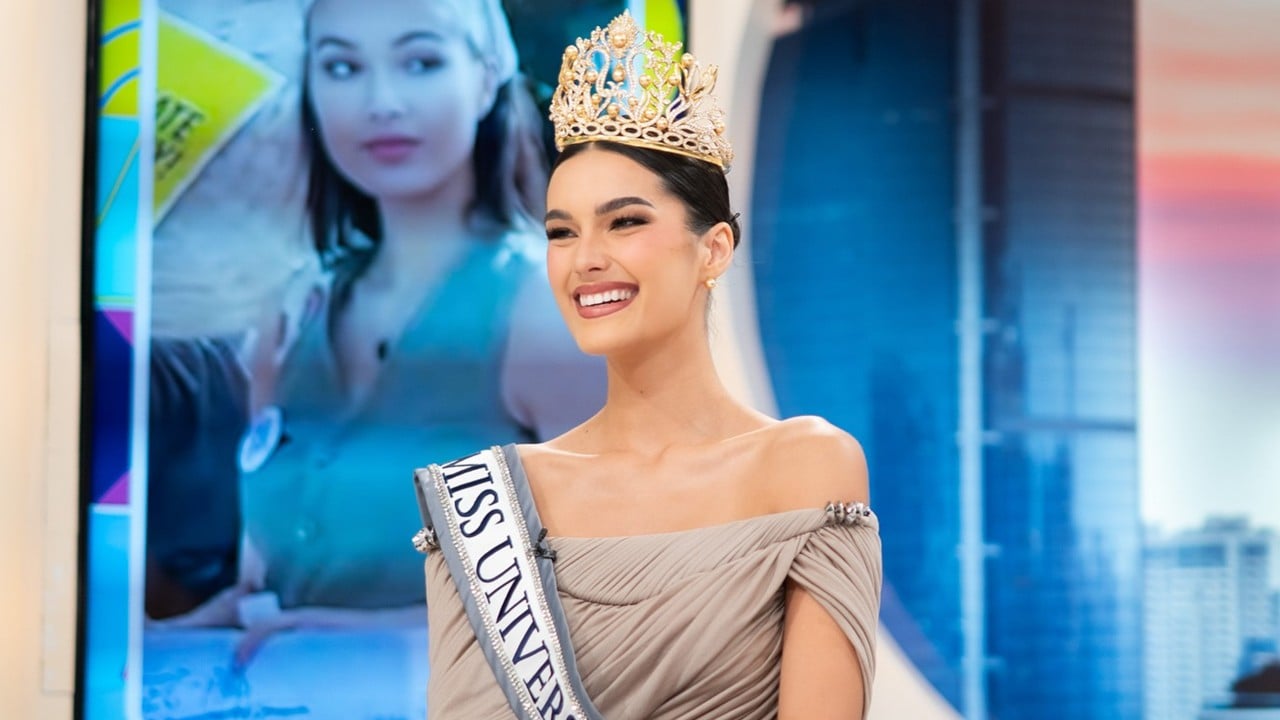
The coronation of a mixed-race winner in a Philippine beauty pageant follows a script so predictable it has become a national ritual. First comes the crown, then the celebratory social media blast, and finally, the inevitable interrogation of her "Filipino-ness." This cycle repeated with surgical precision following the recent Miss Universe Philippines results. Critics pointed to the winner’s upbringing abroad or her lack of fluency in local dialects as proof of a diluted identity. This isn't just about a sash and a tiara. It is a proxy war for how a nation defined by centuries of colonial rule and decades of mass migration views its own soul.
The controversy centers on the "half-Filipino" or "Fil-Am" trope that has dominated the podium for years. To the casual observer, the Philippine obsession with pageantry looks like harmless fun. To those of us who have covered the industry's evolution, it is a high-stakes machinery designed to export a specific, globalized version of the Filipina. The friction arises when the domestic audience realizes the woman representing them on the world stage looks more like a citizen of the world than a neighbor from the local barangay. You might also find this similar article interesting: Your Name is Not the Problem Britain is a Bureaucratic Fossil.
The Export Quality Standard of Beauty
The Philippines produces beauty queens with the same industrial efficiency that Germany produces cars. The "beauty boot camps" in Manila—Aces & Queens and Kagandahang Flores—are elite training facilities where every movement is scrutinized. They don't just teach a walk; they engineer a persona.
For years, the unspoken rule of the international circuit has been that "global" features win. This translates to a preference for taller, fairer-skinned, or mixed-race candidates who can navigate Western media with ease. The pageant organizations aren't necessarily trying to insult the local population. They are playing to win. They understand the judges in New Orleans or El Salvador operate on a Western-centric aesthetic. As reported in recent articles by Refinery29, the results are significant.
This creates a massive disconnect. On one hand, you have the "decolonize beauty" movement, which demands more representation for morena (dark-skinned) women and those with indigenous features. On the other, you have the pragmatic reality of a multi-million dollar industry that views a crown as a successful branding exercise. When a winner like Chelsea Manalo breaks the mold, it feels like a revolutionary act, but the pushback against "foreign-born" winners remains a stubborn fixture of the discourse.
The Diaspora Dilemma and the Citizenship of the Heart
We have to talk about the eleven million Filipinos living overseas. They are the financial backbone of the country, sending home billions in remittances that keep the economy afloat. Yet, when their children return to the Philippines to compete in pageantry, they are often treated as interlopers.
The criticism usually follows a specific hierarchy of grievance:
- The Language Barrier: If she can't speak Tagalog, Bisaya, or Ilocano, is she truly one of us?
- The "Parachute" Athlete Effect: Is she just using the Philippine franchise because she couldn't win in the USA or Europe?
- The Cultural Disconnect: Does she understand the daily struggle of the commuter in Manila, or is her connection to the country limited to vacation photos?
These questions are harsh. They are also deeply hypocritical. The Philippines celebrates the "Global Filipino" when they win a Grammy or an Oscar, regardless of where they were raised. We claim Bruno Mars and Olivia Rodrigo with desperate fervor. But the moment a person of Filipino descent enters the domestic arena to compete for a local title, the gatekeeping begins.
This tension reveals a deep-seated insecurity. There is a fear that the "authentic" Filipino—the one who stayed, who suffered through the typhoons and the political instability—is being erased by a polished, wealthier version of themselves from the West. It is a battle between the bloodline and the lived experience.
The Architecture of Identity
What does it actually mean to be "purely" Filipino? Historically, the archipelago has been a melting pot of Malay, Chinese, Spanish, and American influences. The search for a "pure" Filipino identity is a fool’s errand because the culture itself is defined by its ability to absorb and adapt.
The anger directed at mixed-race winners is often a misdirected critique of colorism. For centuries, Spanish and American colonial rule ingrained the idea that light skin equals power and status. This "colonial mentality" is still visible in the rows of whitening creams in every Manila pharmacy. When people complain about a winner not looking "Filipino enough," they are often reacting to the fact that she represents a beauty standard that the average citizen cannot achieve without surgery or expensive products.
However, labeling someone as "not Filipino" because of their parentage or birthplace is a dangerous road. It creates a hierarchy of citizenship that ignores the reality of the 21st century. If we define identity strictly by geography, we alienate millions of people who were raised in the diaspora but hold their heritage as a core part of their being.
The Industry Perspective
The pageant organizers are caught in a pincer movement. If they crown a local girl who lacks the "international" look, they risk losing their streak of placements in the global competition. If they crown a "halfie" from California, they face a PR nightmare at home.
The solution has been to lean into the "Filipino Heart" narrative. This is a clever marketing pivot. It shifts the focus from physical traits to emotional resonance. Candidates are now coached to emphasize their "resilience," their "faith," and their "close-knit family values"—traits that are universally accepted as the pillars of Filipino-ness.
But even this is a performance. We are asking young women to perform a specific brand of ethnicity to satisfy a demanding public. It is a high-wire act where one wrong word in an interview can lead to a viral cancellation.
Money, Power, and the Pageant Industrial Complex
We cannot ignore the economics. Beauty pageants in the Philippines are big business. They are sponsored by real estate giants, airlines, and telecommunications companies. A Miss Universe Philippines winner is an instant A-list celebrity, a walking billboard for the country's biggest brands.
The preference for mixed-race or Westernized candidates often stems from their "marketability." Global brands want a face that can sell products across borders. A candidate who speaks fluent English with a neutral accent is more valuable to a multinational sponsor than one who is confined to the local market.
This commodification of identity is where the real "crisis" lies. We aren't just debating beauty; we are debating who gets to profit from the Filipino brand. When a foreign-raised candidate wins, the "local" industry feels bypassed. The trainers, the designers, and the glam teams who have worked with local talent for years see the crown go to someone who might have brought her own team from New York or London.
The Myth of the Authentic Filipino
The loudest voices in this debate often belong to those who believe identity is a static, unchanging thing. They want a version of the Philippines that exists in a vacuum, untouched by the complexities of global migration. That country doesn't exist.
The Philippines is a nation of travelers. We are nurses in London, sailors in the Mediterranean, and engineers in Dubai. To demand that our beauty queens—the literal faces of the nation—be exempt from this globalized reality is a form of cognitive dissonance.
The "brutal truth" is that there is no such thing as a single, authentic Filipino identity. A T’boli weaver in Mindanao is just as Filipino as a tech executive in Makati or a second-generation student in Queens. If we continue to use pageantry as a tool for exclusion, we are essentially saying that the millions of Filipinos who have gone abroad to provide for their families have forfeited their right to belong.
The debate isn't going away. Every time a new queen is crowned, the digital mobs will check her birth certificate and her accent. They will look for reasons to disqualify her from her own heritage. But as the world gets smaller and the diaspora grows larger, these definitions will become increasingly irrelevant.
The pageant stage is a small, glittery reflection of a much larger struggle. It is a country trying to figure out if it is defined by its borders or its people. Until we realize that being Filipino is a matter of choice and commitment rather than just a genetic lottery or a zip code, the crown will always be a heavy burden to wear.
We are looking for a purity that never was. The strength of the Filipino identity has always been its fluidity, its ability to survive and thrive in any environment. If a queen can stand on a stage in a foreign land and say, "I am a Filipino," and mean it, that should be enough. The rest is just noise.
The industry will continue to produce "export-quality" beauties because that is what the market demands. The public will continue to clamor for "authentic" representation because that is what their hearts desire. These two forces are in a permanent state of friction, and that friction is exactly what makes Philippine pageantry the most intense, obsessed, and scrutinized subculture in the world.
Stop looking for a "pure" winner. She doesn't exist. Look instead for the woman who can carry the complexity of a modern, fragmented, and beautiful nation on her shoulders without breaking. That is the only authenticity that matters.