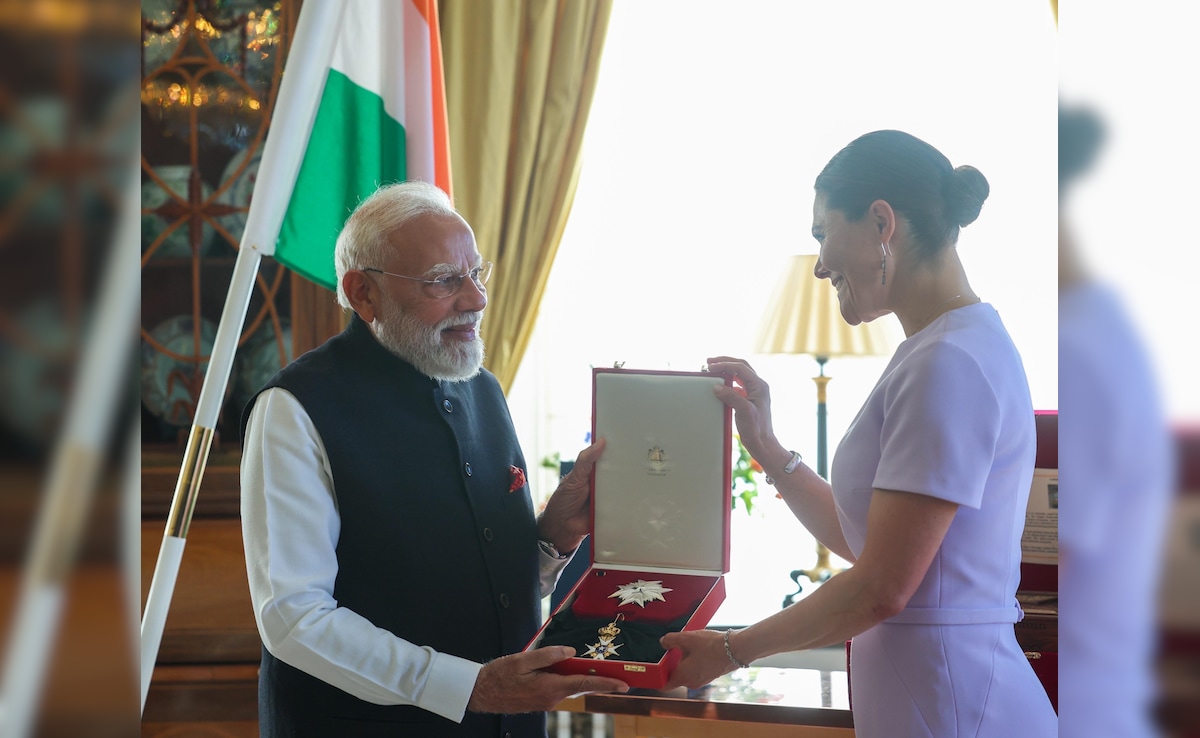
The room in Stockholm carried the specific, muted chill that only northern Europe can manage in the late months of the year. Outside, the Baltic waters grayed under a heavy sky. Inside, the architecture spoke of centuries of quiet, calculated neutrality. Gold leaf met white marble. Diplomats moved with the hushed efficiency of watchmakers.
Then came the contrast.
When Narendra Modi steps into a European state room, the atmosphere alters. He does not wear the charcoal-gray armor of Western diplomacy. He wears the textures of the global south—deep blues, structured khakis, fabrics that carry the weight of a different hemisphere. And when he greeted King Carl XVI Gustaf of Sweden, it was not with the limp, transactional handshake of modern statecraft. It was the embrace.
To the untrained eye, these ceremonies are the ultimate exercise in political theater. They seem like expensive, scripted pageantry designed for press releases that nobody reads. A foreign leader arrives. A monarch opens a velvet box. A medal is pinned. A photograph is taken.
But look closer at the blue silk box sitting on the mahogany table. Inside lay the Royal Order of the Polar Star.
Sweden does not hand these out to pass the time. Founded in 1748 by King Fredrik I, the honor was explicitly created to reward foreign entities who have made monumental contributions to Sweden’s place in the wider world. For centuries, it has been a quiet instrument of Nordic strategy. To receive it is to be invited into a very old, very selective room.
The ceremony raises a fundamental question. Why now? Why would a nation built on centuries of cautious non-alignment choose this specific moment to bind its highest honor to the leader of a nation thousands of miles away?
The answer is not found in the official citations. It is found in the quiet, desperate shifts of global power.
The Weight of the Northern Star
Consider the mechanics of a modern superpower. For decades, the West operated under a comfortable assumption. Power was an axis that ran cleanly between Washington, Brussels, and Tokyo. The rest of the world was a market to be accessed, a resource to be managed, or a region to be stabilized.
That world is dead.
Sweden knows this better than most. For over two hundred years, the Swedish identity was anchored by neutrality. They sat out world wars. They watched the Cold War from a calculated distance. But geography is a cruel master. Look at a map of northern Europe. Look at the Baltic Sea, which Sweden shares with a deeply unpredictable Russia.
When the geopolitical tectonic plates shifted over the last few years, Sweden made a choice that shattered two centuries of tradition: they joined NATO.
Suddenly, a nation that prided itself on standing alone realized that survival in the twenty-first century requires immense, deeply anchored friendships. You cannot rely solely on your neighbors when the entire neighborhood is vulnerable. You look across the globe. You look for the anchors.
Enter New Delhi.
India is no longer a developing nation waiting for instructions. It is the world’s most populous democracy, an economic engine moving at terrifying speed, and the undisputed voice of the Global South. When Stockholm looks out into the fog of the next fifty years, they do not see a distant trading partner. They see a necessary counterweight.
The Royal Order of the Polar Star is not a thank-you note for past favors. It is a strategic anchor dropped into the future.
Steel, Green Hydrogen, and the Silent Alliance
Let us move away from the gold leaf of the palace and look at something far more grounded: a steel plant in northern Sweden.
Historically, making steel is an environmental disaster. It requires coal, immense heat, and it pumps millions of tons of carbon into the atmosphere. For a country like Sweden, which views environmental stewardship not as a political stance but as a core component of its national soul, traditional manufacturing is a profound moral crisis.
They solved it by creating fossil-free steel using green hydrogen. It was a triumph of Swedish engineering.
But a triumph of engineering is useless without scale. Sweden has ten million people. It is an boutique economy. If you invent a technology that can save the planet’s atmosphere, but you only deploy it within your own borders, you have achieved nothing but self-congratulation.
To actually change the trajectory of the world, you need a partner with scale. You need a country that is building hundreds of miles of railway every single month. You need a nation that is lifting millions of people into the middle class every single year, all of whom will need apartments, bridges, and cars.
During the bilateral meetings that accompanied the medal ceremony, this was the invisible current running through the room. India needs Sweden’s high-tech, deeply sustainable industrial secrets. Sweden needs India’s unimaginable scale and intellectual capital.
It is a beautiful symmetry, but it is also deeply vulnerable.
Think about the sheer logistical madness of tying these two worlds together. You are dealing with entirely different bureaucratic cultures. In Stockholm, decisions move through a consensus-driven, deliberately slow process where every voice is weighed until a perfect harmony is achieved. In New Delhi, governance is a chaotic, high-velocity exercise in crisis management and massive, top-down directives.
When these two systems collide, they usually grind to a halt. The wheels get stuck in the mud of mid-level diplomacy.
That is why the medal matters. By bestowing the Order of the Polar Star upon Modi, King Carl XVI Gustaf did something that bureaucrats cannot do. He elevated the relationship above the level of trade ministries and tariff negotiations. He made it a matter of state prestige.
The next time a Swedish tech firm or an Indian infrastructure giant hits a wall of red tape, the resolution will not come from a standard legal appeal. It will come because the highest authorities in both lands have declared, in front of the world, that their fates are intertwined.
The Human Geometry of the Accord
It is easy to get lost in the macro-economics of green hydrogen and fighter jet technology—Sweden’s Saab has been quietly courting India for years, offering its Gripen jets with promises of total technology transfer. But the real friction, and the real success, of this relationship happens at the human level.
Imagine a twenty-four-year-old software engineer from Bengaluru landing at Arlanda Airport in the dead of January.
The air is thin and cuts like glass. The sun sets at three in the afternoon. The cultural landscape is quiet, reserved, and intensely private—a complete inversion of the sensory overload, warmth, and communal density of southern India. Yet, over the past decade, the Swedish tech sector has become increasingly reliant on these exact individuals. Ericsson, Spotify, Volvo—their digital backbones are built, in large part, by Indian minds.
This is the lived reality of the modern Indo-Swedish corridor. It is a story of cultural translation.
[The Indo-Swedish Strategic Corridor]
Sweden: High-Tech Innovation + Sustainable Engineering + Strategic Baltic Position
   │
   ▼ (Enabled by State Honors & Bureaucratic Alignment)
   ▲
India: Massive Scale + Intellectual Capital + Voice of the Global South
For a long time, Europe treated this migration as a one-way street—a talent drain from the East to service the aging West. But the tone in Stockholm during this state visit was radically different. There was an admission, subtle but undeniable, of interdependence.
Sweden is a nation that understands its own limitations. They know they cannot compete with the sheer demographic weight of China or the raw financial muscle of the United States. Their survival strategy has always been to be smarter, cleaner, and more reliable than anyone else. But reliability requires trusted partners who share a fundamental belief in the international order.
When Modi stood in that hall, receiving a decoration that has previously been worn by heads of state who shaped the twentieth century, he was validating India’s new role as the guarantor of that order.
The doubts that usually dog Western interactions with India—the critiques from European academics, the hand-wringing over domestic policies—were momentarily silenced by the sheer weight of strategic necessity. The Nordic states have realized that the luxury of moral distance is a casualty of a world in conflict. You cannot afford to keep your distance from the most important democracy on earth when the global landscape is fracturing around you.
Beyond the Velvet Case
The ceremony ended as these things always do. The medal was secured. The joint statements were published, filled with the usual vocabulary of mutual respect and deepened cooperation. The cameras were packed away, and the diplomats returned to their hotels.
But something fundamental had changed in the geometry of the two nations.
As the Indian delegation’s aircraft climbed into the gray Swedish sky, heading back toward the heat and noise of New Delhi, the blue silk box went with them. Inside it was a piece of enameled gold and a ribbon of blue and yellow.
To the cynics, it remains a relic of an old world, a decorative trinket from an era of kings and courts that has no place in a world governed by algorithms and algorithms alone.
They are wrong.
We live in an age that is terrifyingly cold. We communicate through screens, trade through automated ledgers, and wage war through faceless drones. In this landscape of abstraction, the old symbols do not lose their power; they gain it. They become the only things that still carry human weight.
The Royal Order of the Polar Star is a declaration that despite the miles, despite the vast differences in temperature, language, and history, two nations have looked at the coming storm of the twenty-first century and decided they would rather face it together. It is an acknowledgment that in the grand calculus of global survival, sometimes the most powerful weapon you have is the willingness to look an ally in the eye, step across the cultural divide, and offer a genuine, unwavering embrace.