The air in Ottawa during early May has a specific, biting clarity. It is the kind of cold that doesn’t just sit on your skin but reminds you exactly where the geographic lines are drawn. On a Tuesday that should have been defined by mundane diplomatic chatter, the quiet streets of Canada’s capital became the stage for a phantom war.
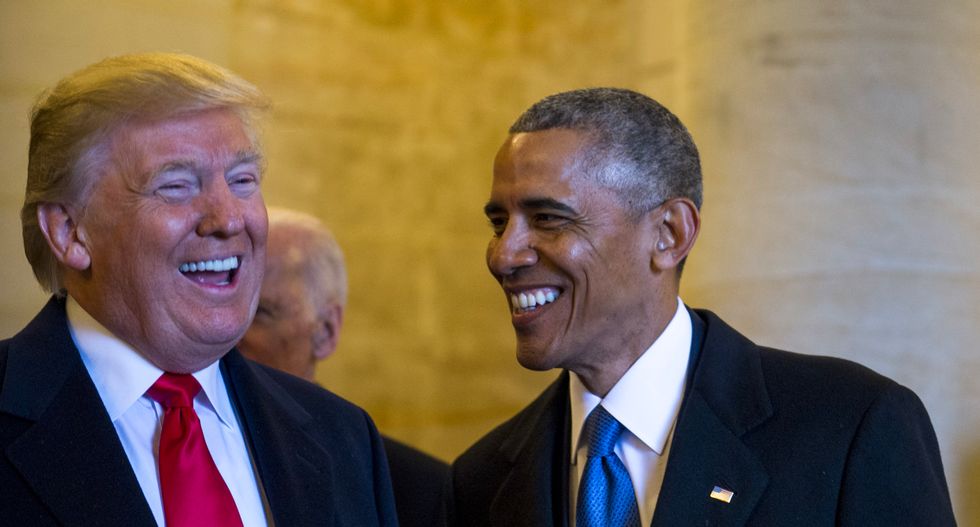
Barack Obama stepped off a plane. He was there to see Prime Minister Justin Trudeau. To the casual observer, it was a meeting of old friends, a nostalgic nod to a brand of liberalism that feels increasingly like a relic from a distant century. But for a specific, vocal segment of the American electorate, this wasn't a lunch. It was a declaration. You might also find this related article useful: Geopolitical Arbitrage and the Mechanics of a Three Day Ukraine Ceasefire.
To understand why a simple handshake across the 45th parallel sent the digital world into a seizure, you have to look past the policy briefs. You have to look at the fear.
The Architecture of a Panic
Inside the glowing screens of a thousand basement offices and suburban living rooms, the narrative took hold instantly. The word "coup" began to trend. It wasn't used in the historical sense—no tanks were rolling down Pennsylvania Avenue—but it was used in the emotional sense. For the MAGA movement, currently watching Donald Trump navigate a legal and political gauntlet that feels like a siege, Obama’s presence in Canada was the final piece of a dark puzzle. As highlighted in detailed coverage by USA Today, the results are notable.
They saw a "shadow government" in exile.
Consider the perspective of a hypothetical voter named Elias. Elias lives in a town where the factory closed in 2012 and the local pharmacy is now a boarded-up shell. For Elias, Trump isn't just a candidate; he is a shield. When Elias sees Obama—the man he blames for the globalist shift that left his town behind—meeting with Trudeau, he doesn't see "diplomacy." He sees a huddle of architects planning the next phase of his obsolescence.
The reaction was visceral. Social media became a frantic ticker tape of conspiracy. Pro-Trump influencers argued that Obama was "briefing" Trudeau on how to handle a potential second Trump term, or worse, coordinating a North American resistance to a democratically elected shift in US power.
The Ghosts in the Room
There is a profound irony in how the two sides of this divide perceive power. For the supporters of the "Make America Great Again" movement, power is something that is being stolen by a shadowy elite. For the supporters of the Obama-Trudeau axis, power is something that is being eroded by a populist tide they no longer know how to stem.
When these two worldviews collide, reality becomes secondary to symbolism.
Obama represents the "long yesterday." He is the avatar of a world where institutions worked, where decorum mattered, and where the United States was the predictable, steady heartbeat of the West. To his detractors, that "steadiness" was actually a slow bleed. They remember the trade deals that hollowed out the Midwest. They remember the feeling of being lectured by a man who spoke in perfect, rhythmic sentences while their cost of living doubled.
In Ottawa, Obama was a ghost. He was the spirit of a pre-2016 world trying to reassert its relevance.
The "melt down" wasn't about what was said over the dinner table in Canada. It was about the terrifying realization that the world is splitting in two. On one side, you have the institutionalists, clinging to the rails of the old ship. On the other, you have a movement that wants to burn the ship and build something entirely different on the shore.
The High Stakes of a Handshake
Why does a visit to Canada matter so much? Because Canada has become the "control group" in the Great American Experiment.
While the US has spent the last decade tearing itself apart over identity, border security, and the very definition of truth, Canada has—under Trudeau—tried to remain the last bastion of the progressive dream. It is the "safe space" for the ideas that Trumpism seeks to dismantle.
When Obama crosses that border, he isn't just visiting a neighbor. He is visiting a sanctuary.
To the MAGA base, this looks like a retreat. They see an "enemy of the people" seeking refuge and counsel from a foreign leader who shares his disdain for the populist uprising. The rhetoric of a "coup" stems from the belief that these leaders are more loyal to their shared ideology than they are to the voters of their respective nations.
It is a crisis of trust.
Imagine you are standing on a frozen lake. You can hear the ice cracking beneath you, but you can’t see where the fissures are. You look to the shore and see two men pointing in opposite directions. One says the ice is fine if you just keep walking the way you’ve always walked. The other says the shore is a lie and you need to jump into the water to save yourself.
That is the American psyche in 2026.
The Invisible Border
The outrage over the Obama-Trudeau meeting reveals a deeper truth: the most important borders in the world are no longer physical. They are the borders of the mind.
There are people who look at that meeting and see a comforting return to normalcy. They see two intelligent, capable men discussing the future of democracy. They feel a sense of relief, a hope that perhaps the chaos of the last few years is just a fever that will eventually break.
Then there are the others.
They look at the same image and feel a cold, sharp anger. They see the "uniparty." They see a class of people who fly in private jets to discuss the lives of people who can barely afford eggs. For them, the "coup" is already happening—not in the streets, but in the halls of power where their voices are treated as noise to be filtered out.
The noise is getting louder.
The MAGA reaction wasn't a fringe event; it was a symptom of a systemic collapse in the shared reality of the West. When a former president visiting a friendly neighbor is interpreted as a treasonous act, the machinery of the state is no longer functioning on logic. It is functioning on trauma.
The Long Shadow
As the sun set over the Parliament buildings in Ottawa, the digital firestorm showed no signs of cooling. The headlines in the US were already pivoting to the next controversy, but the "Ottawa Summit" had already left its mark. It served as a lightning rod, drawing out all the latent electricity of an election year that feels less like a contest and more like an exorcism.
The stakes are invisible because they are psychological.
We are no longer arguing about tax brackets or infrastructure bills. We are arguing about who has the right to exist in the future. Obama and Trudeau represent a future that looks a lot like the past—global, interconnected, and managed by experts. The MAGA movement represents a future that is nationalist, disruptive, and managed by instinct.
These two futures cannot occupy the same space.
The "coup" talk is a manifestation of the fear that the "other side" is about to make a move that cannot be undone. It is the language of people who feel they are running out of time.
In the quiet of the Canadian evening, the two leaders likely talked about things that were quite boring. They likely talked about trade, climate targets, and the general state of the world. They likely laughed at a few old jokes and shared a moment of camaraderie in a world that has grown increasingly hostile to their brand of leadership.
But outside that room, in the vast, shivering expanse of the digital landscape, their meeting was a war cry.
It was a reminder that the world is no longer a place of shared facts, but a place of competing stories. And in the story being told by millions of Americans, that meeting in Ottawa wasn't a visit between friends. It was a dark omen of a struggle that is only just beginning.
The ice continues to crack. The two men on the shore continue to point in opposite directions. And the rest of us are left standing in the middle of the lake, wondering how deep the water really is.
The border between the two Americas has never been harder to cross. It isn't made of steel or concrete. It is made of the stories we tell ourselves about who is a hero and who is a traitor. And as Barack Obama’s plane climbed back into the sky, leaving the cold clarity of Ottawa behind, that border seemed to grow just a little bit taller, and a lot more permanent.