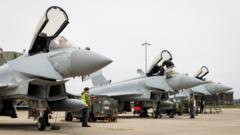
British defense policy is currently stuck in a high-stakes waiting game. While the global security situation gets more volatile by the day, the people in charge of the money can’t seem to agree on how to spend it. The much-anticipated defense investment plan is missing in action. It’s not just a bureaucratic delay. It’s a fundamental disagreement about what the UK’s role in the world should be and how much we’re willing to pay for it.
The tension in Whitehall is thick. You’ve got military chiefs screaming for modernized equipment and ministers who are looking at a massive hole in the public finances. The result is a stalemate. We’re hearing talk of "tough choices," which is usually code for "we don't have enough money for everything we promised." This delay matters because the world isn't waiting for the UK to get its house in order.
The Budget Black Hole and the Defense Investment Plan
The core of the problem is the gap between ambition and reality. For years, the Ministry of Defence (MoD) has operated with a budget that doesn't match its shopping list. The National Audit Office has been pointing this out for a while. They’ve warned that the equipment plan is "unaffordable" to the tune of billions of pounds. This isn't a new headache, but it’s reaching a breaking point.
Ministers are currently wrangling over which programs to keep and which to scrap. Do we prioritize the nuclear deterrent? Or do we focus on the Royal Navy’s carrier strike groups? Maybe the focus should shift entirely to drone tech and cyber warfare. Every choice has a massive political and strategic price tag. If you cut a tank program, you lose jobs in specific constituencies. If you delay a frigate, you leave a gap in the global maritime presence.
The Treasury is playing its usual role as the gatekeeper. They want to see efficiency before they hand over more cash. But the MoD argues that you can’t "efficient" your way out of a decade of underinvestment. It’s a classic tug-of-war. One side wants fiscal responsibility, the other wants national security. Right now, neither side is winning.
Why Procurement Always Seems to Fail
If you've followed British military spending for more than a week, you know procurement is often a disaster. It’s a cycle of over-promising and under-delivering. We buy "exotic" equipment that takes twenty years to build, and by the time it’s ready, the technology is obsolete. Look at the Ajax armored vehicle program. It’s been a nightmare of delays and technical flaws. Billions spent, and the army is still waiting for a vehicle that doesn't vibrate its crew into a headache.
The defense investment plan is supposed to fix this. It’s meant to provide a clear roadmap for the next decade. But you can't have a roadmap if you don't know where the starting line is. The government is trying to balance the books while also trying to look like a global power. That’s a hard act to pull off when your primary fighter jet program, the Global Combat Air Programme (GCAP), is eating up a huge chunk of the future budget.
The delay also hurts the industry. Defense contractors need certainty. They can’t hire engineers or invest in new factories if they don't know if a contract will exist in six months. This "wrangling" isn't just a political debate in London; it’s a direct threat to the UK’s industrial base. We’re essentially freezing the supply chain while the politicians argue over spreadsheets.
The NATO Factor and the 2.5 Percent Goal
There’s also the small matter of our international commitments. The UK has committed to spending 2.5% of GDP on defense, but there’s no firm timeline for when that actually happens. This ambiguity is driving the military leadership crazy. They can’t plan for a 2.5% budget if they’re currently living on a 2.2% reality.
Our allies are watching. With the US leaning more toward the Pacific and Europe facing an aggressive Russia, the UK’s role in NATO is under the microscope. If the defense investment plan remains stuck in a drawer, it sends a signal that the UK isn't serious about its "leading role" in the alliance. It’s hard to talk big about European security when your own army is the smallest it’s been since the Napoleonic era.
Real Consequences of the Funding Gap
This isn't just about ships and planes. It’s about people. The recruitment crisis in the Armed Forces is directly linked to the lack of clear investment. If soldiers are living in damp barracks and training with outdated gear, they aren't going to stay. You can have the best strategy in the world, but if you don't have the people to execute it, it’s just paper.
The delay in the investment plan means that maintenance is being deferred. We’re "cannibalizing" parts from one ship to keep another one sailing. It’s a short-term fix that leads to a long-term disaster. Eventually, the bill comes due, and it’s always more expensive than it would’ve been if we’d just funded things properly in the first place.
Ministers are also fighting over the "Integrated Review." It was supposed to be the definitive word on UK foreign policy, but it’s already feeling dated. The world changed after the invasion of Ukraine. The assumption that heavy armor was a thing of the past turned out to be wrong. Now, the MoD is scrambling to figure out how to rebuild its land forces while still maintaining its high-tech ambitions.
What Needs to Change Immediately
Stop the "salami slicing." For years, the government has dealt with budget shortfalls by cutting 5% here and 2% there. It doesn't work. It just leaves every department underfunded and incapable of doing its job. We need to decide what the UK military is actually for. If we want to be a mini-superpower, we have to pay for it. If we can't afford that, we need to be honest about what we're giving up.
Transparency is the next step. The MoD needs to be brutally honest about the state of its equipment and the actual costs of its programs. No more hiding behind "commercial sensitivity." The public deserves to know why billions are being spent on programs that are years behind schedule.
The government should also look at how it handles the Treasury. National security shouldn't be treated like a discretionary spending project that can be turned off when the inflation numbers look bad. It’s a core function of the state. Until we treat defense spending as a long-term infrastructure investment rather than a yearly argument, we’ll stay in this loop of delays and disappointment.
The wrangling needs to end because the threats aren't going away. Every month the investment plan is delayed is a month of lost readiness. It’s time to pick a lane. Pay the bill or lower the ambition. Trying to do both is failing everyone involved.