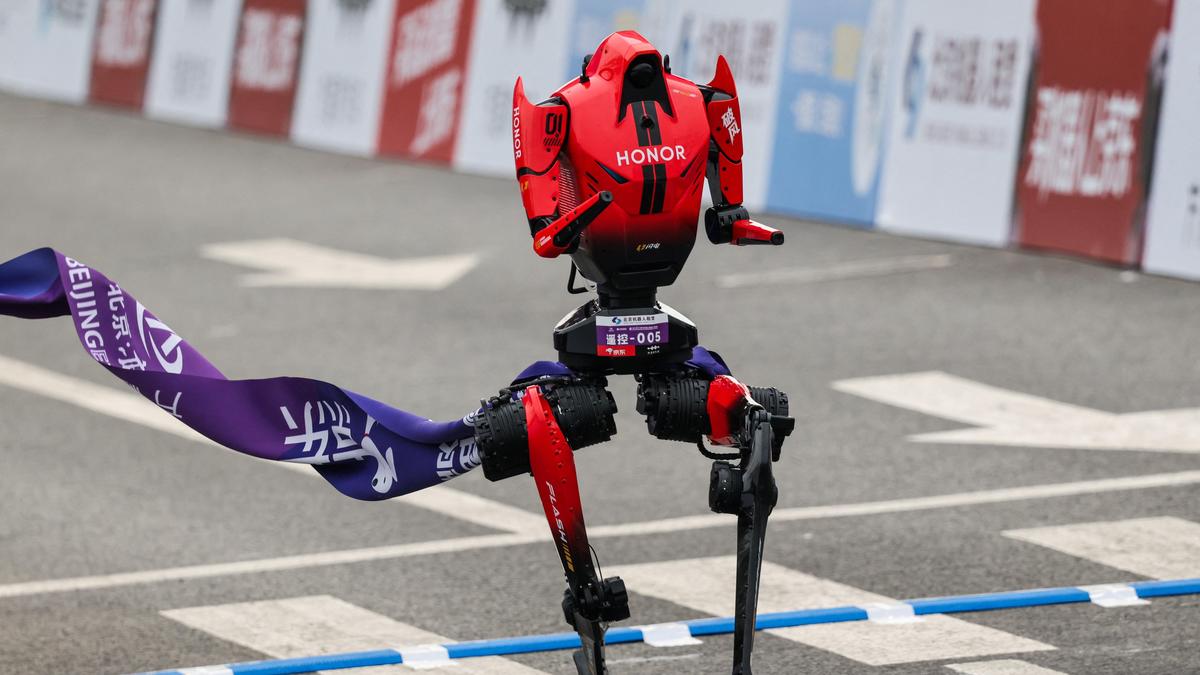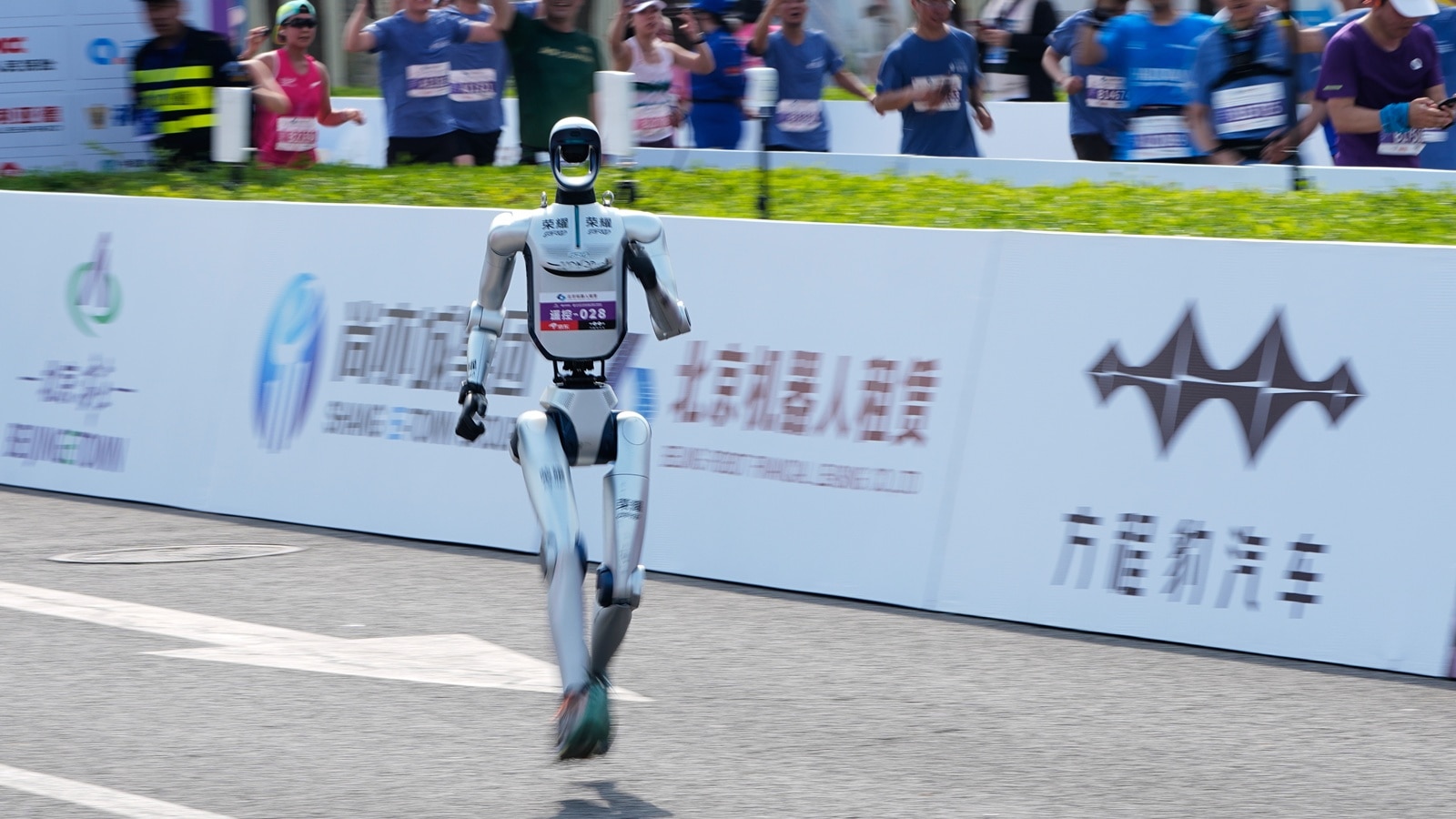
The sight of titanium-limbed machines loping alongside human runners in Beijing wasn’t just a PR stunt; it was a calibrated demonstration of industrial endurance. While the headlines focused on the spectacle of humanoid robots finishing a half-marathon, the real story lies in the staggering battery breakthroughs and torque density required to keep a 150-pound bipedal frame moving for over thirteen miles without a catastrophic hardware failure. This wasn’t a race against humans. It was a race against the laws of thermodynamics and the limitations of current power storage.
To understand why this event matters, one must look past the sleek carbon-fiber shells. Most humanoid robots, even the ones that dance in viral videos, usually operate in short, controlled bursts. Their actuators generate immense heat, and their batteries typically drain in under an hour. For a robot to maintain a consistent running pace over 21 kilometers signifies a massive shift in how these machines manage energy and friction.
The Engineering of Synthetic Stamina
For decades, the hurdle for mobile robotics was balance. Once companies like Boston Dynamics and various Chinese state-backed labs solved the stabilization problem, the bottleneck shifted to power density. A human runner is incredibly efficient, powered by biological fuel that offers a high energy-to-weight ratio. A robot is essentially a heavy battery pack trying to move its own weight using electric motors that get progressively less efficient as they heat up.
The machines seen in the Beijing event utilize high-torque density motors that have been stripped of every unnecessary gram. Engineers have moved away from heavy hydraulic systems toward electric actuators that use planetary gear sets. These gears allow for the high speed necessary for running while maintaining the force needed to push off the asphalt.
Heat remains the primary enemy. In a laboratory setting, you can blast a robot with industrial fans. On a public road in Beijing, the machine must rely on passive cooling or integrated heat sinks. If the internal temperature of a motor crosses a specific threshold, the magnets lose their effectiveness, the torque drops, and the robot collapses. The fact that multiple units crossed the finish line suggests that the thermal management systems—the "sweat" of the machine world—have finally caught up to the demands of long-distance movement.
Why Beijing Is Crowding the Track
China’s push into this space isn't about the love of the sport. It is a calculated response to a looming demographic crisis. With a shrinking workforce, the central government has designated humanoid robotics as a "frontier industry," similar in strategic importance to semiconductors or green energy. The goal is to move these machines out of the lab and into the factory or the home within the next three to five years.
By putting these robots on a public marathon course, the manufacturers are conducting a "stress test" in an uncontrolled environment. Labs are predictable. Pavement is not. Potholes, wind resistance, and the subtle incline of a city street provide data that a treadmill cannot replicate. Every stumble and every recovery is logged and fed back into neural networks that refine the robot's gait in real-time.
The Component War
The hardware seen on the Beijing streets represents a supply chain victory. Most of the critical components—the harmonic drives, the force-torque sensors, and the LIDAR systems—are now being produced domestically within China. This reduces costs significantly. Five years ago, a bipedal robot capable of running would cost upwards of $250,000. Today, Chinese firms are aiming for a price point closer to $30,000.
- Harmonic Drive Scaling: Mass-producing the precision gears that allow for smooth limb movement.
- Local Sensor Integration: Using homegrown vision systems to navigate crowds without relying on expensive Western chips.
- Battery Chemistry: Implementing high-nickel lithium batteries that can discharge steadily over two hours without sagging.
The Gap Between Spectacle and Utility
Despite the impressive footage, we must be honest about what we are seeing. These robots are running at a pace that an amateur human jogger could easily beat. They aren't "outrunning" humanity in terms of speed yet. They are outrunning the previous versions of themselves.
The mechanical gait of a humanoid runner is still jarring. It lacks the elastic energy return of a human Achilles tendon. Humans use their tendons like springs, storing energy with every footfall and releasing it to propel themselves forward. Robots, for the most part, still rely on raw motor power for every single step. This makes their "metabolic" cost of transport significantly higher than ours. Until they can master passive dynamics—using the physics of the swing to save energy—they will remain tethered to the reality of frequent charging.
The Software Brain
The "brains" of these machines are also under intense scrutiny. Running in a crowd requires more than just a sense of balance. It requires spatial awareness. The robots use a combination of Reinforcement Learning (RL) and Computer Vision to identify the path of least resistance.
In the Beijing half-marathon, the robots had to navigate around human participants. This is a complex problem for an algorithm. It involves predicting human intent—guessing whether the person in front of you is about to slow down or veer to the side to grab a water cup. A collision doesn't just mean a bruised shin; for a robot, it could mean a million-dollar repair bill and a public relations disaster.
The Economic Implications of a Running Machine
If a robot can run a half-marathon, it can walk a warehouse floor for twenty hours a day. That is the subtext of this event. The marathon is a proxy for reliability. In the logistics industry, "uptime" is the only metric that matters. If a robot requires maintenance every four hours, it is a liability. If it can handle the physical strain of 13.1 miles of continuous impact, it proves it is ready for the rigors of an industrial environment.
Investors are watching these metrics closely. We are seeing a shift from "can it do it?" to "how long can it do it?" This transition marks the end of the hobbyist era of robotics and the beginning of the commercial era. The companies behind these machines—names like Unitree, Fourier Intelligence, and UBTECH—are no longer just tech startups. They are becoming the heavy machinery giants of the next generation.
Comparison of Industrial Readiness
| Metric | Previous Generation (2020) | Beijing Performance (2026) |
|---|---|---|
| Active Runtime | 45 Minutes | 140+ Minutes |
| Degrees of Freedom | 20-25 | 40-56 |
| Material | Heavy Aluminum | Carbon Fiber / Titanium Alloys |
| Failure Rate | High (MTBF < 5 hours) | Low (MTBF > 50 hours) |
The Human Factor and the Uncanny Valley
There is a psychological component to seeing a machine mimic a quintessentially human achievement. Running a marathon is often viewed as a test of the human spirit. Seeing a machine do it with a steady, unblinking rhythm creates a sense of unease. This "uncanny valley" of movement is something developers are trying to smooth over, not just for aesthetics, but for safety.
If robots are to work alongside humans in hospitals or care homes, their movements must be predictable and fluid. A jerky, mechanical lunge is threatening. A smooth, human-like stride is approachable. The Beijing event was as much a test of public perception as it was a test of hardware.
The Hidden Cost of the Race
While the achievement is real, the environmental and energy costs of these machines are often ignored. The carbon footprint of training the AI models that control these robots is massive. Furthermore, the rare earth minerals required for the high-performance magnets in their motors are subject to intense geopolitical tension.
China has a distinct advantage here, as it controls a significant portion of the global supply chain for these materials. By showcasing these robots, they are also showcasing their control over the resources required to build the future. This isn't just a race of machines; it is a display of vertical integration.
Practical Takeaways for the Industry
The Beijing marathon serves as a loud signal to the global tech community. The era of "cool" robotics is over, and the era of "durable" robotics has begun.
- Battery limitations are the only thing standing between these machines and mass adoption.
- Thermal management is the most underrated aspect of humanoid design.
- Legislation and safety standards will be the next major hurdle as these machines move from closed courses to public sidewalks.
The machines didn't just run; they proved that the hardware has matured enough to leave the laboratory. The next time you see a humanoid, it won't be on a racecourse. It will be at a loading dock, a construction site, or a hospital corridor. The marathon was the graduation ceremony. Now, the real work begins.
Watch the joints of the next model you see. If they are silent and cool to the touch after an hour of operation, the world has officially changed. If they are whining and radiating heat, we are still just practicing. The machines in Beijing were notably quiet. That silence should be the loudest wake-up call for the rest of the global manufacturing sector. Ensure your supply chains are ready for a world where the workforce doesn't need to breathe, but does need a high-voltage outlet every six hours.