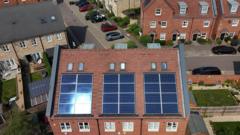
The modern home is becoming a political battlefield, and the latest ammunition is a box of fans and refrigerant sitting in your backyard. Governments are now mandating that new residential developments ditch gas boilers in favor of electric heat pumps, while simultaneously loosening restrictions on "plug-in" solar kits for balconies and patios. This shift isn't just about carbon targets. It is a fundamental rewriting of how the average citizen interacts with the power grid, moving from a centralized model to a fragmented, high-voltage experiment that most homeowners aren't prepared for.
While the "green tech drive" sounds like a gentle push toward progress, the underlying mechanics are aggressive. A heat pump doesn't create heat through combustion; it moves it. By circulating a refrigerant through a cycle of evaporation and condensation, it extracts thermal energy from the outside air—even in freezing temperatures—and pumps it indoors.
The efficiency is undeniable on paper, often reaching 300% to 400% (meaning for every kilowatt of electricity used, you get three or four kilowatts of heat). However, the friction between laboratory efficiency and the drafty reality of existing housing stock is where the narrative begins to crack.
The Infrastructure Gap
Engineers know a secret that politicians often ignore. You cannot simply swap a high-temperature gas boiler for a low-temperature heat pump and expect the same results. Gas boilers typically blast water into radiators at $70°C$ to $80°C$. Heat pumps, to remain efficient, prefer a lukewarm $35°C$ to $45°C$.
This discrepancy means that for a heat pump to actually keep a house warm during a cold snap, the home needs massive radiators or underfloor heating to increase the surface area for heat exchange. It also requires an airtight envelope. If you put a heat pump in a house with thin walls and original windows, the unit will run constantly, the backup resistive heaters will kick in, and your electricity bill will rival a small factory's overhead.
The mandate for new builds sidesteps this by ensuring insulation is baked into the design. But the pressure to retrofit the existing 80% of the housing market is creating a two-tier system. We are seeing a divide between "thermal haves"—those in modern, airtight boxes—and "thermal have-nots" who are stuck with skyrocketing energy costs in older properties that the grid can no longer afford to support with cheap gas.
Plug and Play Solar as a Band-Aid
To offset the massive electrical load these heat pumps place on the grid, regulators are now fast-tracking "plug-in" solar. These are small-scale photovoltaic panels that you can literally hang on a balcony railing and plug into a standard wall outlet.
In theory, this democratizes energy. In practice, it is a drop in the bucket. A standard balcony setup might produce 300 to 600 watts under peak sun. A heat pump under load can pull 3,000 to 5,000 watts. The math doesn't stay in the black for long.
The real value of plug-in solar isn't total energy independence. It is "baseload shaving." These units cover the phantom loads of your home—the fridge, the router, the standby lights on your TV. By legalizing these kits without requiring a professional electrician for every single install, the state is trying to lower the barrier to entry for renters and apartment dwellers. It is a psychological win as much as a technical one. It makes the consumer feel like a participant in the energy market rather than a victim of it.
The Copper Crisis
We are asking the electrical grid to do something it was never designed for. Historically, residential streets were wired for lighting, some appliances, and the occasional oven. Now, every house on the block is expected to power a heat pump, an electric vehicle charger, and an induction cooktop.
If three houses on a cul-de-sac all fast-charge their EVs while their heat pumps are working overtime in January, the local substation transformer is at risk of melting. The cost of upgrading this "last mile" infrastructure is astronomical. Most estimates suggest we need to double or triple our copper capacity in residential areas within the next decade.
Who pays for this? It won't be the developers. It will be the ratepayer. The "hidden tax" of the green transition is the inevitable rise in distribution fees on your monthly bill. We are trading cheap, stable gas infrastructure for a complex, fragile, and expensive electrical network that requires constant balancing.
The Hidden Cost of Refrigerants
There is a looming irony in the heat pump mandate. Most current units use R-32 or R-410A refrigerants. While these don't deplete the ozone layer like the chemicals of the 1980s, they are potent greenhouse gases. If a heat pump leaks—and many do over a 15-year lifespan—the environmental impact can be thousands of times worse than $CO_2$.
The industry is moving toward "natural" refrigerants like R-290 (propane), but these come with their own risks, namely flammability. Installing a large box filled with propane outside your bedroom window requires a level of technician training that currently doesn't exist at scale. The labor shortage is the silent killer of this entire movement. We have a surplus of promises and a deficit of qualified installers who understand the thermodynamics of low-temperature systems.
The Smart Grid Trap
The only way this system works is through "demand response." This is a polite way of saying the utility company needs the power to turn your heat pump down when the grid is stressed.
New "smart" heat pumps are designed to be communicable. In exchange for lower rates, you give up a degree of control. During a peak load event, your thermostat might be adjusted by two degrees remotely. While this sounds like a logical sacrifice for the greater good, it represents a shift in property rights. Your home's temperature becomes a variable in a state-managed equation.
For the tech-savvy, this is an opportunity. Those who combine heat pumps with home batteries and plug-in solar can "arbitrage" the market, charging their batteries when prices are negative and selling back when the grid is desperate. But for the elderly or the technologically illiterate, this new world is a confusing maze of dynamic pricing and app-controlled comfort.
The Strategy for the Homeowner
If you are looking at a new property or considering a retrofit, the hardware is secondary to the shell.
- Insulation First: A heat pump is a waste of money if your R-value is low. Spend the money on triple glazing and cavity wall insulation before touching the HVAC.
- Thermal Mass: Look for homes with high thermal mass (concrete or stone) which can hold the lower-grade heat provided by a heat pump much longer than timber frames.
- Oversize the Radiators: If you are retrofitting, do not let an installer tell you the old radiators are "fine." They aren't. You need more surface area to get the same heat output at lower temperatures.
- Buffer Tanks: Ensure your system includes a buffer tank to prevent "short-cycling," which destroys the compressor's lifespan.
The transition to heat pumps and balcony solar is being framed as a consumer choice, but the reality is a massive top-down industrial pivot. It is an attempt to electrify everything before we have the copper in the ground or the workers in the field to support it. The early adopters are the crash-test dummies for a system that is being built while we are already flying it.
Check your local building codes today. In many jurisdictions, the "choice" to install a gas line is already gone. You are an electric consumer now, whether the grid is ready for you or not.