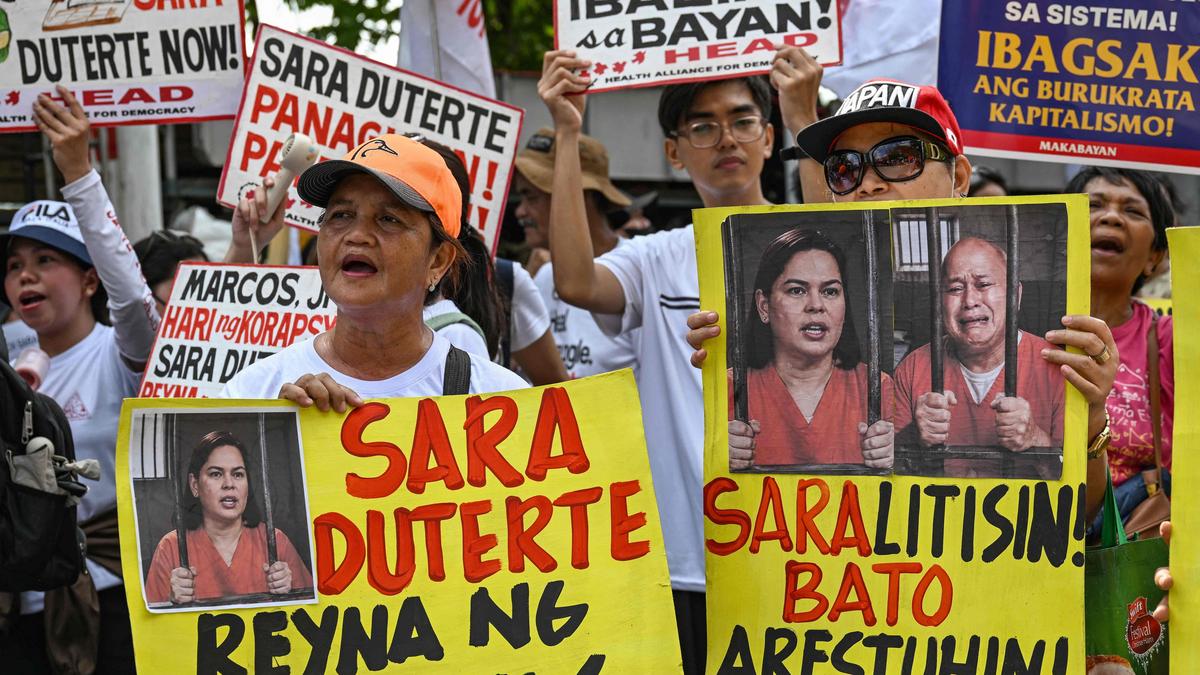
The formal convening of the Philippine Senate as an impeachment court marks a dangerous escalation in the warfare consuming Manila's ruling class. Ostensibly, the historic proceedings against Vice President Sara Duterte center on grave allegations of unexplained wealth, the misuse of state funds, and a public threat to have President Ferdinand Marcos Jr. assassinated. Yet, focusing merely on the formal charges misses the deeper reality of this crisis. This is a scorched-earth battle for absolute control of the state, fueled by the spectacular collapse of the 2022 "UniTeam" electoral alliance, with the 2028 presidential election as the ultimate prize.
The immediate catalyst for this constitutional showdown occurred on May 11, 2026, when the House of Representatives, heavily dominated by Marcos allies, voted 257 to 25 to impeach Duterte. This marks the second time the lower house has moved to strip her of office, following a 2025 effort that was ultimately voided by the Supreme Court on a constitutional technicality. By forcing a trial in the Senate, the anti-Duterte coalition aims to systematically dismantle the political capital of the country's most formidable populist dynasty before the next presidential cycle begins.
The Mechanics of an Elite Schism
To comprehend how the Philippines arrived at this fracture, one must look at the structural mechanics of Philippine political coalitions. They are not built on shared ideology. Instead, they are temporary marriages of convenience designed to capture and distribute patronage.
The 2022 alliance between the Marcos and Duterte dynasties was engineered to achieve a landslide victory, combining the solid northern voting bloc of the Marcos family with the massive southern mandate of the Dutertes. It worked perfectly at the ballot box. It failed immediately in office.
Once the objective of winning the executive branch was achieved, the inherent structural friction between a sitting president and an ambitious vice president took over. In the Philippines, the vice president is elected separately and holds no inherent cabinet-level power unless granted by the chief executive. When Marcos allies in the House began stripping Duterte of her requested confidential intelligence funds for the Office of the Vice President and the Department of Education, the financial and political oxygen sustaining her network was deliberately cut off.
Weaponizing Accountability
The specific charges leveled against the vice president are serious. Lawmakers have brought forward detailed government records of vast, undeclared bank transactions, alongside accusations that she mismanaged millions in discretionary funds. Compounding her legal jeopardy is her own rhetoric. During a volatile online press conference, Duterte declared that she had instructed an assassin to kill President Marcos, the First Lady, and House Speaker Martin Romualdez if she herself were to be assassinated.
While her legal team maintains these statements were taken out of context and represented a defense of her own safety rather than an active plot, the rhetoric provided her opponents with the perfect national security justification to accelerate her removal.
Yet, the enforcement of accountability in Manila remains highly selective. The sudden transparency regarding the vice president's finances stands in sharp contrast to the historical leniency granted to cooperative allies. The anti-corruption machinery of the state has been effectively deployed as a precision weapon, exposing genuine vulnerabilities within the Duterte apparatus while leaving the financial networks of loyalists untouched.
The Standoff in the Senate Plenary
The battleground has now shifted to the 24-member Senate, where the arithmetic of conviction requires a two-thirds majority. This is where the administration's strategy faces severe turbulence. The Senate has long guarded its institutional independence from the lower house and remains populated by figures with shifting, transactional loyalties.
Just hours before the House voted to impeach Duterte, a dramatic internal coup altered the Senate leadership. A bloc of 13 senators ousted the pro-Marcos Senate President, replacing the leadership with figures sympathetic to the Duterte family. This sudden reconfiguration exposed the limits of the president’s control over the legislature.
The atmosphere in the capital has deteriorated from political posturing into physical instability. A tense standoff unfolded within the legislative complex when Senator Ronald "Bogo" dela Rosa, a staunch Duterte ally and the former national police chief who oversaw the elder Rodrigo Duterte’s deadly anti-drug campaign, sought refuge in the Senate plenary hall. Agents from the National Bureau of Investigation had attempted to execute an arrest warrant against him linked to the International Criminal Court’s ongoing prosecution of the former president for crimes against humanity. By remaining within the protective custody of the Senate chamber, dela Rosa highlighted a raw truth: the country's legal and political institutions are gridlocked, operating on the brink of structural failure.
The Geopolitical Subtext
Beneath the domestic power struggle lies a profound geopolitical division that carries significant international consequences. The Duterte dynasty established its power on a foreign policy pivot away from Washington, seeking closer economic and strategic alignment with Beijing. Former President Rodrigo Duterte routinely sidelined maritime disputes in the West Philippine Sea in exchange for promised Chinese infrastructure investments.
President Marcos has completely reversed this posture. He has rapidly repaired ties with the United States, granted American forces expanded access to local military bases under the Enhanced Defense Cooperation Agreement, and aggressively confronted Chinese incursions into the country’s exclusive economic zone.
| Administration | Foreign Policy Alignment | South China Sea Strategy |
|---|---|---|
| Duterte | Beijing-centric, skeptical of Washington | Accommodative, economic appeasement |
| Marcos | Washington-aligned, multilateral | Confrontational, assertive transparency |
Sara Duterte’s continued presence at the top of the executive succession line represents a constant threat to this alignment. For the current administration and its international partners, ensuring she never ascends to the presidency is not just a matter of domestic political survival; it is an imperative for preserving the current national security strategy.
No Easy Exit
The Senate trial will not resolve the deeper instability plaguing the country. If the Senate acquits the vice president, an emboldened Duterte faction will use the victory to frame the entire process as a failed, vindictive witch hunt, supercharging her 2028 presidential campaign. If the Senate convicts and removes her, the administration risks turning her into a political martyr, potentially triggering mass unrest among her deeply loyal base in Mindanao and fracturing the military and police forces, which remain divided in their loyalties between the two clans.
The trial is a high-stakes gamble that lays bare a fragile state structure where constitutional mechanisms are routinely leveraged for elite preservation, leaving the underlying vulnerabilities of the republic completely unaddressed.