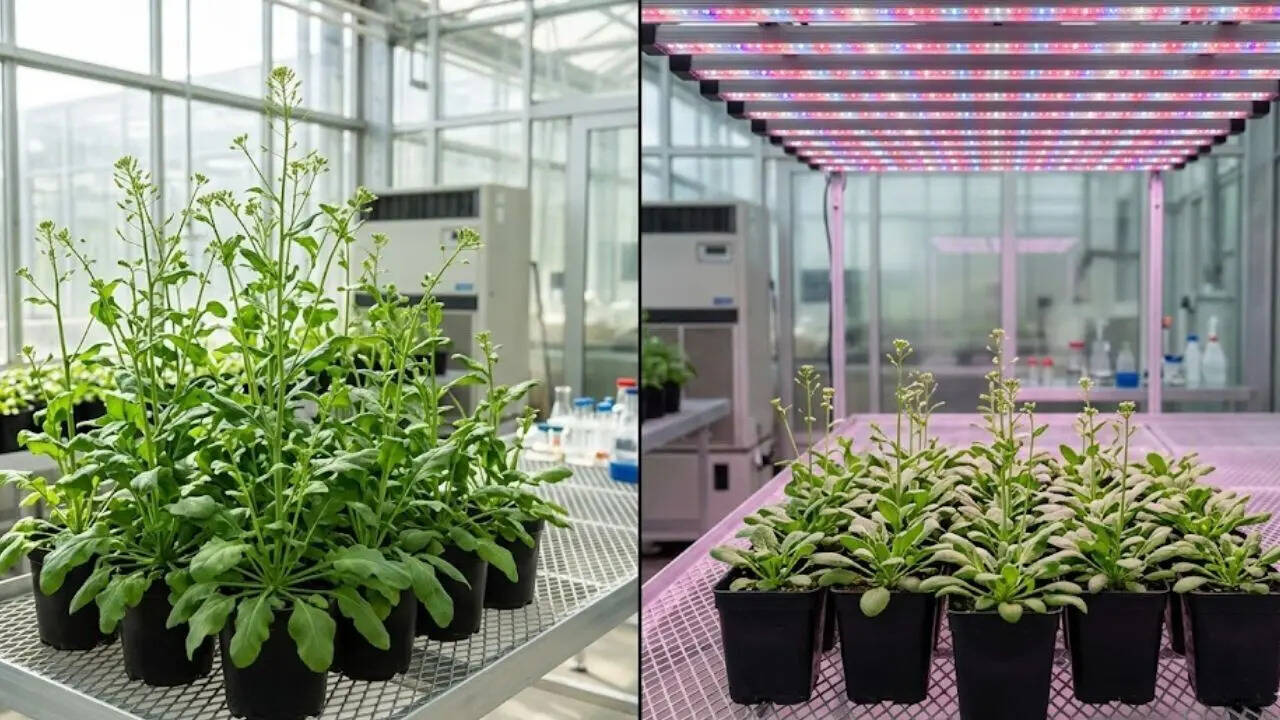
The assumption that more light equals more growth is a fundamental misunderstanding of botanical biology. While photosynthesis requires photons to drive energy production, excessive or poorly timed light exposure triggers a biological emergency known as photoinhibition. This process effectively puts the brakes on a plant's development to prevent permanent cellular damage. Modern agriculture and indoor farming often overlook this mechanism, pushing crops to a breaking point where the very energy source meant to fuel them becomes a metabolic poison.
When light intensity exceeds the capacity of the plant's chloroplasts to process it, the internal machinery begins to fail. Specifically, the Photosystem II (PSII) protein complex, which is the engine of photosynthesis, takes a direct hit. High-energy photons strike the system faster than electrons can be shuttled away, leading to the creation of reactive oxygen species. These are unstable molecules that tear through cell membranes like shrapnel. To survive, the plant intentionally shuts down growth, diverting all resources to repair and defense. This isn't just a minor slowdown; it is a full-scale industrial strike by the plant’s internal workforce.
The Secret Cost of Constant Illumination
Agricultural tech firms often promote 24-hour light cycles as a way to maximize yields. They claim that bypassing the natural day-night cycle forces plants into a state of hyper-productivity. This is a fallacy. Plants, like humans, possess circadian rhythms—internal biological clocks that regulate gene expression and metabolic flux. When these rhythms are disrupted by constant light, the plant loses its ability to manage its energy budget.
Research into the Arabidopsis thaliana model has shown that plants grown under constant light often develop chlorosis, a yellowing of the leaves caused by chlorophyll breakdown. The plant becomes confused. It continues to produce sugars that it cannot transport or store efficiently. This leads to a feedback inhibition where the accumulation of sugar in the leaves signals the plant to stop photosynthesizing altogether. You end up with a plant that is structurally stunted, even if it is technically receiving the "perfect" amount of food.
The Mechanism of Photomorphogenesis
It is not just the intensity of light that matters, but the specific quality and timing. This is governed by a process called photomorphogenesis. Plants use sensors called phytochromes and cryptochromes to "see" their environment. These sensors detect the ratio of red to far-red light, which tells the plant whether it is being shaded by a neighbor or if it is under an open sky.
In high-light environments, particularly those dominated by blue spectra common in many LED setups, plants often adopt a "compact" growth habit. They shorten their internodes—the space between leaves—and thicken their cell walls. While this makes for a sturdy-looking plant, it drastically reduces the overall biomass. The plant is essentially hunkering down, preparing for a harsh environment rather than reaching for the sun. This defensive posture is a direct response to light stress, prioritizing survival over expansion.
The Hidden Danger of Reactive Oxygen Species
The primary culprit in light-induced growth suppression is the production of Reactive Oxygen Species (ROS). Under normal conditions, ROS serve as signaling molecules, telling the plant how to respond to its environment. However, when light levels are too high, ROS production skyrockets. These molecules attack the very proteins responsible for carbon fixation.
One of the most sensitive components is the enzyme Rubisco. Despite being the most abundant protein on Earth, it is surprisingly inefficient and easily damaged. When ROS levels climb, Rubisco activity drops. This creates a bottleneck. Even if the plant has plenty of water and carbon dioxide, it cannot process them because the "factory" has been damaged by light. The plant must then invest massive amounts of nitrogen and energy to rebuild these enzymes, energy that would have otherwise gone into making bigger fruits or taller stems.
The Role of Non-Photochemical Quenching
To mitigate this damage, plants have evolved a safety valve known as Non-Photochemical Quenching (NPQ). This is a mechanism that allows a plant to dissipate excess light energy as heat. Think of it as a pressure relief valve on a steam engine. When the "pressure" of incoming photons becomes too high, the plant opens the valve.
The problem for growers and researchers is that NPQ is not a perfect system. It takes time to "turn on" and even longer to "turn off." When a cloud passes over a field, or a light flickers in a greenhouse, the plant remains in a protective, heat-dissipating state for several minutes even after the light levels have dropped. During this time, the plant is missing out on valuable opportunities for photosynthesis. This lag time is a major contributor to the "slow growth" observed in fluctuating or excessively bright light environments.
The Spectrum War
The rise of LED technology has allowed for the customization of light "recipes," but this has also introduced new ways to accidentally stunt growth. For decades, the industry focused on the "McCree Curve," which suggests that red and blue light are the only frequencies that matter for photosynthesis. This led to the development of "blurple" lights that saturated plants with these two colors.
We now know this approach is flawed. While red and blue light are highly efficient at driving photosynthesis, they also trigger the strongest stress responses. Green light, long dismissed as useless because plants reflect it, actually penetrates deeper into the leaf canopy. By including green and far-red wavelengths, growers can reduce the stress on the top leaves and encourage more uniform growth throughout the plant. Without these "buffer" colors, the top of the plant enters a state of permanent photoinhibition, while the bottom of the plant starves in the dark.
Why the Industry Ignores the Data
The reason we see so many "stunted" crops in high-tech facilities is largely economic. Electricity is expensive. To justify the cost of running a vertical farm, operators feel pressured to push their lighting systems to the limit. They operate on the edge of the plant’s tolerance, betting that the increased light will lead to faster turns.
But this is a losing bet. By ignoring the physiological limits of the plant, they are creating a sub-optimal product. A plant that is constantly fighting off light stress is a plant that is less nutrient-dense and more prone to disease. Stress hormones like abscisic acid (ABA) increase in response to light-induced drought stress (caused by excessive transpiration), which further closes the stomata and halts growth.
The Impact of Temperature and Light Coupling
Light does not act in a vacuum. It is intrinsically linked to temperature. As light intensity increases, so does the leaf temperature. Most enzymes have an optimal operating temperature, usually between 20°C and 30°C for temperate plants. Once the leaf temperature crosses a certain threshold, the plant’s metabolic efficiency plummets.
In many indoor setups, the radiant heat from light sources—even LEDs—cooks the leaves. The plant responds by closing its stomata to settle its water balance. Once the stomata are closed, the plant can no longer take in carbon dioxide. Photosynthesis stops. The plant is now sitting in a high-light environment with no way to use the energy. This is the worst-case scenario. The energy has nowhere to go except into the production of more ROS, leading to a death spiral of cellular degradation.
Reevaluating the Dark Period
The obsession with light has led us to undervalue the importance of darkness. Darkness is not just "off time." It is a period of intense metabolic activity. This is when the plant moves the sugars it created during the day from the leaves to the roots and growing tips. It is also when the plant performs the bulk of its cellular repair.
By cutting the dark period short, or eliminating it entirely, we prevent the plant from completing its "housekeeping." Starch accumulates in the leaves, the repair of PSII proteins is hindered, and the plant's overall vigor declines. Even a few hours of darkness can significantly improve the growth rate of most species compared to 24-hour light. The "more is better" philosophy is a relic of an era when we didn't understand the nuances of plant signaling.
The Evolutionary Context
To understand why light slows growth, we must look at where these plants came from. Most of our food crops evolved in environments with shifting light, clouds, and the movement of the sun. They are not adapted to the relentless, unchanging intensity of an industrial grow room. Their systems are tuned for variability.
A plant that experiences a "natural" light curve—a slow ramp-up in the morning and a ramp-down in the evening—is much more efficient than one hit with a square wave of instant-on, high-intensity light. The gradual increase allows the plant to prepare its quenching mechanisms and activate its enzymes before the peak intensity hits. When we bypass these natural signals, we force the plant into a reactive state rather than a proactive one.
Genetic Engineering and the Future of Growth
There is ongoing work to "fix" these ancient evolutionary traits. Some researchers are using CRISPR to modify the proteins involved in Non-Photochemical Quenching, trying to make the "off" switch faster. The goal is to allow plants to recover from light stress in seconds rather than minutes.
If successful, this could theoretically allow for higher light tolerances without the corresponding growth slump. However, this ignores the complexity of the plant as a whole. Changing one part of the photosynthetic chain often creates bottlenecks elsewhere. For now, the most effective way to ensure healthy growth is not to override the plant’s biology, but to respect its limits.
Stop treating light like a simple input and start treating it like a powerful, potentially destructive force that requires precise management.


