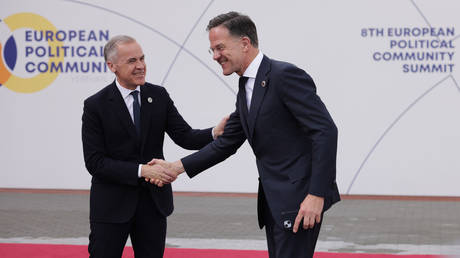
The traditional North American economic model, defined by regulatory divergence and a focus on US-centric trade flows, is being superseded by a deliberate structural pivot toward European institutional frameworks. Under Prime Minister Mark Carney, Canada is not merely seeking a trade partnership with the European Union; it is executing a systemic alignment designed to leverage European regulatory hegemony as a hedge against rising global protectionism. This transition represents a fundamental shift in Canada’s statecraft, moving from a secondary North American power to a core architect of a "Middle Power" bloc anchored in European fiscal and environmental standards.
The Mechanics of Institutional Convergence
The EU’s interest in Carney is not driven by diplomatic sentiment but by the requirement for a predictable, high-standards liquidity partner that shares its vision for a regulated green transition. The Carney administration’s logic operates on the principle of Regulatory Multiplier Effects. By adopting EU-aligned standards in carbon pricing, financial disclosure, and digital governance, Canada reduces the friction of market entry for its firms into the Eurozone, effectively bypassing the costs associated with "double compliance."
This convergence is structured around three primary functional pillars:
- Financial Infrastructure Standardization: The implementation of mandatory climate-related financial disclosures that mirror the EU’s Sustainable Finance Disclosure Regulation (SFDR). This creates a unified capital pool for ESG-focused institutional investors.
- Strategic Autonomy Integration: Canada’s entry into the EU’s Security Action for Europe (SAFE) initiative. This is a deliberate decoupling from exclusive reliance on US defense procurement, integrating Canadian aerospace and tech firms into European supply chains.
- The Middle Power Bridge: Positioning Canada as the legal and regulatory nexus between the Comprehensive and Progressive Agreement for Trans-Pacific Partnership (CPTPP) and the EU Single Market.
The Cost Function of Strategic Autonomy
Transitioning from a US-reliant economy to a European-aligned one carries a significant short-term cost function ($C_s$), where $C_s$ is the sum of regulatory overhaul costs, diverted trade flow inefficiencies, and the political premium of higher environmental standards. However, the Carney strategy posits that the long-term risk-adjusted return ($R_{adj}$) of this alignment exceeds the cost of remaining within an increasingly volatile US-China bilateral orbit.
The logic of this "rebound" is grounded in the Draghi Competitiveness Framework. Mario Draghi’s 2024 report highlighted the EU’s need for secure access to critical minerals and energy—resources Canada possesses in abundance. Carney’s value proposition to Brussels is the provision of "Values-Aligned Commodities." Unlike the transactional nature of resources from authoritarian regimes, Canadian exports now carry a "democracy premium" and a "carbon-neutral guarantee," making them the preferred inputs for the EU’s Industrial Green Deal.
Bottlenecks in the Transatlantic Pivot
Despite the strategic clarity of the Carney administration, several structural bottlenecks threaten the pace of integration:
- Interprovincial Trade Fragmentation: While federal barriers have been targeted, the persistent friction between Canadian provincial regulations acts as a "internal tariff," diluting the efficiency of EU-Canada agreements.
- Energy Infrastructure Lag: The EU’s demand for Canadian hydrogen and LNG requires capital-intensive corridor builds. The current lag between policy intent and physical pipeline/terminal capacity creates a "latency gap" that competitors in the Gulf or North Africa could exploit.
- The Fiscal Union Dilemma: Canada is adopting European-style state-led investment (Sovereign Wealth Funds, sector-specific subsidies) without the underlying fiscal flexibility of a reserve currency issuer like the ECB. This creates a risk of debt-to-GDP escalation if the projected "trillion-dollar investments" do not yield immediate productivity gains.
Quantifying the Security and Defence Partnership
The June 2025 Security and Defence Partnership represents the most aggressive move toward institutional binding. By joining SAFE, Canada is effectively treating the Atlantic as a bridge rather than a barrier. This is not merely a procurement deal; it is a Joint R&D Logic.
- Access to Horizon Europe: Canadian researchers and tech firms now compete for EU innovation grants on equal footing with member states.
- Defence Interoperability: The move toward common standards in AI-driven surveillance and cybersecurity ensures that Canadian tech is "born compliant" with EU privacy and security mandates.
The "Canadian Rebound" is therefore not a return to a previous state, but an evolution into a new category of state actor: the Extraterritorial European Partner. This role allows Canada to exert influence within the G7 and G20 by acting as the primary translator of European regulatory intent into the North American and Pacific spheres.
The final strategic play for Canadian enterprise is the aggressive adoption of the Carney-Draghi Standards. Firms that anticipate the "Brussels Effect"—the tendency of EU regulations to become global defaults—and align their operations with the 2026 Spring Economic Update will capture the first-mover advantage in a trading bloc of 1.5 billion people. The window for divergence is closing; the era of the Transatlantic Regulatory Bloc has begun.