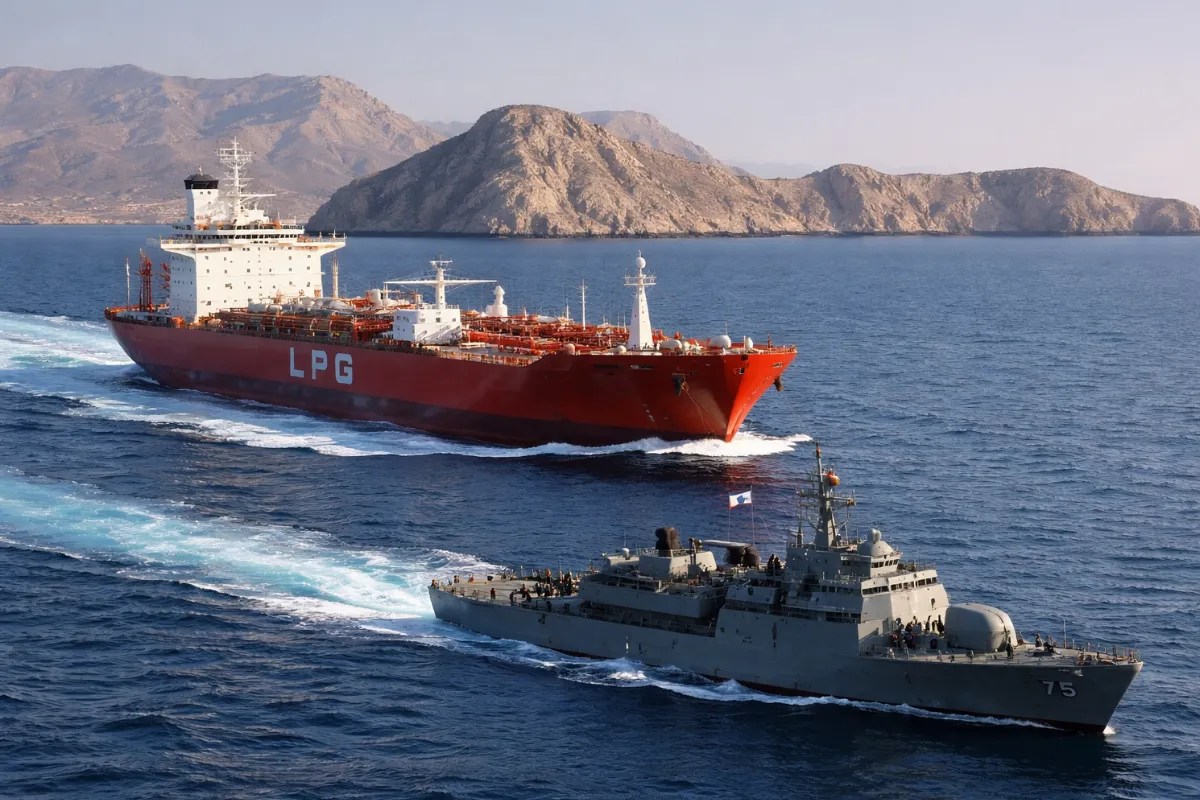
The headlines are celebrating a "diplomatic victory." They want you to believe that the Indian LPG tanker Pratapgad safely traversing the Strait of Hormuz under the watchful eye of the Iranian Navy is a masterclass in New Delhi’s geopolitical balancing act. It is framed as a relief. A win. A sign of "special status" in a volatile region.
It is actually a symptom of a systemic vulnerability that should keep every energy analyst in India awake at night.
If you think a foreign navy—especially one currently engaged in a shadow war with global maritime powers—acting as your private security detail is a long-term win, you are reading the wrong map. We aren't seeing the "relief" of a secured supply chain. We are seeing the birth of a dependency that hands the keys to India’s energy security to the most unpredictable actor in the Middle East.
The Myth of the Neutral Escort
The consensus view suggests that India’s "strategic autonomy" allows it to play both sides, keeping the U.S. at arm's length while maintaining "friendship" with Iran. This is a fairy tale. In the real world of maritime logistics and insurance, there is no such thing as a free escort.
When a sovereign navy escorts a commercial vessel through a chokepoint like Hormuz, they aren't doing it out of the goodness of their hearts. They are doing it to signal control. By "helping" India, Iran is effectively demonstrating that they—and only they—decide who passes through the world's most vital energy artery.
Relying on the Iranian Revolutionary Guard Corps (IRGC) to protect Indian gas is not a strategy. It’s a hostage situation with better PR.
The Cost of "Special Treatment"
Let’s talk about the math that the mainstream media ignores. Every time an Indian vessel accepts an Iranian escort, the risk profile of that vessel doesn't actually go down in the eyes of global insurers.
- Sanction Contamination: By operating in such close coordination with sanctioned entities, Indian shipping companies risk "red-flagging" their assets.
- Counter-Escalation: If a Western coalition decides to enforce stricter maritime blockades, being "protected" by Iran makes the Indian tanker a target by association, not a neutral party.
- Diplomatic Capital: You don't get these favors for free. Tehran expects silence on its regional maneuvers or favorable terms in future energy deals.
I’ve seen energy desks celebrate "successful crossings" while ignoring the fact that their freight rates are climbing because the rest of the world sees these "protected" routes as high-stakes gambles.
Why the "Energy Security" Argument is Flawed
The standard "People Also Ask" query usually revolves around: Is India's energy supply safe during Middle East tensions? The honest answer is: No, and pretending that Iranian escorts solve the problem is dangerous.
The Strait of Hormuz handles roughly 20-30% of the world's total liquefied natural gas (LNG) and a massive chunk of LPG. India’s reliance on this single 21-mile-wide strip of water is its greatest strategic weakness. Instead of diversifying routes or doubling down on domestic storage infrastructure, the current "victory" encourages a "business as usual" mindset.
We are treating a band-aid on a femoral artery like it's a permanent cure.
The Illusion of Naval Power
India’s own Navy is one of the most capable in the Indian Ocean Region (IOR). Yet, in the Strait of Hormuz, we are seeing a retreat into the shadow of Iranian protection. Why? Because the Indian Navy knows that deploying its own destroyers into the Persian Gulf to escort tankers would be seen as an escalatory move against Iran.
So, we outsource our security to the very people who created the risk in the first place.
Imagine a scenario where the local arsonist offers to stand guard over your house with a bucket of water. You might feel "relieved" that your house isn't burning today, but you'd be a fool to think you've solved your fire insurance problem.
The Middle East Tension Trap
The current conflict isn't a temporary spike in temperature; it's a fundamental shift in how maritime trade will function for the next decade. The "lazy consensus" says that once the current tensions subside, we go back to normal.
Normal is dead.
The weaponization of chokepoints is now a standard tool of statecraft. By celebrating the Pratapgad crossing, India is signaling that it is willing to work within a fractured, "permission-based" maritime order rather than fighting for a "rules-based" one. This sets a precedent where every Indian ship becomes a pawn in a larger game of regional signaling.
The Real Data on LPG Reliance
India is the world's second-largest consumer of LPG. We aren't talking about luxury goods; we are talking about the fuel that powers millions of kitchens.
- Import Dependency: Over 50% of India's LPG is imported.
- The Hormuz Bottleneck: More than 90% of those imports originate from the Gulf.
- Buffer Stocks: India’s strategic petroleum reserves are a start, but LPG storage is notoriously more complex and less "robust" than crude oil storage.
When the media reports on a single tanker getting through, they ignore the 50 other tankers that are currently paying "war risk" premiums. They ignore the fact that India’s energy bills are being dictated by the volatility of a region where "friends" can become "gatekeepers" overnight.
Stop Celebrating Tactics, Start Demanding Strategy
If you want to actually secure India’s energy future, stop looking at the Strait of Hormuz. Start looking at the North-South Transport Corridor (INSTC) not as a "maybe," but as a survival necessity. Start looking at massive investments in electrical cooking infrastructure to break the LPG dependency entirely.
The "contrarian" truth is that every successful Iranian-escorted crossing is a step further away from true Indian energy independence. It reinforces a status quo that is fragile, expensive, and ultimately controlled by foreign interests.
We are high-fiving because we were allowed to walk through a dark alley without getting mugged, failing to realize we’ve just paid the mugger for the privilege.
Stop asking how we can get more tankers through Hormuz. Start asking why we are still so dependent on a route that requires a permission slip from a sanctioned navy.
The next time a tanker crosses under "protection," don't call it a relief. Call it a reminder of how much of our sovereignty we’ve traded for a steady supply of gas.
Build the pipelines. Build the domestic storage. Diversify the suppliers. Or get used to the fact that India’s economic heart beats only as long as the Iranian Navy allows it.