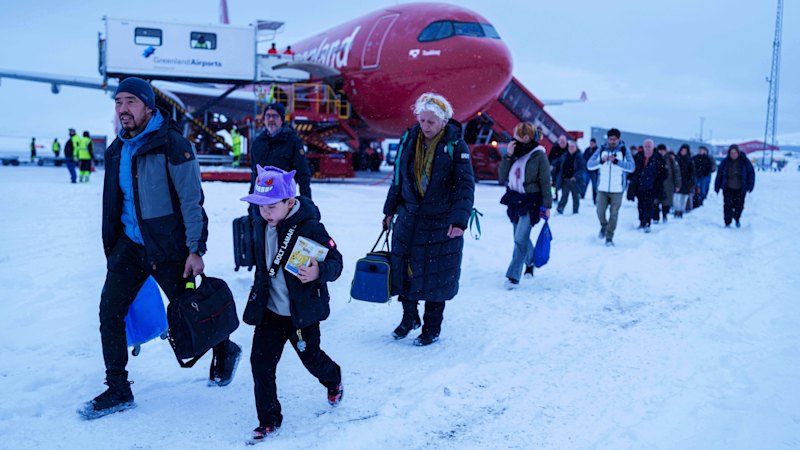
The wind in Thule doesn’t just blow. It carves. It is a physical weight, a wall of ice-laden air that screams across the Greenlandic permafrost at velocities capable of scouring the paint off a Jeep in an afternoon. In the early 1950s, if you were a Danish officer stationed in this white void, you weren’t just fighting the Soviet threat. You were fighting the crushing realization that your own best friend—the United States—might be the one who eventually forced your hand.
Deep in the archives of the Danish Ministry of Foreign Affairs, documents gathered dust for decades, hiding a secret that felt more like a thriller than a piece of post-war diplomacy. Denmark, a small nation with a massive footprint thanks to its sovereignty over Greenland, had a problem. The Americans were building massive runways. They were stacking crates of supplies. They were turning the Arctic into a giant, frozen aircraft carrier. If you enjoyed this article, you might want to read: this related article.
Denmark watched. They nodded. They signed the treaties. But in the dark, they were also calculating exactly how many pounds of explosives it would take to turn those pristine runways into a jagged graveyard of concrete and rebar.
They were preparing to blow up their own land to keep the Americans out. For another perspective on this development, check out the latest coverage from The Washington Post.
The Architect of a Ghost Plan
Consider a man like Erik. He is a hypothetical composite of the engineers and military planners who walked these halls in 1951, but his dilemma was entirely real. Erik spends his days looking at maps of Narssarssuaq and Thule. He isn't looking for ways to expand them. He is looking for the structural weaknesses in the asphalt.
To the world, Denmark was a founding member of NATO, a loyal partner in the defense of the West. To Erik, the Americans were a guest who had brought their own furniture, rearranged the living room, and started eyeing the master bedroom. The fear wasn't just about a Soviet invasion. The "secret" part of the Danish plan—the part that remained buried until researchers unearthed the "Operation Center" files—was the contingency for a "U.S. seizure."
If the Americans decided that Greenland was too strategically vital to be left in Danish hands, the Danes had a scorched-earth policy ready to go.
It is a staggering thought. A junior partner in an alliance preparing to sabotage the infrastructure of the senior partner. Imagine the tension in those closed-door meetings in Copenhagen. The smell of stale tobacco and the rustle of blueprints. They knew they couldn't win a shooting war against the United States. They knew they couldn't stop a carrier group. But they could ensure that if the Americans took the prize, the prize would be useless.
The Physics of Sabotage
A runway is a deceptively simple thing. It is a long, flat stretch of paved earth. However, in the Arctic, a runway is a miracle of engineering. The ground underneath is permafrost—soil that has been frozen for millennia. If you disturb it, the ground turns into a marshy, unstable soup.
The Danish plan involved pre-placed demolition charges. This wasn't a "last minute" idea. This was a systematic, calculated preparation. They identified the precise points where an explosion would not just create a hole, but would cause the underlying permafrost to shift and heave.
One well-placed blast wouldn't just stop a plane from landing today. It would render the entire strip unfixable for months, maybe years. The cold would do the rest of the work. Nature is an efficient accomplice when you’re trying to destroy something in the North.
The Danes weren't being paranoid. They were being historians. They remembered how quickly the borders of Europe had shifted in 1940. They saw how the United States had treated its "protectorates" during the height of the war. Sovereignty is a fragile thing. It only exists as long as you can defend it, or as long as it isn't worth someone else's trouble to take it from you.
By wiring the runways for destruction, Denmark was making Greenland "too much trouble."
The Invisible Stakes of 1951
We often think of the Cold War as a binary struggle. US versus USSR. Capitalism versus Communism. But the reality was a messy, vibrating web of smaller nations trying to keep from being crushed by the two giants.
Denmark's secret preparations reveal a profound lack of trust that rarely makes it into the history books. We are taught that NATO was a monolith of shared values. The truth is more human. It was a marriage of convenience where one spouse kept a loaded pistol in the nightstand, just in case the other one got too aggressive during an argument.
The stakes weren't just about territory. They were about the Danish soul. If they lost Greenland, they lost their seat at the table of Great Powers. They became just another small European peninsula. Greenland was their leverage. It was their pride.
The plan to blow the runways was the ultimate expression of that pride. It was a way of saying: "This is ours. If we can't have it, nobody can."
The Logistics of a Secret
How do you wire a base for destruction without the people living there noticing?
The Danish military had to operate with surgical precision. They used "maintenance" as a cover. They sent teams to "inspect" the drainage systems and "survey" the terrain. Under the guise of routine upkeep, they were mapping the kill zones.
There is a certain cold irony in the fact that the Americans were likely paying for much of the equipment and fuel that the Danes used to scout the demolition sites. US taxpayers were unwittingly funding the blueprints for the destruction of their own billion-dollar investments.
It was a game of shadows played on a landscape of blinding white.
The documents show that the Danish government was terrified of these plans leaking. If Washington found out, the diplomatic fallout would have been catastrophic. It would have looked like treason. But to the Danes, it was the highest form of patriotism. They were protecting the kingdom from everyone—even its "liberators."
The Ghost in the Permafrost
Decades have passed since those charges were planned. The Cold War ended. The Soviet Union collapsed. The runways at Thule—now Pituffik Space Base—still hum with activity. The world moved on to satellites and cyberwarfare.
But the ghost of the 1951 plan lingers. It serves as a reminder that in the world of high-stakes geopolitics, there are no permanent friends, only permanent interests.
We see this today as the ice melts. New shipping lanes are opening. Rare earth minerals are being discovered under the retreating glaciers. Once again, Greenland is the most important piece of real estate on the planet. And once again, the Great Powers are circling.
The Danish secret wasn't just about TNT and blasting caps. It was an admission of vulnerability. It was the frantic heartbeat of a small nation trying to stay relevant in a world dominated by giants.
When you look at a map of the Arctic now, don't just see the blue water and the white ice. See the invisible lines of tension. Remember the men like Erik, who sat in the freezing wind, staring at a runway, and wondering if today was the day they would have to turn the miracle of flight into a pillar of fire.
The explosives were never detonated. The plan was eventually filed away, a relic of a more paranoid era. Yet, the logic remains.
Trust is a luxury of the safe. For everyone else, there is a hidden fuse, buried deep beneath the snow, waiting for a command that everyone hopes will never come.
The silence of the Arctic isn't peaceful. It's a breath being held.