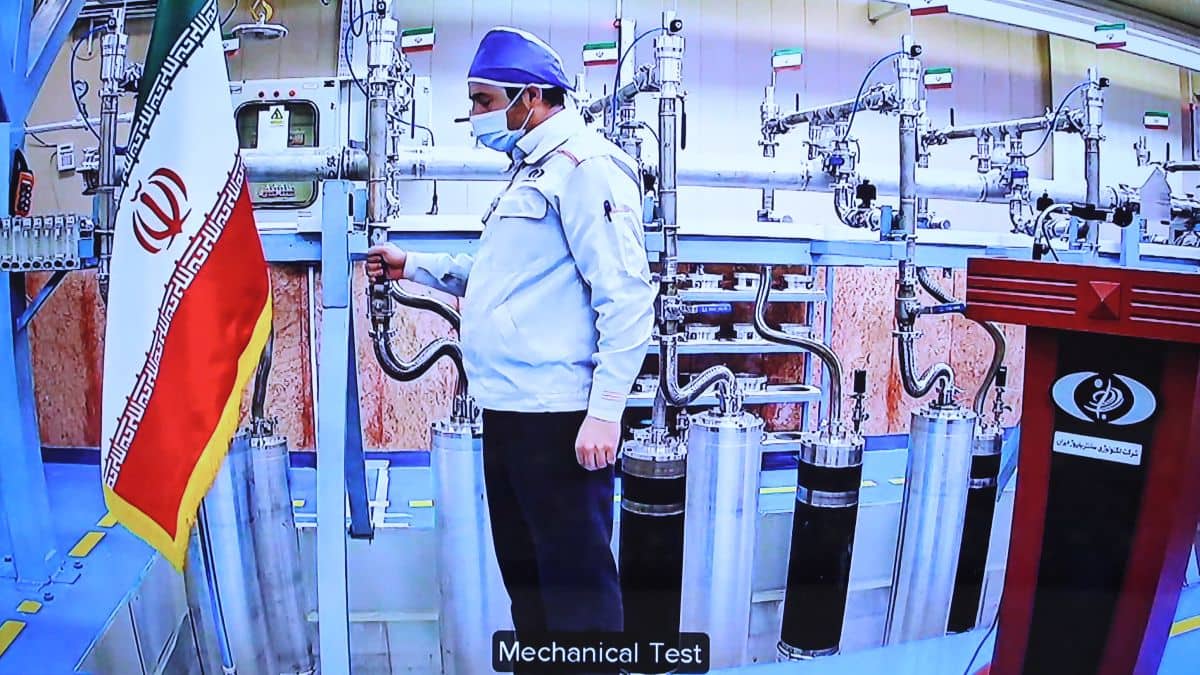
The air in the Isfahan desert doesn't just sit; it presses. It is a dry, relentless weight that tastes of dust and ancient stone. But if you stand near the perimeter of the Natanz fuel enrichment plant, the most important sounds aren't the wind or the shifting sand. The most important sound is the hum.
It is a mechanical hive-mind, the collective vibration of thousands of carbon-fiber cylinders spinning at speeds that defy intuition. To understand Natanz, you have to stop thinking about it as a "facility" or a "diplomatic flashpoint." You have to think about it as a high-speed clock where every second is a gamble against physics and every tick is a provocation to the world's superpowers.
Beneath the surface, buried under meters of reinforced concrete and sophisticated air-defense systems, lies the heart of Iran’s nuclear ambition. This is not a laboratory. It is a fortress of mathematics and metallurgy.
The Anatomy of a Target
Natanz exists in two worlds. Above ground, it looks like a sprawling industrial park, an unremarkable collection of administrative blocks and warehouses. Below ground, it is a subterranean cathedral of centrifuges.
The primary purpose of this site is the enrichment of uranium. Specifically, it houses the IR-1, IR-2m, and IR-6 centrifuges. Imagine a child’s spinning top, but made of aerospace-grade materials and rotating so fast that the outer edges approach the speed of sound. This is the $UF_6$ gas cycle. By spinning uranium hexafluoride gas at these violent speeds, the heavier isotopes are pushed to the walls, allowing the lighter, fissile $^{235}U$ to be collected.
It is a delicate process. A single vibration, a microscopic flaw in the bearing, or a sudden change in power, and the entire "cascade"—the series of connected centrifuges—can turn into a storm of shrapnel.
This fragility is why Natanz is the most targeted piece of real estate on the planet. When reports surfaced of US-Israeli strikes hitting the facility, the world reacted with a familiar, cynical shudder. We have been here before. We have seen the cyber-attacks of Stuxnet, which turned the facility’s own software into a weapon, forcing the centrifuges to spin themselves into junk. We have seen the "mysterious" explosions in the power distribution centers.
But this time, the stakes shifted from digital sabotage to kinetic impact.
The Human Shadow in the Hallway
Consider a hypothetical engineer named Arash. He isn't a shadowy operative or a wild-eyed radical. He is a man who studied fluid dynamics at Shiraz University, a man who likely worries about his daughter’s grades or the rising price of bread in Tehran.
When Arash walks through the decontamination showers and descends into the enrichment halls, he isn't walking into a news headline. He is walking into a workspace where the margin for error is zero. For him, a "strike" isn't a geopolitical maneuver discussed on CNN; it is the sudden, terrifying realization that the roof above him—no matter how many layers of concrete are poured—might not be enough.
The psychological toll on the thousands of workers at Natanz is the invisible variable in the nuclear equation. How do you maintain the steady hand required for nuclear chemistry when you know that several of the world’s most advanced air forces have your cubicle coordinates programmed into their GPS?
This human element is exactly what the "dry" reports miss. They talk about "output capacity" and "breakout time." They don't talk about the silence in the cafeteria after a strike. They don't talk about the frantic phone calls to families once the signal jammers are deactivated.
The Physics of Escalation
The strikes aren't just about breaking machines. They are about breaking a timeline.
In the world of nuclear non-proliferation, the term of art is "breakout time"—the duration it would take for a country to produce enough weapons-grade uranium for a single nuclear device. For years, the Joint Comprehensive Plan of Action (JCPOA) kept that window at roughly twelve months. Today, after the collapse of that deal and the subsequent "maximum pressure" campaigns, that window has shrunk to weeks, perhaps even days.
The logic of a military strike on Natanz is built on a paradox.
- The Intent: Destroy the centrifuges to reset the clock.
- The Reality: Knowledge cannot be bombed.
Every time a hall at Natanz is damaged, Iran responds by installing more advanced machines. The IR-1s, which were prone to failure, are being replaced by the IR-6s, which are faster, more efficient, and harder to kill. By targeting the facility, the West inadvertently accelerates the technological evolution of the program. It is a brutal cycle of "Destroy and Upgrade."
Moreover, the deeper Iran digs, the more difficult the diplomatic path becomes. When the facility moved into the mountain—into the fortified "Fordow" style bunkers—the message was clear: we no longer trust the sky.
The Invisible Stakes
Why does a facility in the middle of a desert matter to a coffee shop in London or a boardroom in New York?
Because Natanz is the barometer for the new Cold War. It is where the physical world meets the digital world. The attacks on this facility have pioneered a new kind of warfare—one where logic bombs are as deadly as gravity bombs.
When a strike occurs, the global oil markets flinch. The diplomatic cables between Washington, Jerusalem, and Riyadh catch fire. But the real cost is measured in the erosion of the international order. Every strike is a confession that diplomacy has failed. Every crater in the Isfahan soil is a testament to the fact that we have moved past the era of "trust but verify" into an era of "strike and delay."
There is a profound uncertainty that hangs over the site. Iran claims the facility is for peaceful energy and medical isotopes. The IAEA (International Atomic Energy Agency) points to the levels of enrichment—reaching 60%, a stone's throw from the 90% required for a bomb—and asks why a civilian program needs such high-purity fuel.
The truth is likely buried as deep as the centrifuges themselves.
The Concrete Echo
If you were to stand in the center of the enrichment hall today, you would see a forest of steel. You would see the flickering lights of the control panels, the steady green glow of systems that are, for the moment, functioning perfectly.
But you would also see the scars. You would see the reinforced pillars designed to withstand a bunker-buster. You would see the redundant power lines buried in the earth. You would see a nation that has decided that its survival depends on its ability to spin a gas faster than its enemies can drop a bomb.
The "Inside Natanz" story isn't about blueprints or enrichment percentages. It is a story about the stubbornness of human will and the terrifying precision of modern weaponry. It is about the fact that we live in a world where peace is maintained by the constant threat of total destruction.
The sun sets over the Isfahan desert, casting long, jagged shadows across the sand. The anti-aircraft batteries rotate slowly, scanning a sky that is, for now, empty. Below the ground, the hum continues. It is a low, vibrating pulse—the heartbeat of a conflict that no one knows how to end, and no one can afford to lose.
The centrifuges keep spinning. The clock keeps ticking. And the concrete, for all its strength, feels thinner every single day.


