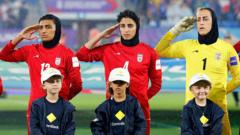
When the Iranian women’s national football team stood in silence during their national anthem, they weren’t just playing a match. They were dismantling a decades-old narrative of state-mandated compliance. This act of defiance, mirrored by various athletes across the Iranian sporting landscape, has transformed the football pitch into a primary theater of political resistance. While the world watches the highlights, the reality for these players involves a brutal calculation of risk that extends far beyond their professional careers.
The silence was deafening. By refusing to sing, these athletes aligned themselves with the "Woman, Life, Freedom" movement, a gesture that carries the weight of potential imprisonment, lifetime bans, or worse. Former men's national team coaches and veteran analysts recognize this as a definitive break from the past. It is no longer about sport alone. It is about the survival of an identity that the state has spent forty years trying to suppress.
The Infrastructure of Control
To understand why a simple refusal to sing is an act of "heroism," one must first grasp the restrictive environment of Iranian women's sports. The Iranian Football Federation operates under the strict oversight of the Ministry of Sport and Youth, which in turn answers to the ideological demands of the establishment. For female players, the "hijab rule" is the most visible layer of control, but the true barriers are structural.
Funding for the women’s game remains a fraction of the men's budget. Training facilities are often substandard, and international friendlies are frequently canceled to avoid "unnecessary" exposure. When these women succeed despite these hurdles—as they did by qualifying for the Asian Cup—they become accidental icons. The state wants to use their success as proof of "Islamic progress," while the players use that same platform to signal their rejection of the system.
This creates a paradox. The government cannot easily disband a winning team without drawing international condemnation, yet they cannot allow a winning team to become a mouthpiece for revolution.
The Internal Mechanics of Dissent
Dissent in Iranian football is rarely a spontaneous outburst. It is a calculated, collective decision. Sources close to the athletic circles in Tehran suggest that these protests are discussed in hushed tones, away from the prying eyes of "supervisors" embedded within the team delegations. These supervisors are not there to coach; they are there to monitor ideological purity.
When a team decides to stand silent, they are betting on their collective profile to shield them. They know that if one player protests, she is easily replaced and erased. If the entire starting eleven stands still, the state faces a PR nightmare. This is the "heroism" referenced by former coaches—the willingness to gamble one's livelihood for a collective message of solidarity with the protesters on the streets of Shiraz, Isfahan, and Tehran.
The Shadow of the 1978 Precedent
History looms large over the current crisis. In 1978, on the eve of the Revolution, football was a catalyst for public sentiment. The current establishment remembers this all too well. They view the stadium not as a place of leisure, but as a potential flashpoint for organized unrest.
The crackdown on high-profile male players like Voria Ghafuri and Ali Daei served as a warning shot to the women’s team. If the legends of the game can be detained or have their passports confiscated, the women’s team—who possess significantly less financial independence—are arguably more vulnerable. Yet, their protests have been more consistent and visually striking. They have less to lose in terms of wealth, perhaps, but everything to gain in terms of basic human agency.
The Role of the Diaspora and International Pressure
International governing bodies like FIFA find themselves in an increasingly untenable position. FIFA’s statutes strictly prohibit political interference in the management of national federations. However, the Iranian government’s involvement in team selection and the punishment of protesting players is a clear violation of these rules.
The global football community has often opted for "quiet diplomacy," a strategy that critics argue has failed to protect athletes. The heroism of the Iranian women’s team highlights the cowardice of international institutions that prioritize tournament schedules over the safety of the participants. While fans across the globe post hashtags in support, the players return to an airport where "morality police" and intelligence officers await their arrival.
Beyond the Anthem
The protest extends into the very way the game is played and celebrated. In many instances, players have refused to celebrate goals. A goal in football is the ultimate moment of release, a culmination of years of training. To forgo that joy is a somber acknowledgment that there is nothing to celebrate while their compatriots are facing violence in the streets.
This emotional discipline is taxing. Imagine the mental fortitude required to compete at the highest level of international sport while knowing your family is being watched. This isn't just about "sportsmanship." It is about a high-stakes psychological war between a generation that wants to breathe and a regime that wants to dictate the air.
The Economic Leverage of the Athlete
Unlike male players who often have lucrative contracts in European or Gulf leagues, Iranian female footballers are largely tethered to domestic clubs. These clubs are often owned by state-linked conglomerates or municipal bodies. A player who steps out of line doesn't just lose her spot on the national team; she loses her salary, her housing, and her ability to work within the country.
This economic strangulation is a deliberate tool of the state. By keeping the women’s game underfunded and isolated, the authorities ensure that the cost of protest is as high as possible. When a former coach calls them "heroes," he is acknowledging that these women are choosing potential poverty and exile over the comfort of silence.
Counter-Arguments and the State Narrative
The state-aligned media in Iran paints a different picture. They characterize the silence of the players as "foreign-led provocation" or the result of "social media brainwashing." They argue that the players have a duty to represent the flag, regardless of their personal political views.
However, this argument falls flat when the flag itself has become a symbol of the very repression the players are fighting. For many of these athletes, the "national" team no longer represents the government, but the people. They are reclaiming the concept of the nation from the regime that claims to own it.
The Long-Term Impact on the Game
The immediate consequence of this bravery is a fractured sporting culture. The national team may face suspensions or "restructuring" that sidelines the most vocal activists. We are seeing a brain drain of athletic talent, as those who can leave seek asylum or opportunities in leagues where their speech is not a crime.
But the cultural impact is already solidified. A new generation of Iranian girls has seen their idols stand tall. They have seen that the football pitch can be a site of power, not just a place to follow rules. This shift in consciousness cannot be undone by a federation memo or a police interrogation.
The "heroes" of the women's team have redefined what it means to win. A trophy is temporary, but the image of eleven women standing in silent defiance of a dynamic they didn't choose is a permanent fixture in the history of the sport. They have proven that the most important play in the game doesn't always involve the ball. It involves the person standing behind it.
Monitor the upcoming Asian qualifying rounds. Watch the sidelines, not just the scoreboard. The next phase of this struggle will be determined by whether the international community finally decides to back the players with more than just rhetoric.