The ink on a treaty is a fragile thing. It lacks the weight of stone or the resilience of steel. It is merely a promise made by people in suits, sitting in gilded rooms, while the rest of the world goes about the business of living. But when those promises begin to fray, the sound isn't a loud explosion. It is a quiet, rhythmic tearing.
Germany just pulled the thread harder. In related developments, we also covered: The Long Walk at Mar a Lago.
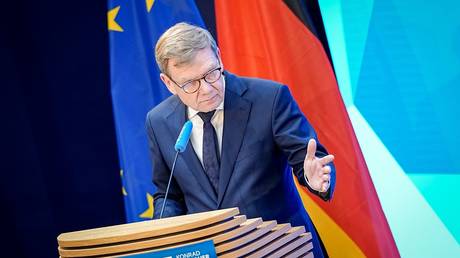
In the hallways of Brussels, the air has grown thick with the scent of an impending correction. For years, the European Union has operated on a gentleman’s agreement: we share the money, we share the values, and we pretend the friction isn't there. But Berlin has signaled that the era of pretending is over. By backing a movement to tighten the screws on "dissenters"—nations like Hungary or Poland that have historically zigged while the bloc zagged—Germany is attempting to transform the EU from a loose neighborhood of allies into a disciplined household with a very strict set of house rules.
Consider a small-scale version of this drama. Imagine a group of neighbors who decide to pool their resources to build a magnificent communal garden. One neighbor provides most of the seeds and the water; others provide the labor and the land. Everything works until one neighbor decides they want to plant hemlock in their corner, or perhaps they stop showing up to pull the weeds but continue to take the best of the harvest. The neighbor providing the water eventually gets tired. They realize that if the garden is to survive, they have to be able to shut off the tap to the plot that refuses to follow the plan. The Guardian has analyzed this critical issue in great detail.
Germany is the neighbor with the water. And they are tired of the weeds.
The Mechanics of the Velvet Hammer
The core of the issue lies in a mechanism that sounds deceptively boring: the "Conditionality Regulation." Behind that gray, bureaucratic phrasing is a weapon of immense economic power. It allows the EU to freeze billions of Euros in funding if a member state is found to be undermining the "rule of law."
In the past, punishing a wayward member was nearly impossible. It required a unanimous vote. If you had two "problem" countries, they simply promised to vote for each other, creating a mutual shield that rendered the EU’s highest courts toothless. It was a loophole you could drive a tank through.
Germany’s new stance is about closing that gap. They are pushing for a system where dissent isn't just debated; it’s billed.
The stakes are not found in the legal filings, but in the reality of a bridge in Budapest that doesn't get built, or a school in a rural province that loses its heating subsidy because the national government refused to align its judiciary with Brussels' standards. This is the human cost of the geopolitical chess match. When the money stops flowing, it doesn't hit the politicians first. It hits the pavement. It hits the people waiting for the bus.
A History of Silence and its Price
Why now? Why has the powerhouse of Europe decided to trade diplomacy for a ledger?
The answer is found in the ghost of the 20th century. Germany’s commitment to the European project isn't just about trade; it is a penance and a safeguard. For decades, the German philosophy was "change through trade." They believed that if you integrated economies deeply enough, political values would naturally follow. They thought that a shared bank account would lead to a shared heart.
They were wrong.
Wealth did not guarantee a liberal democracy. In fact, in some corners of the Union, EU funds were used to fortify the very structures that the Union was designed to prevent. Money intended for infrastructure was diverted to cronies. Legal systems were dismantled using the very subsidies meant to strengthen them.
The German government, facing its own internal pressures and a stagnating economy, can no longer justify sending billions across the border to governments that openly mock the hand that feeds them. It is a moment of profound vulnerability. To admit the old way failed is to admit that the European dream is more fragile than anyone dared to say out loud.
The Invisible Line in the Sand
There is a tension here that we often ignore because it is uncomfortable. It is the tension between sovereignty and solidarity.
When a country joins the EU, they sign away a piece of their soul in exchange for a piece of the world’s largest market. But how much of that soul is actually for sale? If a nation decides it wants to define its own marriage laws, or its own media regulations, or its own border policies, is it still "European"?
The critics of Germany’s move argue that this is a form of liberal imperialism. They see a future where Brussels dictates every facet of national life, using the threat of poverty as a silencer. They fear a Europe where "diversity" applies to food and language, but never to thought or governance.
But there is another side to that fear.
What happens to the student in a country where the press is silenced? What happens to the entrepreneur who can’t get a fair trial because the judge is a political appointee? For them, the German "tightening" isn't an act of aggression. It’s a lifeline. It is the only external pressure capable of forcing their leaders to respect the rights of the individual.
The Sound of the Tap Turning
We are entering a season of cold accounting.
The German backing of these curbs suggests that the Union is moving toward a "multi-speed" existence. Those who follow the rules stay in the warm glow of the central hearth. Those who don't are pushed toward the drafty corners of the room.
It is a high-stakes gamble. If you push a nation too hard, they might not fall in line; they might just leave. We have seen how that story ends, and the scars of Brexit are still fresh and jagged across the English Channel. No one wants a repeat of that trauma, yet Germany seems to have decided that a smaller, disciplined Union is better than a large, chaotic one that is rotting from the inside.
This isn't just about budgets. It is about the definition of a neighbor.
If we live on the same street, share the same park, and use the same currency, are we responsible for how you treat your children behind closed doors? Germany has finally answered with a resounding "Yes." They have decided that the "house rules" apply to everyone, and the price of admission is no longer a one-time fee paid at the door. It is a subscription that can be canceled at any time.
The tragedy of this moment is that both sides are right. The dissenters are right to fear the loss of their national identity to a distant bureaucracy. Germany is right to fear that without standards, the Union is merely a suicide pact.
The result is a landscape where trust has been replaced by a calculator. We are watching the slow death of the "gentleman’s agreement" and the birth of a more clinical, transactional Europe. It is safer, perhaps. It is certainly more orderly. But as the screws tighten and the funding freezes, the warmth that once defined the European project feels further away than ever.
The neighbor has reached for the tap. The water is still flowing, but everyone in the garden is now watching the handle, waiting to see how far it will turn before the soil goes dry.
The reality of 2026 is that the European House is no longer being held together by shared dreams, but by the cold, hard mathematics of the German treasury. If the foundation is cracked, you can either patch it with words or reinforce it with iron. Berlin has chosen the iron. Whether the structure can withstand the pressure of its own reinforcement is a question that will be answered in the empty pockets of the dissenters and the quiet resentment of the governed.
The tearing sound is getting louder.
In the end, a Union is only as strong as the consensus of its members. When you replace consensus with coercion, you might save the budget, but you risk losing the soul of the project. Germany is betting that the money matters more than the feelings. In a world of rising prices and falling security, they might be right. But a garden grown in fear of the gardener is a very different place than one grown for the beauty of the bloom.
The tap turns. The water slows. The neighborhood waits.