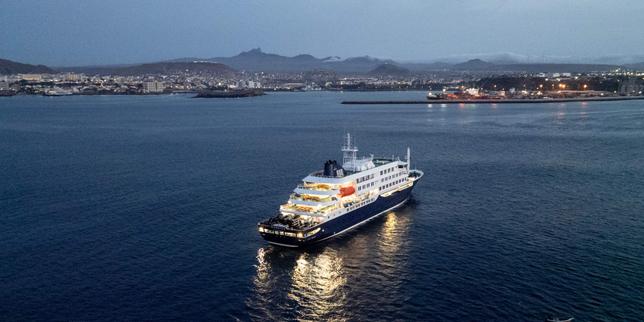
The media loves a floating petri dish. When a "virus-hit" ship makes the rounds, news outlets pivot instantly to a tired script: panicked passengers, incompetent captains, and the alleged "betrayal" of being told everything is fine while the body bags are being prepped. It’s a narrative built on a fundamental misunderstanding of maritime law, infectious disease kinetics, and the cold reality of risk management.
Stop crying about being "lied to" by a cruise director. Start looking at why a ship is actually the safest place to contain an outbreak that the mainland isn't ready to handle.
The Illusion of Absolute Safety
Every time a passenger steps onto a vessel, they sign away the right to be treated like a citizen of a land-locked democracy. You are on a floating sovereign entity. The "outrage" that passengers were told the ship was "not infectious" after a death occurred isn't a scandal; it’s standard operational protocol designed to prevent a stampede in the middle of the ocean.
If you want the truth, don't look at the captain’s intercom. Look at the manifest.
The industry reality is simple: ships are high-density environments. When a pathogen enters a closed loop, the infection rate follows a predictable $R_0$ that makes urban centers look like isolated outposts. The mistake isn't the "lie." The mistake is the passenger’s belief that a luxury liner is a hospital. It is a business. Its primary function is to keep the engine turning and the buffet stocked until the liability can be legally transferred to a port authority.
The Quarantine Paradox
Conventional wisdom says "get everyone off the ship immediately." This is medically illiterate.
When you offload three thousand potentially infected individuals into a port city, you aren't "saving" them. You are weaponizing them. The ship is the perfect quarantine vessel because it is already self-contained. It has independent air filtration (however flawed), centralized waste management, and a controlled entry point.
The "cruelty" of keeping people onboard is actually a brutal form of civic duty. I’ve consulted on logistics for high-risk transport, and the hardest pill for people to swallow is that sometimes, the most ethical choice is to keep the infected exactly where they are until the logistics of isolation can be perfected on shore.
- Fact: A ship is a biological data set.
- The Nuance: By keeping passengers on board, epidemiologists can track the spread in a controlled environment.
- The Reality Check: You aren't a guest; you're a data point in a real-time stress test of global health systems.
The Logic of the "Lies"
"They told us it wasn't infectious."
Of course they did. Panic is a more effective killer than most respiratory viruses in a confined space. In 1918, the "Spanish Flu" didn't just kill through cytokine storms; it killed through the total collapse of social order. On a ship, social order is the only thing standing between a managed outbreak and a lord-of-the-flies scenario in the Neptune Lounge.
Captain’s don't "lie" because they are evil. They withhold information because the average passenger has the crisis-management skills of a panicked hamster. If a captain announces a confirmed viral death before the logistics of cabin-isolation are ready, they risk a riot. A riot at sea is a death sentence for everyone, infected or not.
Risk Is Not a Customer Service Issue
We have entered an era where travelers believe that "paying for a ticket" exempts them from the laws of biology. It doesn't.
If you board a ship during a global or regional health crisis, you are consenting to a specific type of biological gambling. The "misinformation" cited by disgruntled passengers in every major cruise scandal of the last decade usually boils down to a delay in communication. In the time it takes for a lab result to be verified on shore and relayed to the bridge, the situation has already evolved.
The gap between a death occurring and a public announcement is not a cover-up. It’s the time required to prevent the ship from turning into a chaotic mess that no port will ever allow to dock.
Stop Asking if it’s Safe
People always ask: "Is it safe to go back on the water?"
This is the wrong question. It’s never been "safe." You are on a metal box surrounded by corrosive salt water, powered by combustible fuel, and packed with thousands of strangers carrying various degrees of viral loads. The question you should be asking is: "Is the infrastructure capable of handling me when things go wrong?"
Usually, the answer is no.
The cruise industry relies on a "just-in-time" delivery model for health and safety. They have enough medical staff for a few heart attacks and some Norwalk virus cases. They are not built for a prolonged siege. When you demand "transparency" from a cruise line, you are asking for them to admit they are out of their depth. They won't do that. It would be bad for the stock price.
The Professional’s Guide to Nautical Bio-Risk
If you find yourself on a ship that has "gone dark" on information, stop checking the news. The news is just as clueless as you are.
- Assume the air is shared. Even with HEPA filters, the pressure differentials in ship corridors mean that every time a cabin door opens, you are exchanging air with the hallway.
- The Captain is a Corporate Officer. Their primary loyalty is to the hull and the brand, in that order. You are third. Act accordingly.
- Sanitize your own space. If you think the "enhanced cleaning" crew is doing anything more than a theatrical wipe-down with diluted bleach, you’ve never seen a ship’s turnaround schedule.
The Hard Truth About Maritime Ethics
We like to pretend that there is a "right" way to handle a virus-hit ship. There isn't. There are only various shades of "bad."
The competitor's article focuses on the "betrayal" of the passengers. I’m telling you that the betrayal is a necessary component of maritime stability. If you want a guarantee of honesty and total transparency during a crisis, stay in your house. Once you cross the gangway, you are part of a floating experiment in crisis management where the goal is the survival of the many at the expense of the comfort—and sometimes the lives—of the few.
The cruise industry isn't broken. It’s functioning exactly as intended: as a high-margin, high-risk ecosystem that prioritizes the flow of commerce over the individual’s right to know exactly how fast the ship is sinking.
If you can't handle being told a "ship is not infectious" while the doctor is signing a death certificate, you don't belong on the ocean. You belong in a suburban bunker where the only thing you have to worry about is the reliability of your Wi-Fi.
The ocean doesn't care about your feelings, and neither does the ship’s log. Stop looking for a hero in a captain’s hat and start realizing that in a quarantine, you are your own first responder.
Pack your bags or stay on the dock. Just don't act surprised when the corporate entity you paid to entertain you prioritizes its own survival over your peace of mind. That’s not a scandal. That’s the contract.