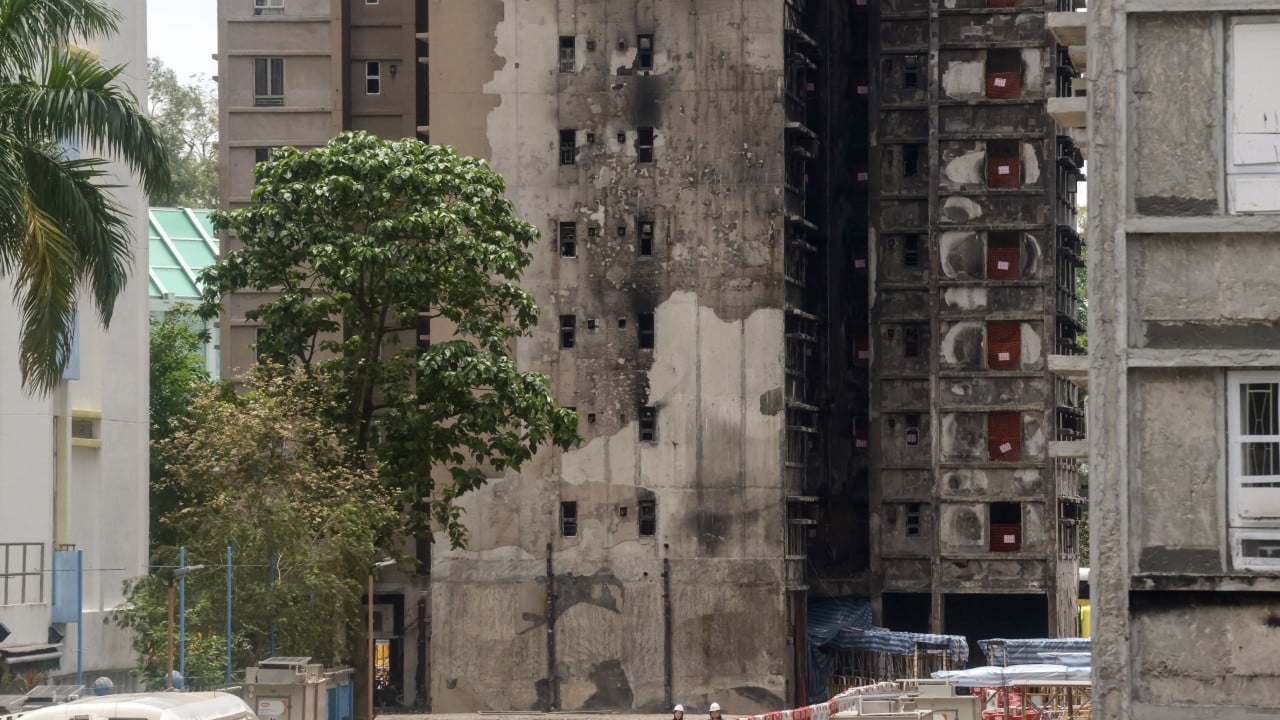
The air inside the temporary housing unit is thin, smelling of antiseptic and the faint, lingering scent of boxed lunches. Mrs. Chan sits at a folding card table, her hands hovering over a tablet she only learned to turn on three weeks ago. Outside the window, the world is a blur of grey transit vans and the distant, skeletal silhouette of Wang Fuk Court.
Her home is still there, technically. But a home without residents is just a collection of concrete boxes, and for the displaced families of Wang Fuk Court, the distance between their current temporary shelter and their front doors feels like an ocean. The physical gap is small. The bureaucratic gap is a canyon.
Then, the screen flickers to life.
The Glow of the Small Screen
The administrator’s face appears in a pixelated grid. He isn’t in a grand hall or standing behind a mahogany podium. He is in an office, likely under the same fluorescent hum that defines most of government life in Hong Kong. But for the hundreds of residents watching from smartphones, tablets, and borrowed laptops, this isn't just a meeting. It is a lifeline.
The decision to move these administrative consultations online wasn't born of a desire for "innovation." It was born of necessity. When a building undergoes the kind of upheaval that scatters its community across different districts, the traditional town hall meeting dies. You cannot ask a seventy-year-old grandmother to cross three bus lines and a subway transfer just to hear an update on plumbing repairs.
Online meetings represent a shift in the power dynamic of urban management.
Instead of the residents coming to the authority, the authority enters the residents’ temporary space. It happens in their kitchens. It happens while their children do homework in the background. It is intimate, awkward, and deeply human.
The Weight of the Unseen Stake
Consider a hypothetical resident we’ll call Mr. Wong.
Mr. Wong has lived in Wang Fuk Court for twenty-two years. He knows exactly which floor tile in the lobby is loose and which neighbor plays their television too loud on Tuesday nights. To an administrator, Mr. Wong is a data point—Unit 4B, displaced, Category A priority. To Mr. Wong, the displacement isn't a logistical hurdle. It is a fracture in his identity.
When the administrator speaks about "structural timelines" and "safety certifications," Mr. Wong is looking for something else. He is looking for the subtext. He is listening for the tone of voice that tells him if he’ll be back by the Lunar New Year.
The digital format strips away the physical intimidation of a government building. In a cold, echoing hall, a lone voice at a microphone often sounds small. On a video call, the chat box becomes a roar of collective consciousness. Questions fly. When? Why? How much? The screen becomes a shield for the shy and a megaphone for the frustrated. This is the hidden pulse of the Wang Fuk Court meetings. It isn't just about the facts of the displacement; it’s about the reclamation of agency.
Breaking the Concrete Wall
For a long time, the relationship between property management and tenants has been one of stone. One side issues a notice; the other side complies or complains. But the digital shift at Wang Fuk Court is forcing a softening of that barrier.
The administrator has to deal with "unstable connections." He has to wait while a resident figures out how to unmute. He sees the cramped quarters where they are currently living. This visual data matters. It’s hard to be a "dry" bureaucrat when you are staring directly into the eyes of a family living out of suitcases because of a decision your department is managing.
The facts remain stubborn. Repairs take time. Safety is a non-negotiable metric. The law is the law.
But the delivery of those facts has changed. We are seeing the death of the "official statement" in favor of the "ongoing conversation."
The Logistics of Displacement
To understand why these online meetings are a vital organ in the body of the city, you have to look at the numbers. We are talking about hundreds of households. That is thousands of lives suspended in a state of "between."
The logistical nightmare of coordinating a physical meeting for such a group is staggering.
- Rental of a venue large enough to hold the crowd.
- Security and crowd control.
- Printing of thousands of pages of handouts.
- The carbon footprint of a thousand people commuting to a single point.
By moving this to the cloud, the administrator removes the friction of the physical. The "room" is now infinite. No one is turned away because the fire code says the hall is full. Every resident has a front-row seat.
This isn't just about saving money on hall rentals. It is about the democratization of information. In the old world, the person at the back of the room might miss the nuance of an answer. In the digital world, everyone hears the same audio at the same volume.
A New Language of Governance
There is a specific kind of silence that happens on a large-scale video call. It’s the silence of a hundred people holding their breath.
When the administrator addresses the specific concerns of the Wang Fuk residents—the status of the elevators, the reinforcement of the exterior walls, the projected date for the return of utilities—the silence is heavy. It’s the sound of people building a mental bridge back to their front doors.
The transition hasn't been perfect. There are elders who struggle with the interface. There are moments where the audio drops out just as a crucial date is mentioned, leading to a flurry of panicked messages in the sidebar.
Yet, these glitches are part of the story. They reflect the messiness of the displacement itself. The technology is a mirror of the situation: fragile, evolving, and essential.
The Human Registry
Behind every "displaced resident" is a story of a disrupted routine.
There is the woman who can no longer walk to her favorite bakery in the morning. There is the student who has to study in a noisy community center because their temporary unit is too small. There is the elderly man who misses the specific light that hits his balcony at 4:00 PM.
These are the things that don't make it into the administrator’s official report. But they are the things that the online meetings indirectly address. By providing a consistent, scheduled point of contact, the administration is providing a sense of rhythm to lives that have been rhythm-less for months.
It tells the residents: You are not forgotten. You are still part of the ledger. We see you, even if it’s through a 720p webcam.
The Echo of the Future
What is happening with Wang Fuk Court is a blueprint.
Urban centers are becoming more dense, and the infrastructure is aging. Displacements—whether due to renovation, safety concerns, or redevelopment—will become more frequent. The "Wang Fuk Model" of digital transparency is likely the new standard.
It’s a realization that information is a form of housing. If you cannot give someone their home back immediately, you must at least give them the truth about it in a way they can access without further hardship.
Mrs. Chan closes the laptop. The screen goes black, reflecting her face and the small, cluttered room behind her. She doesn't have her keys back yet. She doesn't have her old life back. But she has a date. She has a name. She has the memory of a hundred other faces on the screen, all nodding at the same time, all waiting for the same door to open.
The digital meeting ends, but the community remains connected by the invisible threads of a shared signal and a shared hope. The concrete is still drying at Wang Fuk Court, but the bridge is already built.