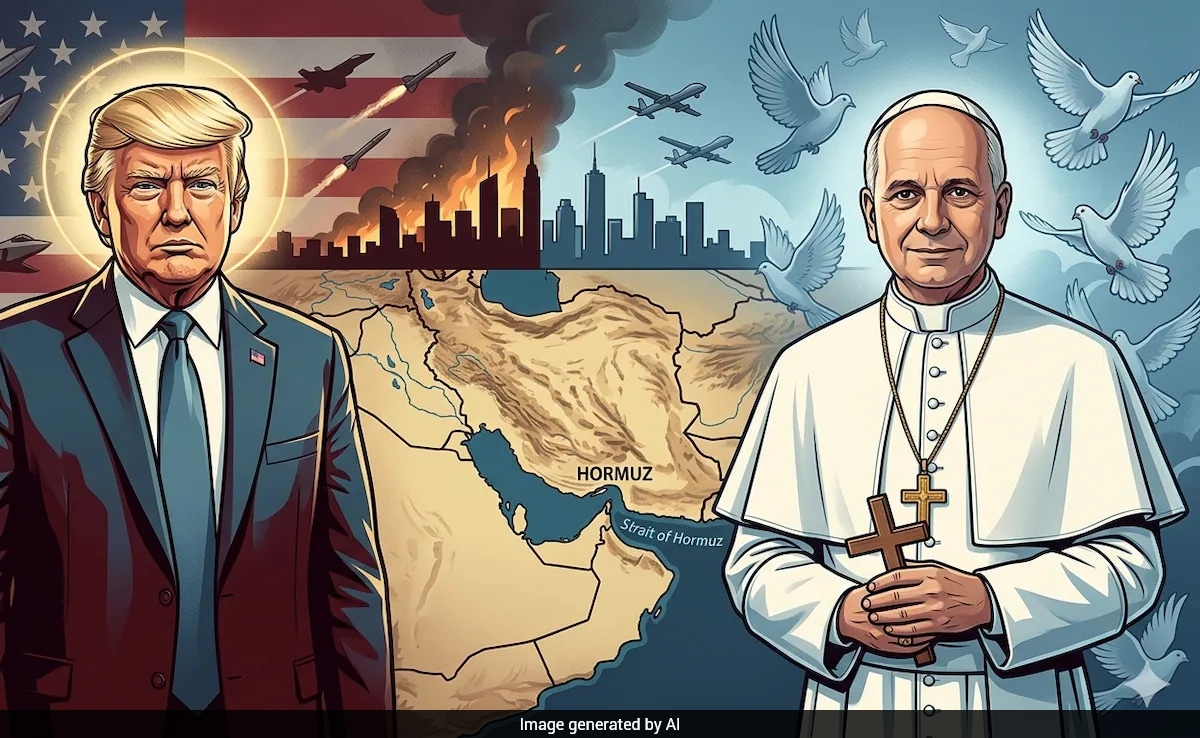
The intersection of religious rhetoric and military strategy has reached a boiling point as the Trump administration frames a potential conflict with Iran not merely as a geopolitical necessity, but as a providential mandate. By positioning a higher power as a "Co-Commander" in the theater of war, the White House has moved beyond standard political posturing into the territory of holy war. This shift has triggered an immediate and sharp rebuke from the Vatican, where Pope Francis has issued a definitive "no" to the sacralization of state-sponsored violence. The tension represents more than a theological disagreement; it is a fundamental breakdown in the global consensus on how modern nations justify the use of force in an era of high-tech surveillance and unconventional warfare.
At the heart of the matter is a calculated effort to unify a domestic base while signaling to Tehran that the United States views its regional objectives through a lens of absolute moral certainty. When a leader invokes the divine to authorize a kinetic strike or a naval blockade, the traditional guardrails of diplomacy begin to dissolve. You cannot negotiate with a mandate from heaven. This leaves the international community, and specifically the Holy See, in a position where they must defend the secular boundaries of international law against a rising tide of messianic nationalism.
The Weaponization of Faith in Modern Conflict
The administration's move to cast the military apparatus as an extension of divine will is a classic play from the historical playbook of total war, updated for the 2020s. By using this language, the White House bypasses the messy, bureaucratic requirements of explaining complex regional dynamics—like the nuances of the Joint Comprehensive Plan of Action (JCPOA) or the intricacies of Iranian proxy networks in Iraq and Yemen. Instead, it offers a binary choice between good and evil. This simplification is dangerous because it ignores the tactical realities on the ground.
Military analysts recognize that Iran is not a monolithic entity. It is a nation with internal factions, a sophisticated cyber warfare wing, and a desperate need for economic stability. Framing the conflict as a spiritual crusade shuts down the channels of back-room diplomacy that typically prevent a "cold" conflict from turning "hot." The Vatican’s intervention is specifically designed to remind Washington that the "Just War" theory, which has governed Western thought for centuries, requires a much higher threshold for violence than "divine approval" or pre-emptive strikes.
The Vatican Strategy of De-escalation
Pope Francis has spent his papacy dismantling the idea that any war can be considered "holy." His rejection of the administration's stance is grounded in a deep-seated fear that religious rhetoric will be used to mask what is essentially a fight over energy corridors and regional hegemony. The Vatican’s diplomatic corps, known for being some of the most experienced in the world, understands that once a conflict is defined by faith, the possibility of a ceasefire becomes nearly impossible.
The Pope’s "no" is a tactical strike against the legitimacy of the administration's narrative. By denying the White House the moral cover it seeks, the Vatican is attempting to force the conversation back into the realm of the United Nations and the Geneva Convention. This is a rare moment where the moral authority of the Church is being used as a hard-power check on the military-industrial complex.
The Role of Advanced Technology in the Moral Calculus
The nature of a war with Iran would look nothing like the crusades of the past. It would be a conflict defined by autonomous drones, precision-guided munitions, and broad-spectrum electronic warfare. This creates a strange paradox for the "Co-Commander" narrative. How does one reconcile the concept of divine guidance with the cold, algorithmic logic of an MQ-9 Reaper drone or a Stuxnet-style cyberattack?
Technology has fundamentally changed the ethics of the battlefield.
- Autonomous Weapons Systems: The delegation of lethal force to AI makes the claim of "divine command" feel even more disconnected from the reality of the killing.
- Cyber Infrastructure: Attacks on Iranian power grids or financial systems hit the civilian population hardest, violating the principle of non-combatant immunity.
- Surveillance Bloat: The use of mass data to track and target Iranian officials creates a "god-view" for military operators that mimics religious omnipresence, but lacks any form of mercy.
Breaking the Global Consensus
For decades, the West has operated under the assumption that while leaders might be personally religious, their foreign policy would remain anchored in secular realism. The current shift toward a "Co-Commander" philosophy breaks that unspoken rule. It alienates traditional European allies—like France and Germany—who are already skeptical of American intentions in the Persian Gulf. These nations view the introduction of religious justifications as a sign of instability, suggesting that the U.S. is no longer making decisions based on shared intelligence or mutual security interests.
If Washington continues down this path, it risks a total isolation from the very partners it needs to contain Iranian influence. The Vatican's vocal opposition provides a "permission structure" for other Catholic-majority nations in Europe and Latin America to distance themselves from American military objectives. It turns a regional dispute into a global identity crisis.
Domestic Politics and the Escalation Ladder
Domestically, the "Co-Commander" rhetoric serves a very specific purpose. It secures the support of a specific demographic that views the Middle East through the lens of eschatology. For these voters, a conflict with Iran isn't a policy failure; it is a fulfillment of a historical arc. The administration is essentially "crowdsourcing" its mandate for war, using faith to bypass the need for a formal Congressional declaration.
However, this strategy has a major flaw. It assumes that the American public is willing to accept the high costs of a war with a sophisticated adversary like Iran. Unlike the insurgencies in Afghanistan or the early stages of the Iraq War, Iran possesses the capability to strike back at U.S. interests globally. They have a robust ballistic missile program and a sophisticated network of sleeper cells. When the body bags start coming home, the "divine mandate" will be put to its ultimate test.
The Intelligence Gap and the Danger of Certainty
One of the most concerning aspects of the current administration's stance is the apparent dismissal of intelligence that contradicts the desired narrative. In an environment where God is the "Co-Commander," dissenting voices within the CIA or the DIA are easily silenced. If the mission is ordained, then data regarding Iranian compliance or the lack of an active nuclear weapons program becomes irrelevant.
This is how intelligence failures happen. We saw it in 2003 with the "slam dunk" evidence of WMDs in Iraq. The difference now is that the justification isn't just bad data—it’s an unfalsifiable religious claim. This makes it impossible for internal oversight committees to do their jobs. You cannot audit a miracle, and you cannot verify a vision.
Strategic Consequences of the Rhetorical Shift
The Iranian leadership, for their part, is more than happy to meet the U.S. on this ideological battlefield. Tehran has its own version of religious nationalism, and they are experts at using American aggression to justify their own internal crackdowns on dissent. By framing the conflict in religious terms, the U.S. is playing directly into the hands of the IRGC (Islamic Revolutionary Guard Corps). It allows the Iranian regime to tell its people that the "Great Satan" is finally showing its true face.
This creates an escalation ladder where neither side can step down without appearing to betray their faith. It is the ultimate trap.
The Economic Reality Behind the Altar
Beyond the prayers and the pronouncements, the conflict remains anchored in the cold reality of oil and gas. Iran sits on some of the world's largest energy reserves and controls the Strait of Hormuz. A war would send global oil prices into a tailspin, potentially triggering a global recession. No amount of religious fervor can shield the American consumer from $7-a-gallon gasoline.
The Vatican’s "no" is also a recognition of this economic reality. The Pope understands that the poorest people in the world will suffer the most from the economic fallout of a U.S.-Iran war. While the White House talks about commanders in the sky, the Holy See is looking at the people on the ground who will be unable to afford food or heating because of a disrupted global supply chain.
Logistics of a Modern Holy War
If the administration moves forward, the logistics will be handled by private contractors and AI-driven logistics software. We are looking at a "God-sanctioned" war managed by Palantir and Amazon Web Services. This juxtaposition is jarring. The use of high-end tech to prosecute a war justified by ancient religious tropes represents a new kind of cognitive dissonance in American foreign policy.
The infrastructure of war is now so removed from the human experience that it’s easy for leaders to treat it as an abstract moral exercise. When you can kill from a trailer in Nevada, the "divine" justification feels less like a spiritual conviction and more like a PR strategy to keep the home front quiet.
The Failure of Traditional Diplomacy
The fact that the Pope has to be the one to say "no" indicates a massive failure in the traditional diplomatic channels. The State Department has been hollowed out, leaving a vacuum that is being filled by religious advisors and hawks. Without a robust corps of career diplomats to provide a reality check, the administration is free to craft its own version of the truth.
The international community is now looking for a third way. There is a desperate need for a mediator who can bridge the gap between Washington’s messianism and Tehran’s defiance. The Vatican is positioning itself for that role, but it remains to be seen if the White House is even interested in an exit ramp.
The Permanent Cost of Providential War
Once a nation starts using God as a tactical asset, there is no going back. It changes the nature of the presidency and the military. It sets a precedent that the Constitution’s separation of church and state stops at the water’s edge. If we allow the commander-in-chief to claim divine partnership in the destruction of another nation, we have effectively abandoned the Enlightenment principles that the United States was founded upon.
The Pope’s rejection isn’t just a religious statement; it’s a warning to the West. He is telling us that we are playing with a fire that we cannot control. The tools of modern warfare are too powerful, and the global economy is too fragile, to be governed by the whims of a leader who claims to have a direct line to the Creator.
The administration’s attempt to draft the divine into the U.S. military’s organizational chart is a desperate move to find legitimacy for a conflict that lacks a clear strategic objective. It is a shield against accountability. By saying "no," the Vatican has stripped away that shield, leaving the White House to face the world—and the consequences of its own actions—alone.
Prepare for a summer of high-stakes brinkmanship where the primary casualties are likely to be the truth and the global order. The lines are drawn, the rhetoric is set, and the "Co-Commander" is being invoked. But in the silence of the Vatican, a different kind of power is being exercised: the power to say that enough is enough. Stop looking for a mandate in the clouds and start looking at the maps.
The next move belongs to the Pentagon, but the moral high ground has already been lost.