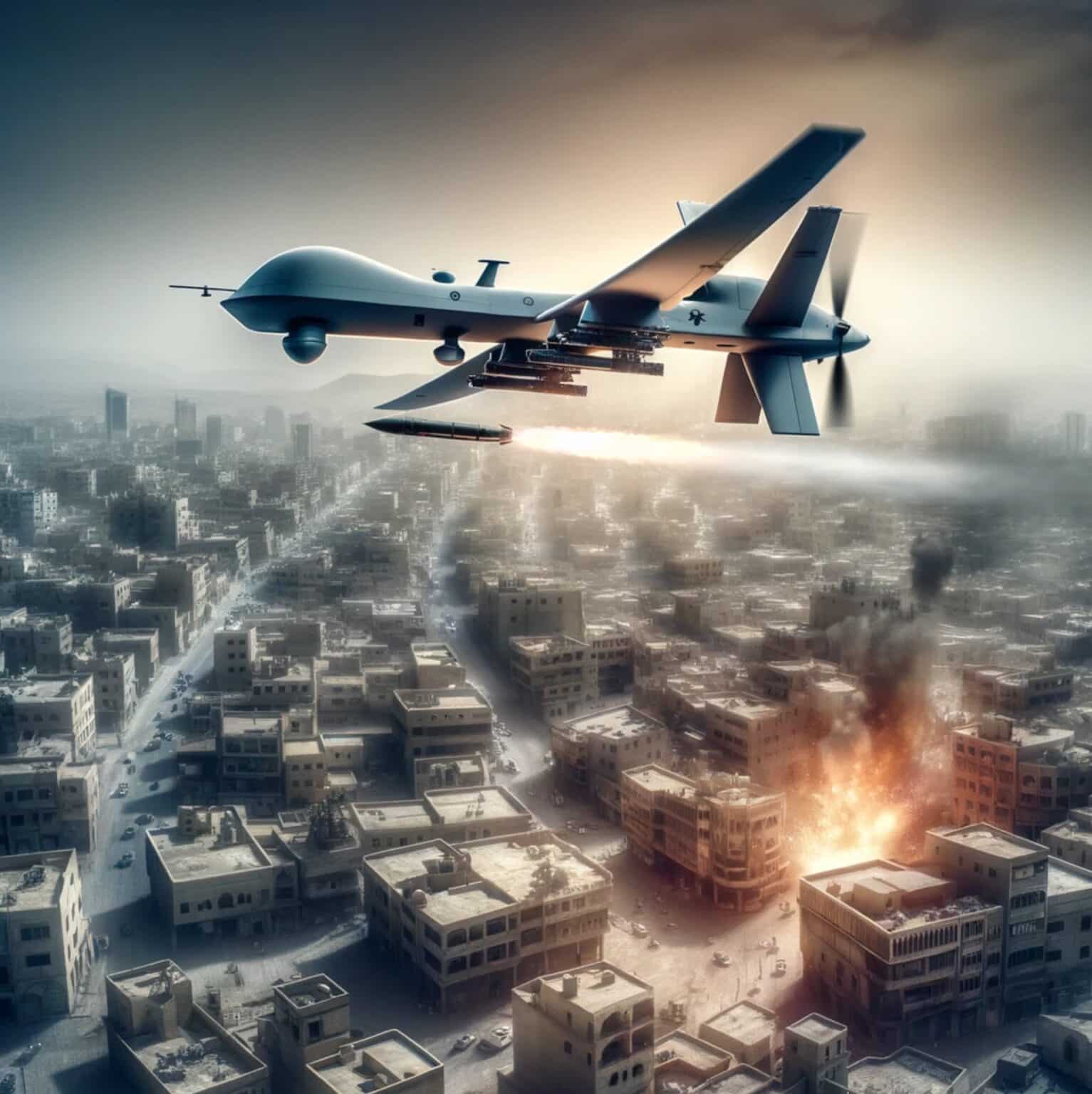
The headlines are practically dripping with manufactured panic. A drone strikes the perimeter of the United Arab Emirates’ Barakah nuclear power plant, a brush fire ignites, and suddenly the collective internet loses its mind, screaming about apocalyptic meltdowns. The mainstream media got exactly what it wanted: clicks driven by raw, unadulterated radiation phobia.
They are asking the wrong question. They are asking, "How do we protect nuclear plants from drones?"
The real question is, "Why are we treating a blackened patch of grass outside a reinforced concrete fortress like a national security crisis?"
Here is the truth that the defense analysts and anti-nuclear lobbyists will not tell you: the incident at Barakah did not expose a vulnerability. It demonstrated absolute, unyielding security. It proved that modern nuclear infrastructure is essentially impervious to the exact types of asymmetrical warfare that cripple traditional energy grids. If you want to disrupt a nation's power, you do not attack a containment dome. You attack everything else.
The Myth of the Vulnerable Reactor
For decades, the public has been conditioned by Hollywood and sensationalist reporting to believe that nuclear power plants are fragile glass castles waiting to shatter. One wrong move, one stray missile, and the whole region becomes an uninhabitable wasteland.
It is a lie.
Modern reactors, specifically the APR-1400 design utilized at Barakah, are built like nuclear bunkers because they are nuclear bunkers. We are talking about concrete containment buildings reinforced with internal steel liners, designed to withstand not just a stray commercial drone carrying a few kilograms of explosives, but the direct impact of a fully fueled commercial airliner traveling at cruising speed.
Let’s look at the mechanics of what actually happened. A drone—likely a low-cost, one-way attack loitering munition—hit the perimeter. It caused a fire. Where? On the ground. Outside the secure facility area.
To cause a radiological release, an attacker has to penetrate meters of reinforced concrete, breach a high-pressure reactor coolant system, and compromise the fuel rods. A perimeter drone strike has as much chance of causing a nuclear meltdown as a firecracker has of demolishing Hoover Dam.
I have spent years analyzing energy infrastructure vulnerabilities. I have watched energy executives pour millions of dollars into redundant physical security barriers while ignoring the actual, glaring weak points in their supply chains. The obsession with a cinematic, explosive attack on a reactor core is a distraction from the real threat vectors.
The Real Target is the Grid, Not the Core
If an adversary actually wants to cripple the UAE’s energy supply, hitting Barakah’s containment structure is the most inefficient strategy on the board.
Why? Because nuclear plants are centralized behemoths with localized, hyper-defended footprints. If you want to take down an energy network, you target the transmission lines, the substations, and the switching stations.
The Fragility of Distribution
- Linear Vulnerability: Transmission lines stretch across thousands of kilometers of open, undefended desert. A single drone dropping a carbon-fiber spool onto a critical junction can short out an entire regional grid.
- Component Scarcity: High-voltage transformers are not sitting in a warehouse waiting to be shipped. They take months—sometimes over a year—to manufacture and replace.
- The Irony of Success: When Barakah automatically safely shuts down or isolates a unit due to external grid instability, the plant worked exactly as designed. The failure is never the nuclear physics; it is the copper wires delivering the power to your air conditioner.
When a strike occurs near a nuclear site, the plant’s automated systems are designed to err on the side of extreme caution. If the grid trips, the reactor trips safely. The media reports this as a "near miss," when in reality, it is the equivalent of your home circuit breaker flipping during a lightning storm. The system did its job.
Dismantling the Panic
Let’s address the inevitable flood of questions that fill internet forums every time a spark flies near a reactor.
Can a drone strike cut off the cooling water to a nuclear plant?
This is the favorite talking point of anti-nuclear NGOs. They point to Fukushima and scream about cooling failure. But they ignore thirty years of engineering evolution. Modern generation III+ reactors utilize passive cooling systems. Imagine a scenario where all external power is completely severed, the operators are gone, and the backup diesel generators are destroyed. A passive system relies on gravity, natural convection, and evaporation. It does not need a human to flip a switch, and it does not need an external water pump to run. It cools itself.
What if a swarm of hundreds of drones attacks simultaneously?
Even if an adversary deployed a coordinated swarm, the physical architecture of the reactor building remains indifferent. Kinetic energy matters. Hundreds of small, low-payload impacts do not accumulate into one massive, armor-piercing blow. They just create a lot of smoke and superficial scorch marks on a concrete structure that is built to survive a literal missile defense failure.
The Dangerous Cost of Over-Regulation
There is a downside to my contrarian view, and it is a pill that the nuclear industry hates to swallow: our own security theater is killing us.
By treating every minor perimeter incident as a existential crisis, the industry plays directly into the hands of its opponents. The regulatory response to these non-events is invariably to demand more administrative paperwork, longer compliance delays, and billions of dollars in unnecessary retrofits for problems that have already been solved by physics.
This regulatory creep drives up the cost of capital. It stretches construction timelines from five years to fifteen. It makes nuclear power appear economically unviable compared to fossil fuels, which routinely explode, leak, and pollute without triggering a fraction of the international press coverage.
We are bankrupting the cleanest source of baseload energy on the planet because we are terrified of blackened grass on a fence line.
Stop Defending the Concrete; Defend the Narrative
The UAE’s response should not be to build a bigger wall or buy another multi-million-dollar air defense system to swat down hobbyist drones. The response should be a cold, calculated shrug.
The architecture worked. The defense-in-depth principles formulated by the International Atomic Energy Agency held firm. The power kept flowing, or the systems shut down safely according to protocol.
The battle is not being fought at the perimeter fence of Barakah. The battle is being fought in the minds of the public, where a minor industrial fire is successfully spun into an existential nightmare. Every time an executive or a politician validates the panic by issuing a trembling press release about "increased security measures," they concede ground to the alarmists.
Nuclear power is not fragile. It is the most resilient, hardened energy technology humans have ever engineered. It is time we started reporting on it like it.