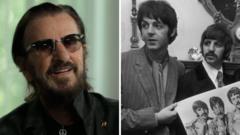
The room smells of history and expensive sage. It is a quiet space, far removed from the screaming winds of 1964, but the man sitting across from the window carries that entire decade in the way he rests his hands on his knees. Ringo Starr is eighty-three years old. He shouldn't be this energetic. He shouldn't be this relevant. Yet, here he is, leaning forward with the conspiratorial grin of a boy who just found the keys to the candy store.
Most people look at a legend and see a statue. They see a fixed point in time, a black-and-white image of a man shaking his mop-top behind a Ludwig kit. But statues don’t breathe. Statues don't decide, six decades into a career, that they want to go back to the dusty trails of Nashville.
The Nashville Ghost in the Machine
We often forget that before the world knew him as the heartbeat of the greatest band in history, Richard Starkey was a boy obsessed with the American South. Not the glamor of Hollywood, but the grit of the guitar strings and the honesty of a steel pedal. Country music wasn't a hobby for him; it was the blueprint.
His latest pivot back to these roots isn't some desperate grab for a new audience. It is a homecoming. He recently teamed up with T Bone Burnett to craft something that feels less like a studio recording and more like a conversation on a porch at dusk. When Ringo talks about this music, his voice loses the practiced sheen of a media veteran. He talks about the "feeling." He talks about the "truth."
Consider a hypothetical listener—let’s call him Sam. Sam is twenty-two, works a job he hates, and thinks the Beatles are something his grandfather played to feel young. Then Sam hears a track from Ringo’s new country project. He doesn't hear a relic. He hears the vibration of a man who has seen the top of the mountain and decided the view is better from the valley floor, where the real stories are told. This is the magic Ringo still wields. He bridge-builds between the mythic past and the messy present.
The Face of the Future
Then there is the matter of the movie.
Hollywood is currently obsessed with its own reflection, and the upcoming Sam Mendes Beatles biopics are the ultimate mirror. Four films. Four perspectives. One story. When the news broke that Barry Keoghan—the man who seems to vibrate with an unsettling, electric intensity in every role he takes—was rumored to be playing Ringo, the internet didn't just react. It exhaled.
Ringo himself seems tickled by the prospect. He doesn't want a caricature. He doesn't want someone to just mimic his Liverpool lilt or the way he holds his sticks. He wants the soul. He sees in Keoghan a fellow traveler, someone who understands that being the "funny one" or the "quiet one" is often a mask for being the one who observes everything.
Imagine the weight on Keoghan’s shoulders. He isn't just playing a drummer. He is playing the glue. Without Ringo, the Beatles were a collection of brilliant, clashing egos that would have burned out in a basement in Hamburg. Ringo was the steady hand on the tiller. He was the one who knew when to play and, more importantly, when to stop. To capture that on film requires more than acting; it requires a deep, spiritual understanding of what it means to support others while maintaining your own light.
The Myth of the Lucky One
There is a persistent, nagging lie that Ringo was just "the lucky guy who joined the right band." It’s a narrative that ignores the sheer technical brilliance of his restraint.
If you listen to the isolated drum tracks of "Rain" or "A Day in the Life," you aren't hearing someone keeping time. You are hearing a composer. Ringo played the drums like a lead instrument, but he did it with the humility of a craftsman. He never played over the song. He played the song.
This philosophy carries over into his life today. He doesn't act like a man burdened by his legacy. He wears it like a well-broken-in denim jacket. He still says "Peace and Love" with a sincerity that makes you feel slightly ashamed of your own cynicism. It’s not a gimmick. It’s a survival strategy. In a world that thrives on outrage and the rapid-fire destruction of icons, Ringo survives by being relentlessly, stubbornly positive.
The Sound of Longevity
He could have stopped in 1970. He could have stopped in 1980. He certainly could have stopped after the world lost John and George. But for Ringo, the music isn't a job you retire from; it’s the heartbeat that keeps the blood moving.
His collaboration with T Bone Burnett is a testament to this. Burnett is a producer who treats sound like an archaeological dig, stripping away the artificial to find the bone and marrow underneath. Putting him with Ringo is a masterstroke. It reminds us that at the core of all this fame, all these billions of streams, and all the historical significance, there is just a man with a stick and a drumhead.
The sticks are lighter now. The stages are different. But the intent is identical.
When you look at Ringo today, you aren't looking at a ghost. You are looking at a roadmap for how to grow old without growing bitter. He still gets excited about a new snare sound. He still cares about who is playing him in a movie. He still believes that a country song can save your soul on a Tuesday afternoon.
The world keeps spinning, faster and louder than ever before. We are buried in noise. We are drowning in the digital scream of "look at me." And there, in the middle of it all, is Ringo. He isn't screaming. He’s just keeping the beat.
Steady.
True.
Waiting for us to catch up to the rhythm he’s been playing all along.