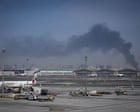
The surge in private aviation pricing within the Dubai corridor is not a byproduct of simple greed but a textbook manifestation of an inelastic supply curve meeting a systemic liquidity event. When a high-net-worth population seeks simultaneous egress from a concentrated geographical point, the traditional charter market undergoes a phase transition from a service industry into a high-stakes auction for finite aluminum and crew hours. To understand why a mid-size jet charter to London or Zurich has spiked from $60,000 to nearly $200,000 in specific windows, one must deconstruct the mechanical bottlenecks of the Gulf aviation ecosystem.
The Three Pillars of Charter Pricing Volatility
Standard market analysis often overlooks the structural rigidities that prevent supply from meeting sudden demand spikes. In Dubai’s current climate, the price floor is dictated by three primary variables:
- Positioning Cost Asymmetry: The most significant hidden cost in private aviation is the "ferry flight." If a localized event triggers a mass departure, aircraft are flown in empty from European or Asian hubs to meet demand. The client pays for the aircraft to arrive, the client’s actual leg, and often the repositioning of that aircraft back to its home base.
- Airport Slot Scarcity and Handling Surcharges: Al Maktoum International (DWC) and Dubai International (DXB) operate under strict slot constraints. During peak exodus periods, the administrative cost of securing a departure window increases, not necessarily through official fees, but through the premium paid to handling agents who can navigate the bureaucratic friction of expedited flight plan filing.
- Crew Duty Limitation Bottlenecks: Aviation safety regulations regarding pilot rest are non-negotiable. As demand intensifies, the pool of locally available crews is exhausted. Bringing in fresh crews involves commercial travel and accommodation costs, which are passed directly to the charterer at a 3x to 5x multiplier during periods of high urgency.
The Cost Function of Urgency
The price of a private jet seat in a crisis is rarely a reflection of the distance flown. Instead, it is a function of the Opportunity Cost of the Tail. For a charter operator, committing a tail (an aircraft) to a Dubai-to-Europe route during a period of high volatility means they are forgoing other potentially more lucrative or operationally efficient contracts.
$Price = (O_c + F_v + M_r) \times U_f$
In this model:
- $O_c$ represents the Operational Base Cost (Fuel, Crew, Maintenance).
- $F_v$ represents the Ferry Value (the cost to get the plane to the origin).
- $M_r$ represents the Market Risk Premium (hedging against potential groundings or delays).
- $U_f$ represents the Urgency Factor, a multiplier that scales based on the lead time between booking and takeoff.
When lead times drop below 24 hours, the $U_f$ often exceeds 2.5. This isn't just "surge pricing" in the style of ride-sharing apps; it is the price of manual intervention required to disrupt existing flight schedules, negotiate with ground handlers, and bypass standard fueling queues.
The Geopolitical Risk Premium
Dubai occupies a unique position as a global "safe haven" that occasionally experiences rapid shifts in its regional risk profile. The current scramble to leave is driven by a recalibration of personal and corporate risk. For the ultra-wealthy, the private jet is not a luxury; it is a vital component of a Physical Liquidity Strategy.
High-net-worth individuals (HNWIs) maintain portfolios that are often geographically diversified, but their physical presence is a point of vulnerability. When regional tensions or regulatory shifts occur, the ability to convert cash into immediate physical relocation is the ultimate hedge. The "scramble" is actually a rational economic response to a perceived increase in the "Cost of Staying." If the perceived risk of remaining in the jurisdiction exceeds the $150,000 premium for a Gulfstream G650 departure, the rational actor pays the premium every time.
Why Fractional Ownership Fails in a Crisis
Many investors believe that fractional ownership or "jet cards" provide a guaranteed exit strategy. This is a common misconception. Most fractional contracts include "Peak Day" clauses and "Force Majeure" exemptions. In a localized mass-departure event, the "guaranteed" 10-hour response time often stretches to 48 or 72 hours as the fleet is stretched thin.
The only parties with true physical liquidity are those with Whole Aircraft Ownership and a dedicated crew on standby. Even then, they are subject to the same air traffic control (ATC) and slot limitations as the charter market. The "wealthy" are not a monolith; there is a clear hierarchy of egress capability:
- Tier 1: Whole Ownership: Maximum control, subject only to sovereign airspace restrictions.
- Tier 2: Managed Charter: High priority, but subject to tail availability.
- Tier 3: On-Demand Charter: The most vulnerable to price spikes, as they are essentially "spot market" buyers in a supply-starved environment.
Operational Friction and the Logistics of the Empty Leg
A "deadhead" or "empty leg" flight usually represents a discount opportunity for savvy travelers. However, during a Dubai exodus, the flow is strictly unidirectional. Flights arriving in Dubai are empty; flights leaving are at maximum capacity. This creates a massive logistical imbalance. Operators cannot offset the cost of the inbound flight with a paying passenger, because no one is flying into the zone of perceived risk.
This imbalance forces the departing passenger to subsidize the entire round-trip of the aircraft. When you see a price quote that looks "insane," it is almost certainly because you are paying for the aircraft to fly 14 hours (7 hours in, 7 hours out) even though you are only on board for half of that duration.
Strategic Infrastructure Constraints
The physical limits of the FBOs (Fixed Base Operators) at DWC and DXB create a hard ceiling on how many people can leave per hour. Even if 500 people are willing to pay $1,000,000 each for a flight, the number of "hangar starts" and "pushbacks" is limited by ground crew availability and runway throughput.
The bottleneck moves through the system in stages:
- Stage 1: The Booking Bottleneck: Brokers are overwhelmed; phone lines and digital platforms lag.
- Stage 2: The Tail Bottleneck: Physical aircraft are simply not in the region.
- Stage 3: The Slot Bottleneck: The aircraft is on the tarmac, but the civil aviation authority cannot grant a departure window due to traffic density.
- Stage 4: The Fueling/De-icing Bottleneck: While de-icing isn't an issue in Dubai, the "fueling queue" becomes a significant factor when 40 aircraft all require 20,000+ gallons of Jet A-1 simultaneously.
The Breakdown of the Broker-Client Relationship
In a normal market, a charter broker acts as a fiduciary for the client, searching for the best value. In a scramble, the broker’s role shifts to that of a Securing Agent. The priority is no longer "the best price," but "the first firm tail." Contracts are often signed and wired in full within minutes to prevent the aircraft from being snatched by another broker representing a different client. This environment removes all negotiating leverage from the buyer, leading to the rapid price escalation observed in the Dubai-to-Western-Europe corridor.
Long-Term Market Distortions
These localized price spikes have a "haloing" effect on the broader private aviation market. When tails are pulled from the Mediterranean or Southeast Asia to service high-premium Dubai departures, supply drops in those regions, causing secondary price increases globally. This is the Contagion of Scarcity. Operators will chase the highest margin, and currently, the highest margin is found in the urgency of a Dubai exit.
The current pricing is not a new permanent floor, but it does expose the fragility of the "Global Citizen" lifestyle. The assumption of 24/7 global mobility is predicated on a surplus of aviation capacity that does not exist during a localized crisis.
Strategic Play: The Liquidity Audit
For individuals and firms operating in high-volatility regions like the UAE, the strategic move is not to seek "cheaper" charter options, but to conduct a Vertical Mobility Audit. Relying on the spot market for emergency relocation is a failing strategy.
- Diversify Aircraft Access: Do not rely on a single broker or a single jet card. Maintain active accounts with at least three operators who have different "home bases" (e.g., one in Europe, one in the Middle East, one in Asia).
- Pre-Funded Escrow: In a crisis, the delay is often in the banking wire. Having funds already sitting in an FBO or broker’s escrow account can shave 6 hours off a departure time, which is often the difference between getting a slot and being grounded for 24 hours.
- Secondary Port Egress: Analyze the feasibility of ground transport to smaller, less-congested airfields in neighboring emirates or even neighboring countries (Oman), where slot competition is less fierce, even if the "luxury" of the FBO is diminished.
The "soaring prices" are a signal that the market is working exactly as it should—rationing a limited resource to those who value it most in a moment of crisis. The only way to win is to stop playing in the spot market and move toward a strategy of pre-arranged physical liquidity.