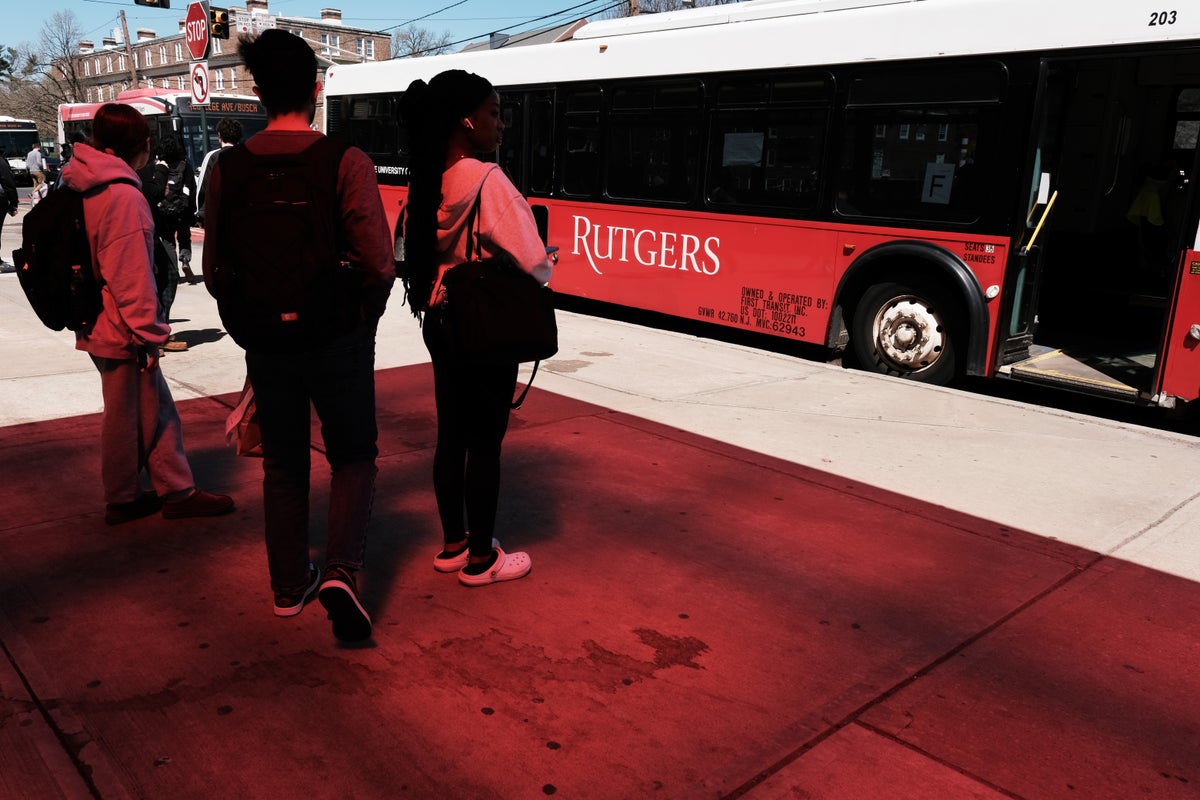
The velvet curtain of a university commencement is supposed to be a thick, comforting weight. It represents the end of the grind—the caffeine-fueled nights, the debt-induced anxiety, and the relentless pursuit of a piece of paper that promises a future. But at Rutgers University, that curtain recently snagged on a jagged edge of political reality.
Adiba Al-Mazrouei, a high-achieving student leader chosen to represent her peers, found herself standing in the middle of a vanishing act. One moment, she was the voice of her graduating class. The next, she was a liability to be managed. The university’s decision to withdraw her invitation to speak didn't just silence one woman; it sent a shiver through the very concept of the academic sanctuary. If you liked this piece, you should read: this related article.
The Weight of a Canceled Invitation
Think of a commencement stage. It is a physical manifestation of an institution’s values. When a speaker is invited, the university is saying: This person reflects who we are. When that invitation is yanked back weeks before the ceremony, the message changes. Now, the university is saying: We are afraid of who you might be.
Rutgers officials pointed to Al-Mazrouei’s public social media posts and her vocal criticism of Israel as the catalyst. They cited "safety concerns" and the potential for "disruption." These are the sterilized words of administrative caution. They are the linguistic equivalent of beige paint—designed to cover up the messy, vibrant, and often painful reality of human disagreement. For another look on this development, refer to the recent update from USA Today.
Consider a hypothetical student, let's call him Leo. Leo is a first-generation graduate. He doesn't care much for international politics; he’s mostly worried about his looming student loan payments and whether his parents will find parking near the stadium. But when he hears that his classmate—someone he’s seen in the library for four years—has been barred from the stage, the atmosphere of his celebration shifts. The air feels thinner. He realizes that the "freedom of expression" he was taught in Political Science 101 has a very specific, very invisible boundary.
The Invisible Boundary of Free Speech
The irony of a university—a place built on the friction of competing ideas—shutting down a speaker is never lost on the students. It creates a vacuum. In that vacuum, resentment grows.
Rutgers isn't an isolated island. It is part of a growing archipelago of institutions that are struggling to navigate the intense emotional currents of the Middle East conflict. The facts are straightforward: Al-Mazrouei was selected by a committee. Her record was exemplary. Then, external pressure began to mount. Donors whispered. Advocacy groups campaigned. The administration, caught between the fire of student activism and the ice of institutional preservation, chose the path of least resistance.
But the path of least resistance is rarely the path of integrity.
When we talk about "safety" in an academic setting, we are often talking about two different things. There is physical safety—the protection of bodies from harm. Then there is "intellectual safety"—the protection of minds from discomfort. By conflating the two, Rutgers didn't just protect the ceremony from a potential protest; they insulated it from a difficult conversation. They traded a moment of possible tension for a permanent atmosphere of distrust.
The Cost of the Quiet
Imagine the preparation that goes into a commencement speech. You labor over every syllable. You want to capture the collective exhaustion and the soaring hope of thousands of people. You want to mention the late-night diner runs and the professor who finally made sense of organic chemistry.
Al-Mazrouei’s speech was never given a chance to be heard, judged, or even ignored. It was deleted before it was ever spoken. This is the "hidden cost" of the withdrawal. It’s not just about the one person who lost their platform; it’s about the thousands of others who now know exactly where the tripwires are buried.
Students learn quickly. They see which topics lead to awards and which lead to the principal’s office. If the goal of higher education is to produce bold thinkers, Rutgers effectively gave a masterclass in how to be quiet.
A Pattern of Institutional Panic
This isn't just about Rutgers. It’s about a systemic failure of nerve. Across the country, commencement season has become a minefield. We’ve seen it at USC, at Columbia, and now in the New Brunswick suburbs. Each time an administration pulls the plug on a speaker due to controversial views, they are admitting that their community is too fragile to handle words.
It is a strange admission for a university to make.
If four years of rigorous education cannot prepare a young adult to listen to a ten-minute speech by someone they disagree with, then what was the point of the education? If the fear is that the speaker will say something "hateful," then the solution in a free society is more speech, not less. It is the rebuttal. It is the debate. It is the collective groan of a crowd that finds a statement distasteful.
By removing the speaker entirely, the university took away the students' agency to decide for themselves. They treated their graduates like children who needed to be shielded from the sun, rather than adults about to enter a world that is defined by its heat.
The Human Echo
Back to Al-Mazrouei. She isn't a "topic." She isn't a "controversy." She is a person who worked hard, earned her spot, and then watched as the institution she represented decided she was too much of a risk.
There is a specific kind of hurt that comes from being told you are a "safety concern." It implies that your very existence, or at least your perspective, is a threat to the peace. It’s a heavy label for a student to carry into their professional life.
The university’s defense—that they were protecting the sanctity of the event—falls flat when you realize that the event was already tainted the moment the "un-invitation" was sent. You cannot have a celebration of achievement that is predicated on the exclusion of a peer for their political beliefs. It turns the graduation gown into a uniform of conformity.
Beyond the Podium
What happens when the music stops and the folding chairs are packed away? The headlines will fade. Rutgers will move on to the next fiscal year. But the precedent remains.
We are living through a period where the "common ground" is being strip-mined. Universities were supposed to be the last holdouts, the places where you could stand on a soapbox and say something that made people angry, and yet still walk across the stage to shake the dean’s hand.
When that handshake is withheld, we lose something more valuable than a peaceful ceremony. We lose the "muscle memory" of democracy. Democracy is loud. It is messy. It is often deeply offensive to someone, somewhere. If we can't practice it at a university graduation, where on earth can we?
The empty podium at Rutgers wasn't just a space where a student should have stood. It was a mirror. It reflected a society that is increasingly terrified of its own shadow, an institution that prioritizes PR over principle, and a generation of students who are learning that the most important thing they can do with their voice is to keep it lowered.
The silence that followed the withdrawal of Adiba Al-Mazrouei’s invitation wasn't the silence of peace. It was the silence of a missed opportunity. It was the sound of a door clicking shut on the way out.
The tassels will still be flipped. The hats will still be tossed into the air. But as those caps fall back to earth, they land on a campus that feels a little smaller, a little colder, and a lot more guarded than it was when these students first arrived as freshmen, full of the dangerous, beautiful idea that their voices actually mattered.