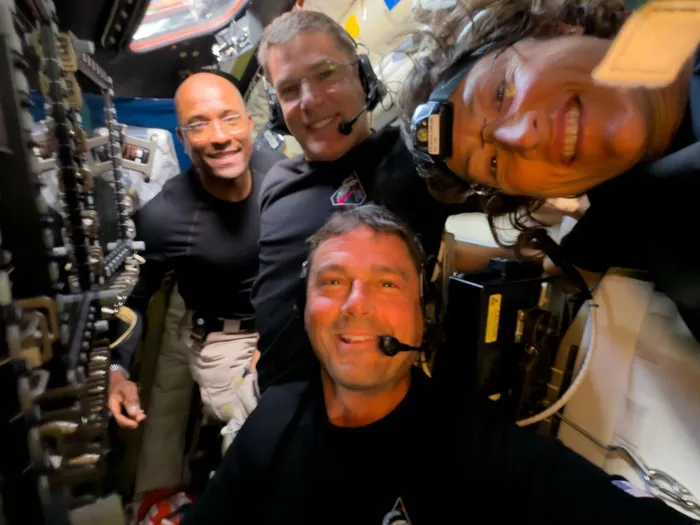
The vibration begins not in the ears, but in the marrow. It is a violent, shuddering frequency that suggests the laws of physics are being rewritten by sheer force of will. Inside the Orion capsule, four humans are strapped into seats that feel increasingly like thin rafts on a very angry ocean. Reid Wiseman, Victor Glover, Christina Koch, and Jeremy Hansen are no longer just pilots or scientists. They are the sensory organs of an entire species, feeling the kick of the solid rocket boosters as they claw through the thick, resisting soup of Earth's atmosphere.
Artemis II is a triumph of engineering, certainly. We can talk about the 8.8 million pounds of thrust or the heat shield that must endure 5,000 degrees Fahrenheit upon its return. But those are just numbers. The real story is the silence that follows the roar. It is the moment the engines cut out and the crew finds themselves suspended in a void so absolute it defies the vocabulary of the terrestrial mind.
They didn’t land. That wasn't the mission. They swung around the far side of the lunar surface, staring down at a monochromatic wilderness of craters and ancient dust. For a few hours, they were the most isolated humans in existence, shielded from the sun’s glare by the moon itself, staring into a darkness that hasn't changed since the dawn of time. They proved that we can go back. They proved that the hardware works and the human spirit hasn't withered in the fifty years since we last walked those gray plains.
Then they came home. The parachutes blossomed over the Pacific, the capsule bobbed in the waves, and the world cheered. The mission was a success.
Now, the cheering has faded. The ticker-tape has been swept up. And we are left with the crushing weight of what comes next.
The Tyranny of the Schedule
To understand the pressure currently mounting within the hallways of NASA and its private partners, you have to look past the press releases. Imagine a master watchmaker trying to assemble a movement where every gear is manufactured by a different company, in a different state, using different tools, while the workbench itself is hurtling through space at seventeen thousand miles per hour.
Artemis III is the goal. The landing. The moment a human boot—likely belonging to the first woman to ever touch the lunar surface—presses into the regolith. But between the success of Artemis II and the reality of Artemis III lies a chasm of logistical and technical nightmares that would make a seasoned general weep.
The problem is no longer about whether we can fly. It is about whether we can build the infrastructure of a permanent presence. Artemis II was a sprint; Artemis III and everything beyond it is a grueling, multi-generational marathon. The stakes have shifted from "Can we get there and back?" to "Can we stay without dying?"
Consider the SpaceX Starship. It is the designated HLS—Human Landing System. In the current architecture, the Orion capsule doesn't actually land on the moon. It’s too heavy, too specialized. Instead, it must dock with a version of Starship that is already waiting in lunar orbit.
But Starship doesn't just show up in lunar orbit. To get there, it requires a feat of orbital gymnastics never before attempted. It needs to be refueled in Earth's orbit. Not once. Not twice. Some estimates suggest it will take ten to fifteen separate "tanker" launches of Starship just to fill the tanks of the one vessel heading to the moon. We are talking about a gas station in the sky that doesn't exist yet, using technology that is still being tested in the fiery trials of south Texas.
If a single one of those tanker launches fails, the schedule slips. If the docking mechanism has a software glitch, the mission stalls. The margin for error has shrunk to the width of a human hair.
The Ghost in the Suit
There is a specific kind of fear that comes with being an engineer at Axiom Space right now. They are the ones tasked with building the next generation of lunar spacesuits. You might think of a spacesuit as a heavy jacket. It isn't. It is a person-shaped spacecraft. It has to manage pressure, provide oxygen, scrub carbon dioxide, maintain temperature, and protect against the jagged, glass-like shards of lunar dust that want to shred seals and lungs alike.
The Apollo suits were masterpieces, but they were designed for short bursts of activity. They were stiff, uncomfortable, and limited. For the Artemis missions, the requirements are different. These astronauts won't just be planting a flag and hitting a golf ball. They will be working. They will be venturing into the permanently shadowed regions of the lunar South Pole—craters where the sun hasn't shone in billions of years.
In these shadows, the temperature drops to levels that make the deep Antarctic feel like a tropical beach. We are talking about -400 degrees Fahrenheit. Metals become brittle. Lubricants freeze solid. Electronics die.
Imagine being the person responsible for the glove. It has to be thin enough for an astronaut to pick up a rock or operate a camera, yet insulated enough to keep their fingers from shattering like glass in the lunar night. This isn't just a design challenge. It is a moral one. If that glove fails, the person inside it dies in a way that is too horrific to describe in a government briefing.
This is the "hard part" people mention in passing. It’s the invisible work. The thousands of hours spent testing a single seam in a vacuum chamber. The frantic redesigns when a test fails. The quiet realization that we are asking machines to operate in an environment that hates them.
The Human Toll of the Long Wait
Technicians and flight controllers are humans, too. They have families. They have mortgages. They have limits. The Artemis program has been marked by a "go-fever" that is constantly tempered by the reality of safety. When a launch is delayed, it isn't just a line on a spreadsheet. It is a crushing blow to the morale of thousands of people who have spent years of their lives preparing for that window.
There is a psychological weight to the moon. It sits there every night, mocking the progress of the people on the ground. During the Apollo era, there was a clear enemy: the Soviet Union. There was a clear deadline: the end of the decade. Today, the "enemy" is far more insidious. It is budget cycles. It is shifting political priorities. It is the creeping feeling of "Why are we doing this again?"
The answer to that "why" is the emotional core of the entire endeavor. We aren't going back to the moon because it’s easy, or because there are riches to be found in the dust. We are going because we are a species of voyagers who have forgotten how to look up.
Artemis II gave us a glimpse of our own potential. It showed us the Earth rising over the lunar horizon—a fragile, blue marble that contains everyone we have ever loved. It reminded us that we are capable of extraordinary things when we stop bickering over the trivial.
But the "hard part" is keeping that flame alive when the missions aren't happening. It’s the years of quiet development, the setbacks, and the grueling work of building a gateway to the stars. It is the transition from being a visitor to being a resident.
The Fragility of the Gateway
NASA is also planning the Gateway—a small space station that will orbit the moon. It is meant to be a waystation, a place for astronauts to live and work before descending to the surface. It is a brilliant concept, but it adds another layer of complexity to an already precarious tower of cards.
Every piece of the Gateway must be launched, docked, and maintained. It requires autonomous systems that can keep the station running when no one is aboard. It requires a level of international cooperation that feels increasingly fragile in our current geopolitical climate.
We are building a bridge to the future using materials and political will that are constantly under threat.
The transition from the triumph of Artemis II to the reality of Artemis III is like the moment a mountain climber reaches a false peak. You’ve worked so hard, you’ve climbed so high, and for a second, you think you’ve made it. Then the clouds clear, and you see the true summit—steeper, colder, and further away than you ever imagined.
You don't turn back. You can't. Not after you've seen the view. But you do have to tighten your harness. You have to check your oxygen. You have to look at your teammates and realize that the only way to reach that peak is through a level of discipline and sacrifice that most people will never understand.
The Dust and the Dream
There is a specific sound that lunar dust makes when it hits a surface—a dry, raspy hiss. It is the sound of the moon’s ancient, stagnant history. Soon, that hiss will be accompanied by the sound of human breathing inside a helmet.
The hard part isn't the rocket. It isn't the fire. It isn't even the distance.
The hard part is the persistence. It is the willingness to fail, to iterate, and to try again when the world is looking the other way. It is the thousands of anonymous men and women who are currently staring at CAD drawings and thermal models, knowing that their work will determine whether those four seats in the next capsule are a chariot to a new era or a tombstone for a dream.
The moon is waiting. It doesn't care about our schedules. It doesn't care about our budgets. It sits in the blackness, a cold, indifferent witness to our ambition.
We’ve proven we can reach out and touch it. Now we have to prove we are brave enough to hold on.
The roar of Artemis II was the beginning. The silence that follows is where the real work begins. It is in that silence that the future is being built, one bolt, one line of code, and one heartbeat at a time. The seat is empty for now, but the dust is already stirred.
The shadow of the next mission is already stretching across the lunar plains, waiting for the first light of a new sunrise.