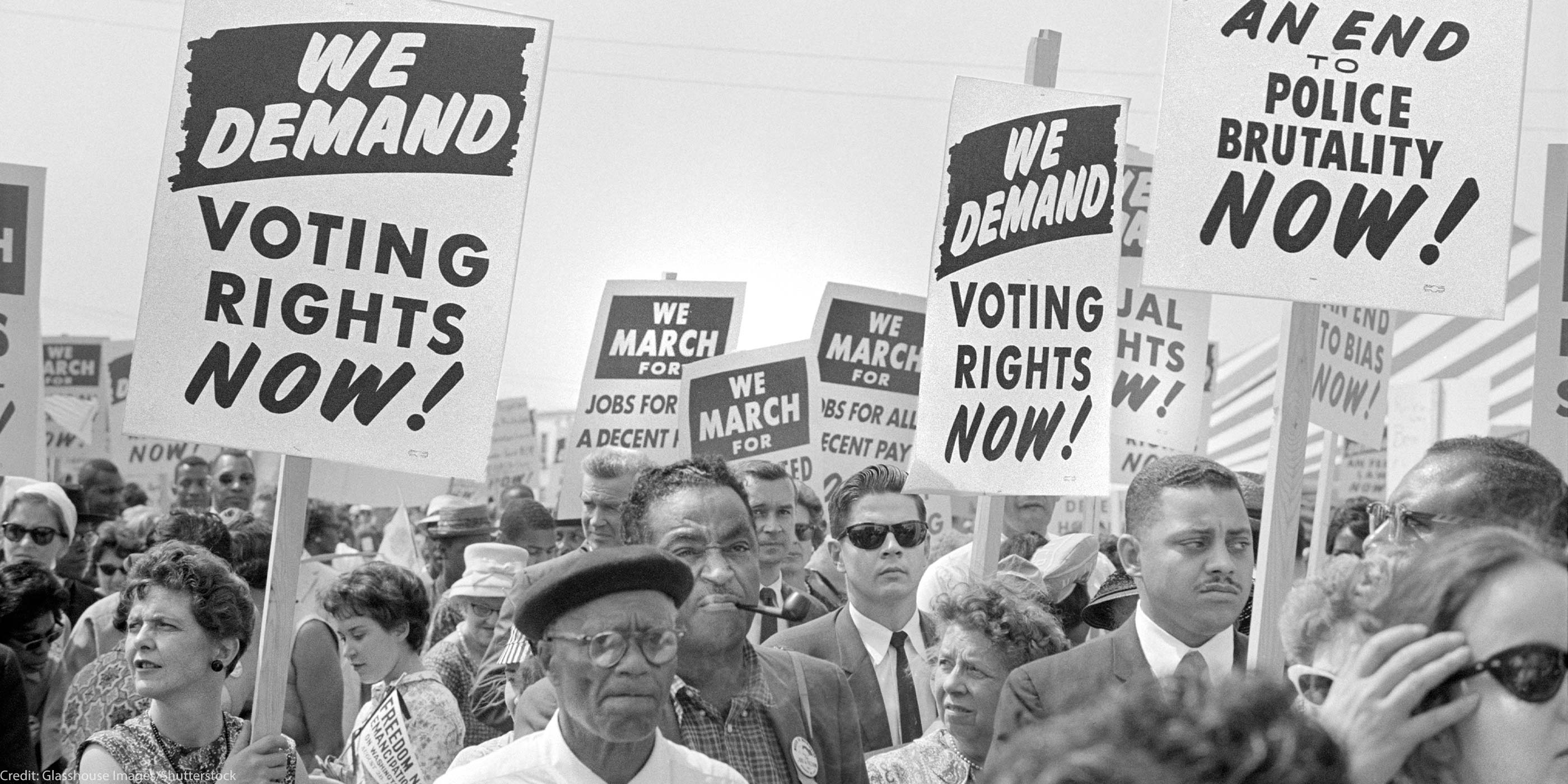
The Voting Rights Act of 1965 did not die in a single afternoon. It has been dismantled piece by piece over two decades through a series of surgical strikes by the Roberts Court. While activists point to a "wrecking ball" approach, the reality is more akin to a controlled demolition of the legal infrastructure that once protected minority voters from local suppression. The primary mechanism of this shift is the systematic removal of federal oversight, effectively returning the United States to a pre-1965 era where the burden of proof rests entirely on the disenfranchised rather than the state.
At the heart of this transformation is the gutting of Section 5. This provision required jurisdictions with a history of discrimination to "pre-clear" changes to voting laws with the Department of Justice. Without it, the federal government lost its most effective early-warning system. Today, the map of American democracy is being redrawn in statehouses where local officials no longer fear a federal veto.
The Shelby County Fault Line
The 2013 decision in Shelby County v. Holder changed everything. Chief Justice John Roberts argued that the "coverage formula" used to determine which states needed oversight was based on forty-year-old data and no longer reflected the reality of a modern, post-racial South. He famously noted that "history did not stop in 1965," suggesting that the very success of the Voting Rights Act (VRA) had rendered its most potent sections obsolete.
It was a bold gamble on the better angels of local politics. The results were almost instantaneous. Within hours of the Shelby County ruling, Texas officials announced they would implement a strict voter ID law that had previously been blocked by federal judges. Other states followed suit with aggressive purges of voter rolls and the closing of polling places in predominantly minority neighborhoods. The "wrecking ball" wasn't just a metaphor; it was a legislative reality that reshaped the electorate in the lead-up to the 2016 and 2020 elections.
The loss of pre-clearance shifted the entire legal burden. Under the old system, a state had to prove a new law wasn't discriminatory before it could be enacted. Now, civil rights groups must sue after a law is passed. These lawsuits are expensive, take years to litigate, and often conclude long after the contested election has already taken place. By the time a court finds a map or a law unconstitutional, the damage to the democratic process is often irreversible.
Brnovich and the New Standard of Hardship
If Shelby County removed the shield, the 2021 decision in Brnovich v. DNC sharpened the sword. This case focused on Section 2 of the VRA, which prohibits any law that "results in a denial or abridgement of the right of any citizen... to vote on account of race or color."
The Court's conservative majority introduced a new set of "guideposts" that make it significantly harder to win a Section 2 challenge. Justice Samuel Alito’s opinion suggested that "mere inconvenience" is not enough to constitute a violation. He argued that the degree of burden must be compared to the voting practices that existed in 1982, when Section 2 was last amended. This "time-machine" standard ignores the evolution of suppressive tactics. It suggests that if a voting restriction was common forty years ago, it is likely constitutional today, regardless of its modern impact on minority communities.
This reasoning creates a high bar for plaintiffs. They must now prove that a law creates a disparate impact so severe that it outweighs the state’s stated interest in "preventing fraud," even if that fraud is statistically non-existent. It is a legal sleight of hand. By elevating "state interest" above "voter access," the Court has signaled that administrative preference can trump constitutional protections.
The Secret Life of Racial Gerrymandering
While the headlines focus on ID laws and ballot boxes, the real battle for power is fought in the drawing of district lines. Redistricting is the ultimate tool of incumbency. In the Alexander v. South Carolina State Conference of the NAACP (2024) decision, the Court further insulated legislatures from scrutiny by making it nearly impossible to distinguish between "racial gerrymandering" (which is illegal) and "partisan gerrymandering" (which the Court says it cannot regulate).
The Court now requires plaintiffs to provide an alternative map that proves the legislature could have achieved its partisan goals without using race as a proxy. This is an immense evidentiary burden. It assumes that race and party affiliation in the American South are not deeply intertwined, a premise that most political scientists find laughable. By allowing states to hide racial data behind partisan labels, the Court has provided a roadmap for diluting minority voting power under the guise of simple politics.
[Image showing the difference between 'packing' and 'cracking' in redistricting]
The Myth of the Neutral Umpire
John Roberts famously compared his role to that of a baseball umpire during his confirmation hearing. He claimed his job was simply to "call balls and strikes." However, the strike zone for voting rights has narrowed to the point of invisibility. The Court’s current trajectory suggests a fundamental distrust of federal intervention in state affairs, a philosophy known as "new federalism."
This philosophy views the VRA not as a vital protection of a fundamental right, but as an intrusion on state sovereignty. To the current majority, the "sovereign dignity" of the states is a paramount concern. This creates a paradox. If the state is the primary arbiter of its own elections, and the state legislature is the body that benefits from restricted access, who is left to protect the voter? The umpire has effectively decided that the home team gets to write its own rulebook.
The Practical Consequences on the Ground
The erosion of the VRA is not just a matter of high-court philosophy; it has concrete, measurable effects on who gets to participate in democracy.
- Polling Place Closures: Since 2013, thousands of polling sites have been shuttered across the South. These closures are disproportionately concentrated in fast-growing minority precincts.
- Voter Roll Purges: States have become more aggressive in removing "inactive" voters. Often, these voters only discover they have been purged when they show up to vote on Election Day.
- Mail-in Ballot Restrictions: New laws targeting drop boxes and signature requirements have added layers of bureaucracy that discourage elderly and low-income voters.
These are not "wrecking ball" hits that level the building. They are termites in the foundation. Each individual law might seem minor, but collectively, they create a cumulative burden that tilts the playing field. In a country where elections are often decided by a few thousand votes in a handful of counties, these "minor" inconveniences are the difference between victory and defeat.
The Collapse of the Bipartisan Consensus
There was a time when the Voting Rights Act was the crown jewel of American consensus. In 2006, the VRA reauthorization passed the Senate 98-0 and was signed into law by George W. Bush. That world is gone. Today, voting rights are a strictly partisan issue. The Court’s decisions reflect this polarization, often falling along predictable ideological lines.
This shift has neutralized Congress. While the John Lewis Voting Rights Advancement Act sits stalled in the Senate, the Court continues to prune the existing law. Without a legislative update to the coverage formula, Section 5 remains a "dead letter." The Court has effectively told Congress to fix the law, knowing full well that the current political climate makes such a fix impossible. It is a cynical loop of accountability.
The Doctrine of Purcell and the Shadow Docket
One of the most overlooked tools in the Court’s arsenal is the Purcell principle. This doctrine suggests that federal courts should not change election rules close to an election because it might "confuse" voters. In practice, the Court has used this to stay lower-court rulings that found laws to be discriminatory.
If a lower court finds a map is unconstitutional in July, the Supreme Court can use the "shadow docket"—unsigned, unexplained emergency orders—to keep that map in place for the November election. The "confusion" of the voter is prioritized over the "disenfranchisement" of the voter. This creates a situation where a discriminatory law can remain in effect for an entire election cycle simply because the clock ran out.
The Strategy of Incrementalism
The Roberts Court rarely swings for the fences. Instead, it relies on incrementalism. By chipping away at definitions and raising evidentiary bars, the Court avoids the public outcry that would follow a total repeal of the VRA. It keeps the name of the law while hollowing out its substance.
This approach is more dangerous than a direct assault. A direct assault invites a direct response. Incrementalism breeds exhaustion and confusion. It allows the Court to maintain a veneer of institutional stability while fundamentally altering the power dynamics of the country. The "wrecking ball" didn't hit the front door; it took out the support beams in the basement while the lights were still on.
The Cost of Silence
The true legacy of this era will not be the laws that were passed, but the voices that were silenced. When it becomes harder to vote, people stop trying. When districts are drawn so that the outcome is a foregone conclusion, people lose faith in the utility of the ballot. The Court’s decisions are contributing to a profound sense of democratic backsliding.
We are witnessing the emergence of a "tiered democracy." In some states, voting is a seamless, encouraged act of citizenship. In others, it is an obstacle course designed to test the endurance of the marginalized. The Supreme Court has decided that this disparity is not a constitutional problem, but a feature of federalism.
The path forward requires more than just legal challenges. It requires a fundamental reckoning with the idea that the right to vote is not a gift from the state, but the very source of the state's legitimacy. If the legal architecture meant to protect that right is being dismantled, the burden falls back on the people to rebuild it through sheer, persistent participation. The Court has made its move. Now, the remaining fragments of the VRA depend entirely on the resilience of those it was meant to protect.



