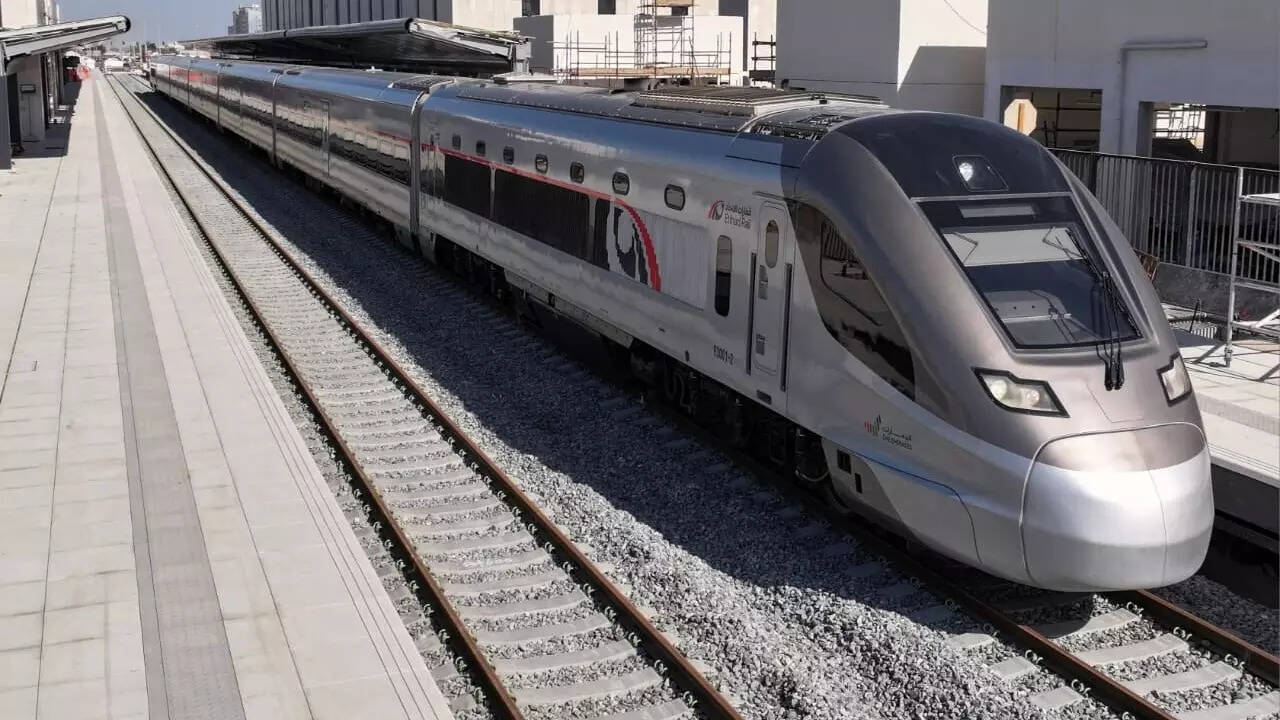
The recent arrival of three exceptional Etihad Rail passenger services carrying residents from the Saudi border into the heart of the UAE is more than a transit milestone. It is a proof of concept for a geopolitical shift that has been decades in the making. While the headlines focused on the convenience for travelers, the real story lies in the massive infrastructure gamble designed to decouple the Gulf’s internal trade from the constraints of asphalt and rubber. For the first time, we are seeing the physical manifestation of the GCC Railway Network, a project that critics once dismissed as an expensive desert mirage.
These initial journeys serve as a high-stakes stress test. By moving people across the Ghuwaifat border via rail, the UAE is auditing its own customs integration, security protocols, and track durability under the weight of real-world expectations. It is a soft launch for a hard reality: the era of the long-haul truck as the sole king of the desert is nearing its end.
The Engineering Reality Behind the Rail
Building a heavy-haul railway through some of the most shifting sands on the planet requires more than just laying steel. It requires an aggressive battle against the elements. The UAE’s rail network utilizes sophisticated sand mitigation technology, including specialized embankments and GPS-monitored sensors that track dune movement in real-time. If the sand covers the tracks, the system stalls. If the system stalls, the economic justification for the multibillion-dollar investment evaporates.
The three trains that recently crossed from the Saudi border operated on a track designed to handle extreme temperature fluctuations. Steel expands in the midday heat and contracts in the desert chill. Engineers have utilized continuous welded rails to minimize the "clickety-clack" noise and, more importantly, to reduce the wear and tear caused by thermal stress. This isn't just about comfort for the residents returning home. It is about the long-term viability of a corridor that must eventually carry millions of tons of freight alongside human passengers.
Why the Saudi Border Connection Matters
The Ghuwaifat connection is the pulse point of UAE-Saudi trade. Traditionally, this border has been a bottleneck. Hundreds of trucks sit idling for hours, burning fuel and wasting time as they navigate manual inspections and paperwork. Etihad Rail’s entry into this space promises to bypass the gridlock.
One single freight train can remove up to 300 trucks from the road.
By successfully moving passengers across this threshold, the authorities are proving that the digital clearing systems are ready. These residents weren't just passengers; they were data points in a new system of automated border control. The goal is a "frictionless" border where biometric data and pre-cleared manifests allow trains to cross at speed, something that is currently impossible for the convoys of heavy vehicles clogging the E11 highway.
The Economic Weight of the Steel Ribbon
The UAE is not building this network out of a sudden love for locomotives. This is a cold, calculated move to diversify the national economy. Logistics currently accounts for a significant portion of the UAE's non-oil GDP. By linking the Port of Fujairah on the east coast to the industrial hubs of Abu Dhabi and the border of Saudi Arabia, the UAE is creating a land-bridge that avoids the volatile Strait of Hormuz.
Comparative Efficiency of Rail vs Road
| Feature | Heavy Trucking | Etihad Rail |
|---|---|---|
| Capacity | 1-2 TEU (Containers) | Up to 100+ TEU per trip |
| Fuel Efficiency | Lower per ton | 75% to 80% more efficient |
| Labor | 1 driver per truck | 1-2 crew per 100 containers |
| Predictability | High (subject to traffic) | Very High (fixed schedules) |
The table above illustrates why the business community is watching these "exceptional" passenger trips so closely. If the rail can move people reliably, it can move semiconductors, cold-chain pharmaceuticals, and construction materials with the same precision.
Overlooked Obstacles and the Maintenance Debt
Every veteran analyst knows that building the track is the easy part. Maintaining it is the nightmare. The salt-heavy air of the Gulf is a silent killer of machinery. Corrosion in this region happens at an accelerated rate compared to European or North American networks. Etihad Rail has to contend with "aggressive" soil chemistry that can eat through concrete sleepers if they aren't treated with specific chemical coatings.
There is also the question of interoperability. For a truly seamless GCC-wide network, the signaling systems in Saudi Arabia, Oman, and the UAE must speak the same language. Currently, the region uses the European Train Control System (ETCS) Level 2. While this is a gold standard, any deviation in software versions at the border can lead to hardware standing still. The success of these three trains suggests that the technical handshake between the UAE and Saudi rail authorities is finally holding firm.
The Human Element and Urban Shifts
For the residents who took these trains, the experience was likely a novelty. But for the urban planners in Abu Dhabi and Dubai, it represents a shift in how the country will be inhabited. Rail connectivity allows for the "de-densification" of city centers. If you can reach the Saudi border or the western region of Al Dhafra in a fraction of the time it takes to drive, the suburbs can expand into areas previously considered too remote.
This is the "Value Capture" model. Land value near rail stations typically increases by 15% to 25%. We are seeing the beginning of a real estate gold rush along the rail corridor. Investors are no longer looking just at the coast; they are looking at the inland hubs where these "exceptional" trains are scheduled to stop.
The Environmental Mandate
The UAE is under pressure to meet its Net Zero 2050 targets. Road transport is a massive contributor to the national carbon footprint. By shifting freight to rail, the country can reduce carbon emissions in the transport sector by more than 20%. These passenger trains are the visible, PR-friendly face of a much deeper green initiative. It is easier to sell the public on the idea of a sleek, modern train ride than it is to explain the carbon-per-ton-kilometer metrics of industrial logistics.
However, the "green" label only sticks if the electricity powering the network comes from sustainable sources. With the Barakah Nuclear Energy Plant and massive solar parks coming online, the UAE is one of the few places on earth where a rail network could truly be powered by carbon-free energy in the near future.
Beyond the Headlines
What the competitor reports often miss is the strategic vulnerability this rail addresses. In an era of global supply chain shocks, having a fixed-link infrastructure that doesn't rely on the availability of thousands of individual truck drivers or the stability of maritime lanes is a massive strategic advantage.
The three trains from the Saudi border are not a one-off event. They are the opening notes of a new industrial symphony. The challenge now is to scale. Moving a few hundred residents is a start, but the system needs to move millions of tons and people annually to pay off the massive capital expenditure.
The next time you see a train cutting through the red sands of the Empty Quarter, don't just see a vehicle. See a 1,200-kilometer spine that is reordering the economic hierarchy of the Middle East. The transition will be slow, then it will be sudden. Those who are still betting on the old ways of desert transport are likely to be left standing at the station.
Check the current freight schedules at the Etihad Rail primary portal to see how your logistics chain can integrate with the new border protocols.