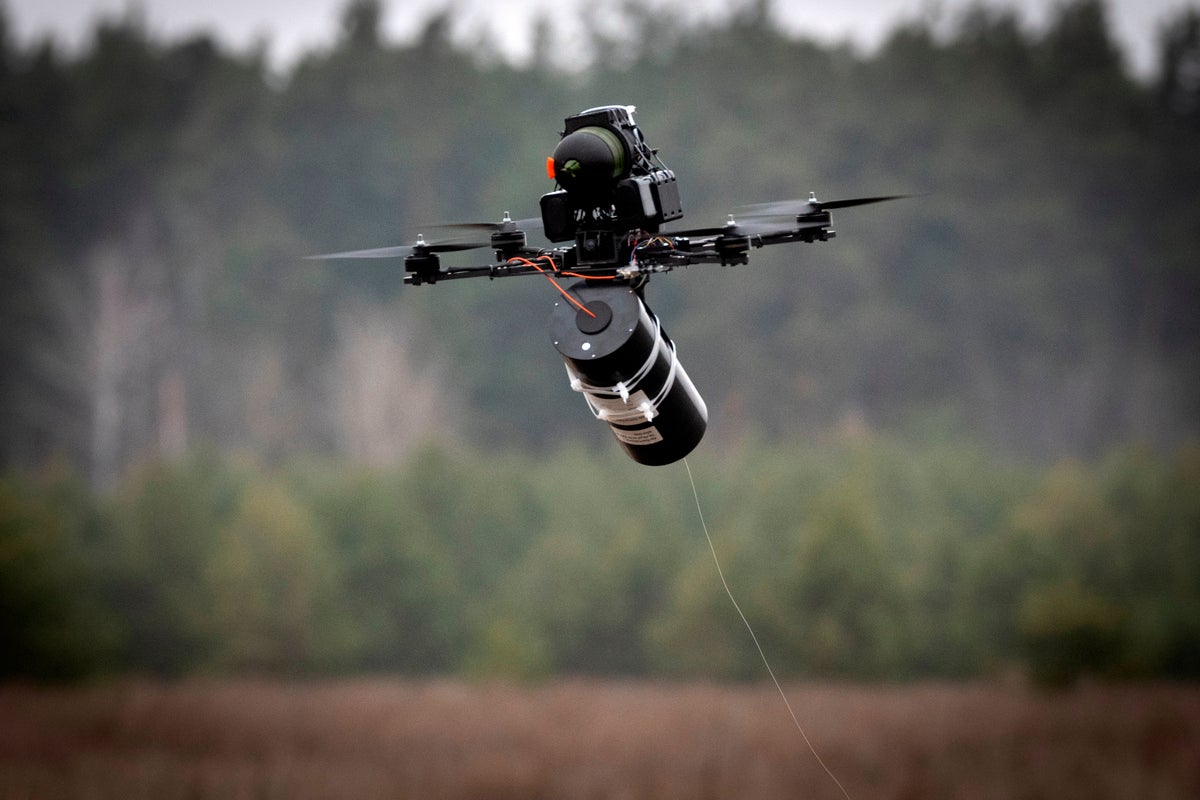
The headlines are breathless. They speak of a "revolution" in the Levant, a "game-ending" shift in asymmetric warfare because Hezbollah started trailing wires behind their FPV drones. The narrative is simple: radio frequency (RF) jamming made wireless drones useless, so the "smart" money moved to glass threads.
It is a seductive story. It is also fundamentally wrong.
What we are witnessing isn't the birth of a new era in warfare. It’s a desperate, short-term tactical pivot that ignores the brutal reality of physics, logistics, and the inevitable evolution of computer vision. If you think spooling out kilometers of silica is the blueprint for the next decade of conflict, you haven’t been paying attention to how fragile these systems actually are.
The RF Jamming Boogeyman
The current obsession with fibre-optic drones—often called "Wired FPVs"—stems from a single failure of imagination: the belief that Electronic Warfare (EW) is an unbeatable wall.
In Ukraine, the "wood chipper" of the Donbas forced operators to seek alternatives because standard 2.4GHz and 5.8GHz signals were being swallowed by massive EW complexes. Hezbollah, watching from the sidelines, saw an opportunity to bypass Israeli signal suppression.
The logic goes: No radio signal, no jamming. Direct physical link, 4K crystal-clear video. Unstoppable.
Except "unstoppable" usually lasts about three weeks in a high-intensity peer-to-peer conflict. The "lazy consensus" assumes that because a drone can’t be jammed, it can’t be defeated. This ignores the fact that a fibre-optic cable is a 5-kilometer-long physical vulnerability.
I’ve watched technical teams pour thousands of dollars into ruggedized spools only to have the entire mission scrubbed because the wire snagged on a charred T-72 or a stray branch. You aren't just flying a drone; you are managing a tether that is thinner than a human hair and under constant tension.
The Weight of the Thread
Let’s talk about the math that the "drone visionaries" conveniently skip.
To fly a drone via fibre optics, you need a spool. That spool isn't weightless. A standard 5km or 10km spool adds significant mass to a platform that is already struggling with battery density.
$m_{total} = m_{airframe} + m_{battery} + m_{payload} + m_{spool}$
As $m_{spool}$ increases, your flight time—and more importantly, your agility—plummets. A wired drone is a sluggish drone. It cannot perform the high-G maneuvers required to dodge point-defense systems or fly into complex interior geometries without the wire snapping.
In the hills of Southern Lebanon, where the terrain is rocky, jagged, and covered in scrub, the "umbilical cord" approach is a liability. Every meter of wire deployed is a meter of wire that can be caught by the wind, tangled in a cedar tree, or severed by the very explosion the drone is trying to cause.
The False Promise of "Unjammable" Video
The industry loves to brag about the 1Gbps throughput of these drones. "You can see the fear in their eyes," the marketing blurbs say.
This is a vanity metric.
You don't need 4K video to kill a tank. You need a stable 480p feed and a pilot who isn't fighting a physical tether. By opting for fibre, groups like Hezbollah are trading tactical flexibility for a pretty picture. It is a classic case of solving a secondary problem (signal quality) while exacerbating the primary problem (platform survivability).
Furthermore, the "unjammable" claim is a half-truth. While you can't jam the command link via RF, you can absolutely defeat the system. If I know there is a wire trailing behind your drone, I don’t need a multi-million dollar EW suite. I need a net. I need localized smoke. I need physical barriers.
We are seeing a return to "trench tech" because we’ve forgotten how to innovate in the digital domain.
The Coming Death of the Tether
The real disruptor isn't a wire; it’s the silicon.
The only reason fibre-optic drones are even a conversation piece right now is that onboard processing power hasn't quite caught up to the demands of fully autonomous terminal guidance in a jammed environment. But that window is closing—fast.
Within 18 to 24 months, the "man-in-the-loop" requirement for the final 500 meters of a drone strike will vanish. We are moving toward "fire and forget" FPVs that use Edge AI to identify, track, and strike targets without needing a constant data link.
Imagine a scenario where a drone is launched toward a known enemy position. It loses its RF link 2 kilometers out. Instead of falling out of the sky or trailing a fragile wire, it switches to internal VSLAM (Visual Simultaneous Localization and Mapping). It identifies the silhouette of a Merkava tank or a Bradly IFV and completes the mission autonomously.
Once that tech hits the mass-production stage—and it’s already being tested in the wheat fields of Zaporizhzhia—the fibre-optic drone becomes a museum piece. Why would any commander choose a system that requires a physical connection to a pilot when they can launch a swarm that thinks for itself?
Hezbollah’s Strategic Blunder
Hezbollah is adopting this because they are fighting a reactive war. They see a gap in Israeli EW and they plug it with whatever is on the shelf. But by investing in wired infrastructure, they are tethering their doctrine to a dead-end technology.
The logistical footprint of wired drones is massive. You need specialized spools, specific training for "tether management," and a much slower operational tempo. In a high-speed conflict, slow is dead.
If you’re an investor or a defense analyst looking at the rise of "wired warfare," don’t be fooled by the novelty. It’s a kludge. It’s the military equivalent of using a dial-up modem because your Wi-Fi is spotty. Sure, it works, but you aren't exactly winning the future.
The Vulnerability Nobody Talks About: Thermal Signature
Fibre-optic cables are made of glass and plastic. They don't have a massive thermal signature, but the process of unspooling them does. The friction of the wire leaving the canister at 100km/h generates heat.
On a high-end thermal optic, a fibre-optic drone isn't just a dot in the sky; it’s a bright line pointing directly back to the operator.
I’ve sat in ops rooms where we tracked "hidden" positions simply by following the literal trail of breadcrumbs left by these systems. You might be unjammable, but you are the loudest thing on the battlefield to a sophisticated sensor suite. You are handing the enemy a map to your front door.
Stop Asking if it Works and Start Asking if it Scales
People also ask: "Are fibre-optic drones the future of urban combat?"
No. They are the nightmare of urban combat. Try flying a tethered drone through a broken window, around a stairwell, and into a basement. The wire will catch on a piece of rebar in seconds.
The "success" stories we see in propaganda videos are highly curated. They don't show the 90% of missions where the wire snapped, the spool jammed, or the drone's flight path was dictated by the tension of the cable rather than the will of the pilot.
The actual path forward isn't going backward to physical wires. It’s moving forward into:
- Frequency Hopping and MASK (Multiple Amplitude Shift Keying): Making RF links so resilient they are effectively unjammable for localized tactical EW.
- Optical Communication (Li-Fi): Using directed lasers for data transmission, which offers the bandwidth of fibre without the physical tether.
- Terminal Autonomy: Removing the human from the loop entirely at the point of impact.
The Brutal Reality of the Front Line
I’ve spoken to operators who have used both. The consensus—away from the cameras—is that they hate the wire. They use it because they have to, not because it’s better. It’s a weapon of necessity, not a weapon of choice.
The competitor articles want to frame this as a "shift in the paradigm." It’s not. It’s a technical debt being paid in real-time. We are seeing the limits of our current electronic warfare capabilities, and instead of pushing through to the next level of digital resilience, we are retreating into the 19th-century concept of "telegraphy by air."
The first military to perfected edge-based autonomy will wipe the floor with anyone still trying to manage a 5-kilometer ball of yarn.
Don't buy the hype. The wire is a leash, and in warfare, the first rule is to never be on a leash.
The "deadly weapon" isn't the drone with the wire. It's the drone that doesn't need you anymore.
Get rid of the spool. Start coding the autonomy. Everything else is just expensive kite flying.