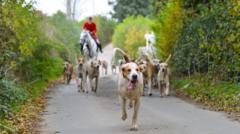
The morning air in the British countryside has a specific weight to it. It is damp, smelling of crushed grass, bruised bracken, and the metallic tang of an impending frost. For decades, this stillness has been broken by a sound that divides the landscape more cleanly than any barbed-wire fence: the sharp, rhythmic cry of hounds and the brassy call of the hunting horn.
But the air is changing.
In oak-paneled rooms and sterile government offices miles away from the muddy lanes, a consultation has begun. It is a dry word for a visceral shift. The government is moving to ban "trail hunting," a practice that was intended to be a legal compromise but has instead become a lightning rod for one of the most enduring cultural wars in modern Britain. To some, this is the final stitch in a wound that has bled since 2004. To others, it is the amputation of a limb.
The Ghost in the Woods
To understand why this consultation matters, we have to look at the mechanics of a ghost. When the original Hunting Act was passed twenty years ago, it didn't actually stop the horses from galloping or the hounds from baying. It simply changed what they were looking for.
In trail hunting, a scent—usually a mix of fox urine and aniseed—is dragged across the terrain by a runner or a quad bike. The hounds follow that artificial line. On paper, it is a sport of pursuit without a kill. It is meant to be a high-speed chess match played out over hedges and through streams.
However, nature is rarely so clinical.
Consider a hypothetical master of the hunt, let’s call him Arthur. Arthur has spent forty years in the saddle. He knows every fox earth and badger sett in the county. When he takes the hounds out on a "trail," he is operating in a grey space. If the hounds happen to pick up the scent of a real fox that crosses the artificial trail—an event known as "accidental" flushing—the chaos that follows is difficult to reign in.
Opponents argue that this "accident" is often the intended outcome. They see trail hunting not as a sport, but as a "smokescreen," a clever legal loophole designed to keep the old ways alive under the cover of a scent-soaked rag. The data suggests they aren't just being cynical. Police reports and video evidence from monitors have frequently shown hounds pursuing live prey, leading to a breakdown in trust that has finally reached the corridors of Westminster.
The Weight of the Gavel
The consultation launched by the Department for Environment, Food and Rural Affairs (Defra) isn't just about animal welfare. It is about the definition of intent.
The legal threshold is shifting. For years, the burden of proof rested on showing that a hunt intended to kill a wild mammal. Proving what is inside a person's head while they are galloping at twenty miles per hour is a prosecutor's nightmare. The new proposals look toward a "reckless" standard.
If the law changes, it won't matter if you meant to kill the fox. If you took the hounds into an area where a fox was likely to be, and you didn't stop them, you are liable.
This shift is a tectonic plate moving under the feet of rural communities. For those who live for the meet, the hunt is the social fabric of the winter. It is the pub fire afterward, the shared labor of the stables, and a connection to a version of England that feels like it is being systematically erased. They see the ban as an urban imposition—a misunderstanding of the balance between humans and the wild.
But the counter-narrative is equally powerful. It is voiced by the hiker who finds their quiet Saturday shattered by a pack of hounds tearing through a nature reserve. It is voiced by the smallholder whose livestock is panicked by dogs out of control. For them, the "tradition" is a relic of entitlement that ignores the modern reality of animal sentience.
The Cost of a Clean Break
There is a quiet, often overlooked tension in this transition: what happens to the dogs?
A foxhound is not a pet. It is a specialized athlete, bred over centuries for endurance, voice, and an obsessive drive to follow a scent. If trail hunting is banned entirely, thousands of hounds across the country face an uncertain future. They cannot simply be moved to a suburban sofa and expected to chase a tennis ball.
The "human element" here includes the kennel hands and the hunt staff whose entire lives are built around the care of these animals. When we talk about banning a practice, we are also talking about the displacement of a specific kind of expertise and a specific way of life.
Yet, the momentum is undeniable. Recent years have seen major landowners—the National Trust, United Utilities, and the Forestry Commission—already pulling the plug. They decided the reputational risk and the constant friction were no longer worth the license fee. The government's consultation is, in many ways, catching up to a decision the land has already made.
The Invisible Stakes
We often frame these debates as "Haves" versus "Have-nots" or "Town" versus "Country." Those labels are too simple. They ignore the farmer who hates the hunt for trampling his crops. They ignore the city dweller who finds beauty in the pageantry of the scarlet coats.
The real stake is our relationship with the wild.
Do we view the countryside as a playground for human tradition, or as a sanctuary that we are lucky to pass through? Trail hunting was an attempt to have both. It tried to keep the theater of the hunt while removing the blood. But you cannot easily sanitize an instinct.
The consultation will run its course. Evidence will be submitted, voices will be raised in heated town halls, and eventually, the law will be rewritten.
As the sun sets over a ridge in the West Country, the shadow of the hunter and the hunted grows long. The horn sounds one last time, a high, lonely note that carries over the valley. It is a sound of a world shrinking, of a boundary being drawn where once there was an open field. The path ahead is clear, even if the ground is uneven.
The trail has run out.