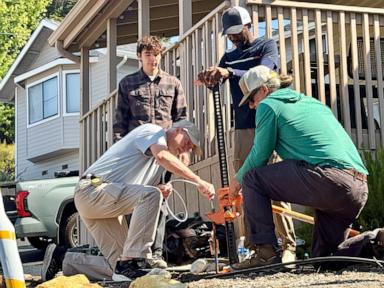
The physical search for human remains in a high-profile cold case is rarely a matter of discovery by chance; it is an exercise in high-stakes forensic archaeology, governed by the intersection of biological decay rates, geological stability, and the limitations of non-invasive detection technology. When law enforcement agencies return to a specific site—such as the Arroyo Grande property associated with the family of Paul Flores—they are not repeating failed actions. They are refining a search grid based on the convergence of new testimonial data and the evolving capabilities of soil-penetrating instrumentation. The objective is to identify a subterranean anomaly that matches the profile of a clandestine burial site that has been undisturbed, or selectively disturbed, for over a quarter-century.
The Structural Mechanics of a Forensic Re-Entry
The decision to execute a new search warrant on a previously examined property rests on a specific legal and tactical threshold. To secure a warrant, investigators must demonstrate to a magistrate that "fresh" evidence suggests a specific probability of discovery. In the context of the Kristin Smart case, this typically involves a shift in one of three critical variables:
- Technological Sensitivity: Improvements in Ground Penetrating Radar (GPR) or the use of multi-spectral imaging that can detect subtle differences in soil compaction or moisture retention that were invisible during previous decades.
- Informational Refinement: New witness statements or biological data that narrow the search radius from "the property" to a specific "quadrant" or "structure."
- Physical Degradation: The natural subsidence of earth over decades, which can occasionally reveal the outlines of former excavations that were previously obscured by fresh fill.
The search at the Flores residence operates under a "zero-loss" protocol. Investigators are looking for trace evidence that persists long after soft tissue has vanished. This includes bone fragments, teeth, clothing fibers, and chemical "halos" in the soil created by the decomposition process.
The Three Pillars of Cold Case Excavation
An analytical breakdown of the search strategy reveals a tripartite framework used to maximize the probability of recovery while maintaining the integrity of the chain of custody.
Subsurface Anomaly Detection
The primary bottleneck in searching a residential property is the "noise" created by legitimate utility lines, septic systems, and historical gardening. Investigators utilize GPR to map these anomalies. A clandestine grave is characterized by a "disturbed soil profile"—a break in the natural stratigraphy of the earth. When a hole is dug and refilled, the soil density never truly returns to its original state, creating a distinct signature for radar waves.
The Bio-Chemical Signature
Even after 30 years, the earth "remembers" a biological presence. Forensic botanists and soil chemists analyze the nutrient levels in the ground. A decomposing body releases a surge of nitrogen and phosphorus. While these chemicals eventually dissipate or are absorbed by local flora, they often leave a lasting impact on the root structures of nearby trees or result in "grave wax" (adipocere) if the environment is sufficiently anaerobic and moist. The current search likely focuses on identifying these chemical variances within the soil matrix.
Tactical Archaeology
Unlike a standard construction excavation, a forensic search is conducted in "lifts"—removing soil in thin, controlled layers (usually 5 to 10 centimeters at a time). This allows technicians to spot changes in soil color or texture, such as "mottling," which indicates that topsoil has been mixed with deeper clay layers. Sifting stations are established on-site to ensure that even micro-deposits, such as a single tooth or a piece of synthetic fabric, are captured.
The Constraints of Time and Soil Chemistry
The success of the current operation is heavily dictated by the specific geophysics of the Arroyo Grande region. Soil acidity (pH levels) determines the rate of bone demineralization. In highly acidic environments, skeletal remains can dissolve completely within decades, leaving only a "shadow" or a stain in the dirt. Conversely, alkaline soil can preserve bone for centuries.
The "Cost Function" of this search is measured in forensic viability. Every year that passes increases the risk of:
- Bioturbation: The displacement of remains by burrowing animals or deep-rooting plants.
- Leaching: The washing away of chemical markers by groundwater.
- Structural Interference: New construction or renovations that physically destroy the original burial site.
The persistence of the San Luis Obispo County Sheriff’s Office suggests they have identified a "High-Confidence Zone" where these environmental factors are believed to have been mitigated, perhaps by the presence of a concrete slab or a protected crawlspace that shielded the site from the elements.
The Legal Implications of Evidence Recovery
The recovery of remains is not the end of the process; it is the beginning of a complex evidentiary chain. Once an anomaly is confirmed as biological, the site transforms into a crime scene governed by rigid protocols.
The relationship between the conviction of Paul Flores and the search for Kristin Smart's body is one of restorative justice rather than legal necessity for the original charge. However, the discovery of remains on a specific property could trigger secondary legal actions. If the remains show signs of having been moved—a theory long discussed in this case—the focus shifts to "accessory after the fact" charges. The soil inside the grave would be compared to soil found on vehicles or tools linked to the suspects, using palynology (the study of pollen and spores) to track the movement of the body across different geographic locations.
The Bottleneck of DNA Degradation
If remains are found, the immediate challenge is identification. Mitochondrial DNA (mtDNA) is the primary tool for aged remains, as it is more resilient than nuclear DNA. However, mtDNA only provides a maternal link and is not as unique as a standard DNA profile. Investigators must balance the need for speed with the risk of destroying the limited biological material available. The use of Next-Generation Sequencing (NGS) allows for the extraction of genetic data from highly degraded samples, a technology that was nonexistent when Smart first disappeared in 1996.
This technological leap is the "force multiplier" in the current search. What was once a hopeless task of finding a "needle in a haystack" has been transformed into a systematic filtration of the haystack using digital and chemical magnets.
The operational focus must now shift from broad-spectrum property surveys to deep-trench forensic sampling in the identified High-Confidence Zones. The presence of law enforcement at the site indicates that the "Probability of Detection" (POD) has crossed the critical threshold required for a multi-day mobilization. The strategic play is no longer about proving a crime occurred—that has been settled in court—but about completing the forensic record through the physical recovery of the victim, a move that requires surgical precision rather than brute-force excavation. Success depends on the ability of the forensic team to distinguish between thirty years of natural geological shifting and the specific, intentional disturbance of a clandestine burial.