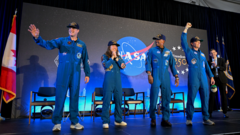
The PR machine is humming. You’ve seen the headlines. The Artemis II crew—Reid Wiseman, Victor Glover, Christina Koch, and Jeremy Hansen—are appearing on every screen, radiating a level of camaraderie that would make a Hallmark movie look cynical. They talk about "best friendship." They talk about "trust." They want you to believe that their emotional bond is the secret sauce that will carry them around the Moon and back.
They are wrong. In fact, if NASA is banking on "friendship" to save a crew during a life-critical system failure in deep space, they are flirting with a catastrophe that the Apollo era worked bloodily to avoid.
The obsession with "crew cohesion" through the lens of friendship is a modern luxury. It’s a soft-science distraction from the brutal, cold reality of orbital mechanics and high-stress decision-making. In the vacuum of space, your best friend’s feelings don’t matter. Their competence does. And often, the former actively degrades the latter.
The Friendship Trap: Why Nice Crews Die
History is littered with "best friends" who drifted into disaster because they didn't want to hurt each other’s feelings. In aviation and aerospace, we call this the "Social Cohesion Bias."
When a crew becomes too close, the professional hierarchy thins. The "friend" voice in your head starts to drown out the "commander" voice. If Reid Wiseman makes a suboptimal call during a Trans-Lunar Injection burn, will a "best friend" challenge him with the same clinical aggression as a professional peer who views him strictly as a mission asset?
Psychological studies on Small Under-Ice Habitats and Long-Duration Spaceflight (LDS) show that high social cohesion often leads to "Groupthink." In these environments, the desire for harmony outweighs the need for critical evaluation. You stop being four distinct points of failure-checking and start being one single, collective mind.
If everyone is in "best friend" mode, who is the outsider willing to say, "This is wrong, and you’re failing"?
The Myth of the Apollo Brotherhood
The competitor articles love to draw a straight line from the "brotherhood" of Apollo to Artemis. This is a historical rewrite.
Neil Armstrong and Buzz Aldrin weren’t "best friends." They were coworkers who respected each other’s technical proficiency. On the way to the Moon, the cabin of the Eagle wasn't filled with banter about their personal lives. It was filled with checklists and telemetry.
Aldrin later admitted their relationship was "cool" and "professional." It worked because there was no emotional baggage to navigate. They didn't need to "foster" (to use a banned corporate term) a bond. They needed to execute.
The Artemis II crew is being marketed as a family. But a family is a terrible structure for a cockpit. Families have secrets. Families protect egos. Families hesitate.
The Bio-Technical Reality of Deep Space Stress
Let’s look at the actual physics of the mission. Artemis II isn’t a quick jaunt to the ISS. It’s a high-radiation, high-G, lunar flyback trajectory.
When the Orion capsule experiences a CO2 scrubber malfunction—a scenario we’ve seen before—the body enters a state of hypercapnia. Your heart rate spikes. Your peripheral vision narrows. Your brain shifts from high-level reasoning to lizard-brain survival.
In that moment, "friendship" becomes a liability.
- Scenario A (The Friend Crew): Wiseman looks at Koch. He sees his friend. He feels empathy for her distress. His amygdala triggers a stress response based on emotional attachment. He loses 1.5 seconds of reaction time.
- Scenario B (The Professional Crew): Wiseman looks at Mission Specialist Koch. He sees a biological component of the life support system. He identifies the malfunction. He executes the override.
That 1.5-second delta is the difference between a successful mission and a debris field.
The Diversity of Thought vs. The Comfort of Commonalities
NASA prides itself on the diversity of the Artemis II crew—the first woman, the first person of color, and the first Canadian to head to the Moon. This is an undeniable win for representation and human achievement.
However, the "best friends" narrative threatens to wash away the very "Diversity of Thought" that makes such a crew powerful. True diversity isn't about looking different; it’s about thinking differently.
When a group spends years together in a "friendship" cocoon, they begin to mirror each other’s cognitive biases. They develop a shared shorthand that excludes external data. They become a closed loop.
I’ve seen engineering teams at major aerospace firms spend millions trying to fix "team dynamics" when the real problem was that they liked each other too much to tell the truth about a failing thruster design. They didn't want to be "the jerk" at the Friday happy hour.
Space doesn’t have a happy hour. Space is a vacuum that wants to boil your blood. It doesn't care if you're a "jerk." It only cares if you're right.
The Toxic Positivity of Modern NASA PR
We have entered an era of "Toxic Positivity" in space exploration.
The Artemis II crew is forced to perform a version of humanity that is palatable for social media. They have to be "best friends" because that’s what sells to a public that is increasingly cynical about the cost of space flight.
But this performance has a cost. It puts an immense psychological burden on the astronauts to maintain an emotional facade. What happens when, six days into the mission, two of them actually don't like each other? What happens when the stress of a 10-day mission around the Moon creates genuine friction?
By tattooing the "best friends" label on them before they even leave the pad, NASA has made it impossible for the crew to admit to interpersonal conflict. And unresolved, suppressed conflict is a ticking time bomb in a pressurized tin can.
The "People Also Ask" Deception
You see the queries: "How do the Artemis II astronauts get along?" or "Are the Artemis II crew friends?"
These are the wrong questions.
The right question is: "Does the Artemis II crew have a robust conflict-resolution framework that functions independently of their personal feelings?"
If the answer is "we just get along great," then NASA has failed.
You don't want a crew that gets along. You want a crew that can argue at 140 decibels about a fuel-to-oxidizer ratio and then immediately transition into a coordinated docking maneuver without a shred of resentment.
The High Cost of Emotional Over-Investment
We must stop romanticizing the "human element" of space flight at the expense of the "mechanical element."
The Orion spacecraft is an incredible piece of engineering. The Heat Shield, the European Service Module, the Launch Abort System—these are the things that will bring them home.
The crew’s "friendship" won't dissipate the 5,000°F heat of re-entry.
If anything, we should be encouraging a degree of professional detachment. Extreme environments require extreme mental discipline. That discipline is often found in the space between people, not in their closeness.
In my years observing the intersection of high-stakes tech and human performance, the most successful teams are those that operate like a Swiss watch—gears that mesh perfectly but never actually merge.
Stop Rooting for Friends, Start Rooting for Professionals
The public needs to stop demanding that astronauts be our "best friends" or each other’s "best friends." It’s a parasocial trap that serves no one.
When Artemis II launches, I don't care if Reid, Victor, Christina, and Jeremy want to grab a beer together afterward. I don't care if they have a group chat where they send memes.
I care that they have the cold, calculating ruthlessness to prioritize the mission over the man. I care that they can look at a "best friend" and see a pilot who is missing a mark, and correct them with the icy precision of a machine.
The "friendship" narrative isn't just annoying PR; it’s a dangerous delusion that masks the terrifying reality of what we are asking these four people to do.
They aren't going to the Moon to be friends. They are going to the Moon to survive.
And in deep space, your friends can't hear you scream—but your crewmates can hear your oxygen alarm. Pray they are professional enough to ignore your panic and follow the manual.
Stop selling us a sleepover. Start selling us a mission.