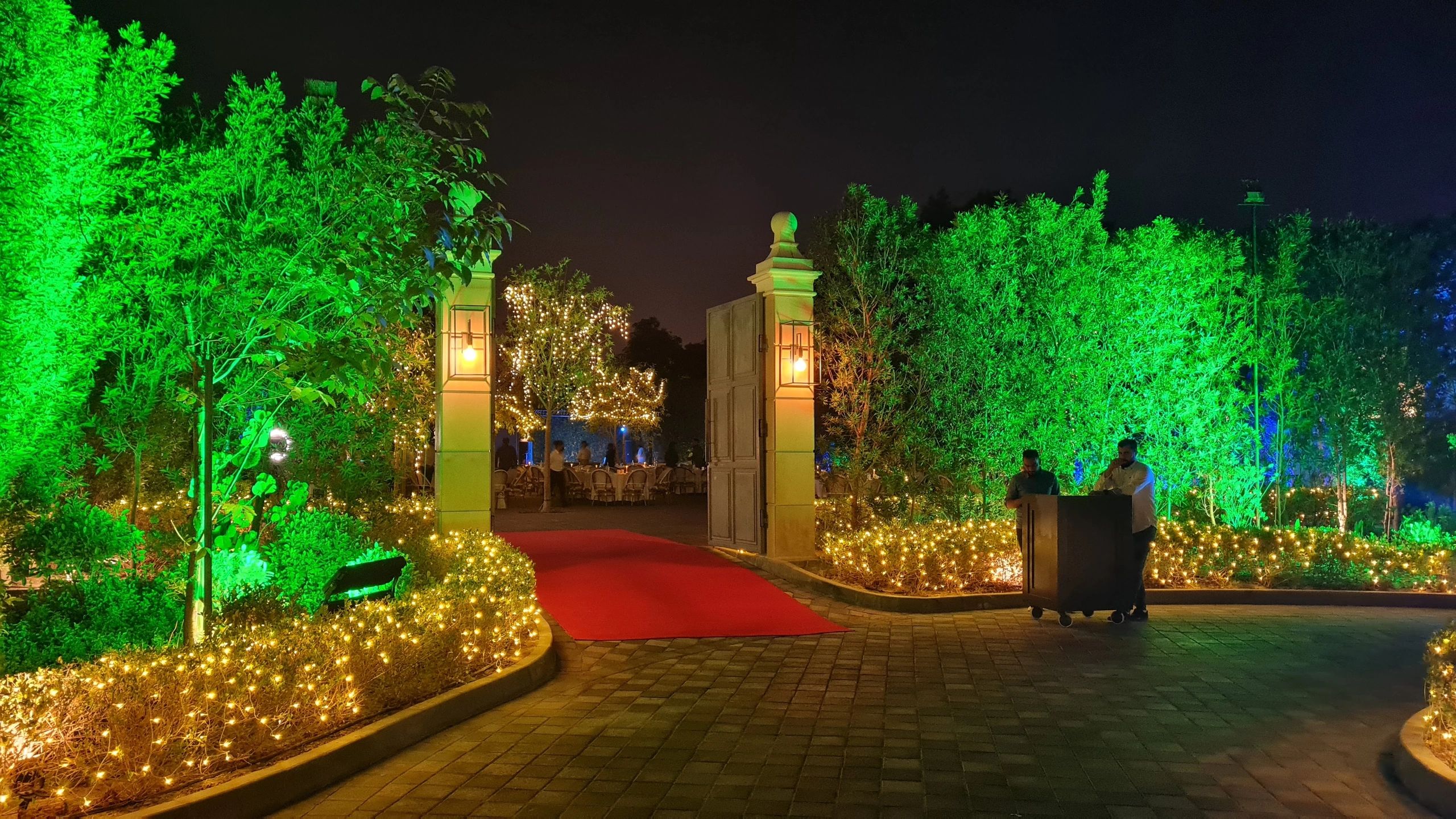
The ice in the glass clinks with a sound so sharp it feels like a reminder. In Dubai, luxury isn’t just a service; it’s a sensory shield. Here, the hum of the air conditioner is the heartbeat of a city built where life shouldn't naturally persist. You sit in a high-rise lounge, the Burj Khalifa piercing the haze like a chrome needle, and for a moment, the geopolitics of the Middle East feel like a distant broadcast from another planet.
Then the phone glows. A notification. A headline about drones, missiles, and closing airspaces.
Suddenly, the floor-to-ceiling glass feels less like a window and more like a bubble. You look at the person at the next table—perhaps an influencer, perhaps a trader—and you see the slight tension in their jaw. This is the duality of the UAE in 2024. It is a sanctuary of gold and marble sitting on the edge of a map that is currently being redrawn in fire.
When Indian television star Erica Fernandes took to social media to describe the "on-ground reality" of Dubai amid escalating tensions between Iran, Israel, and the United States, she wasn't just posting a travel update. She was piercing the veil of the world’s most successful PR machine. Her message was simple: Life goes on. The malls are full. The fountains dance. But the silence in her video spoke louder than the words. It’s the silence of a city that knows its prosperity depends entirely on the world believing it is untouchable.
The Anatomy of a High-Stakes Peace
To understand why a celebrity’s Instagram story can spark a national debate, you have to understand the fragile architecture of Dubai’s soul. This isn't just a city; it’s a global intersection.
Consider a hypothetical resident named Arjun. He moved from Mumbai to Dubai three years ago. To Arjun, Dubai is the place where he finally bought his first luxury car, where his kids go to a school that looks like a tech campus, and where he never has to worry about his safety at 2 AM. But when the news breaks that missiles are traversing the sky a few hundred miles north, Arjun’s perspective shifts. He looks at the cranes on the horizon. He wonders if the investors will keep coming. He wonders if the flight that brings his parents to visit will be diverted, or worse, cancelled.
The "tension" reported in the news is often invisible to the naked eye. If you walked down Sheikh Zayed Road today, you wouldn't see bunkers or soldiers. You would see the relentless pursuit of the "future." But the tension exists in the logistics. It exists in the fluctuating cost of flight insurance and the redirected paths of the Emirates fleet.
Dubai’s genius has always been its ability to remain "neutral ground." It is the Switzerland of the desert, a place where everyone’s money is green and everyone’s ambition is welcome. But neutrality is a heavy burden when the neighbors are at war.
The Narrative of Normalcy
Erica Fernandes’ account of the situation emphasized a "business as usual" atmosphere. This is a deliberate and necessary collective performance. In the UAE, maintaining the narrative of normalcy is a form of national defense. If the world perceives a crack in the armor, the capital—both human and financial—can evaporate overnight.
There is a psychological phenomenon at play here. When you live in a place defined by its perfection, any hint of chaos feels magnified. The contrast between a $500 brunch and a headline about ballistic missiles creates a cognitive dissonance that is hard to shake.
"Is it safe?"
That is the question every expat hears from their family back home. The answer is technically "yes," but "safe" is a relative term. The UAE has invested billions in defense systems, including the Terminal High Altitude Area Defense (THAAD).
Yet, the real defense is diplomatic. The UAE’s strategy is a masterclass in tightrope walking—maintaining the Abraham Accords with Israel while managing a complex, thawing relationship with Iran, all while hosting thousands of American personnel. It is a geopolitical jigsaw puzzle where every piece is made of glass.
The Invisible Stakes for the Dreamers
The headlines focus on the "clashes," but the story is really about the dreamers.
Dubai is a city of 90% expats. From the construction worker from Bangladesh to the CEO from London, everyone is there for a reason: the promise of a better life that their home country couldn't provide. When regional instability flares up, it isn't just "news" to them. It is a threat to their life’s work.
If the Strait of Hormuz—the narrow waterway that sees a massive portion of the world's oil pass through—becomes a flashpoint, the ripple effects are immediate.
The cost of living, already high, begins to creep upward. Supply chains for the exotic fruits and high-end materials that Dubai craves become strained. The invisible lines of trade are the true borders of this city, and those lines are currently vibrating with the shockwaves of conflict.
Why the Debate Matters
The debate sparked by Fernandes’ comments wasn't just about whether she was "downplaying" the risk or "promoting" the city. It was a clash between two different truths.
The first truth: The UAE is a fortress of stability in a volatile region. It has navigated decades of Middle Eastern conflict while remaining a beacon of growth.
The second truth: No one is an island. In a globalized economy, a fire in your neighbor’s yard eventually sends smoke through your vents.
For the traveler, the choice to visit Dubai during these times is a gamble on the strength of that first truth. For the resident, it is a daily exercise in compartmentalization. You learn to enjoy the sunset over the Arabian Gulf while purposefully forgetting that just across that water is a landscape of ancient grievances and modern munitions.
The Weight of the Sky
There is a specific kind of beauty in Dubai at dusk. The heat begins to lift, and the city lights flicker on, creating a grid of electricity that looks like a circuit board. It is a testament to what human will can achieve against the elements.
But as you look up, you realize the sky is different now. It is no longer just a canvas for fireworks or light shows. It is a space that is being monitored, contested, and feared.
The reality of Dubai isn't found in the extremes. It isn't the "tension-free paradise" portrayed in travel brochures, nor is it a "war zone" as the most alarmist headlines might suggest. The reality is a middle ground—a sophisticated, high-speed society that is hyper-aware of its own vulnerability.
The people here continue to build, to invest, and to party. They do so not because they are ignorant of the risks, but because the alternative—acknowledging the fragility of the dream—is too heavy to bear.
You finish the drink. You pay the bill. You walk out into the warm night air, past the supercars and the shivering fountains. Everything looks perfect. Everything feels solid. But for the first time, you find yourself glancing upward, searching the stars for something other than light.
The mirage is beautiful. It is also the only thing keeping the desert at bay.
The city remains a miracle of engineering and ego, a defiant shout against the harshness of the earth and the bitterness of history. As long as the lights stay on and the planes keep landing, the dream holds. But the air is different now. It carries the faint, metallic taste of a world on edge, reminding everyone that even the tallest towers are anchored in shifting sands.
Would you like me to analyze the specific economic impact of regional airspace closures on Dubai's tourism sector?