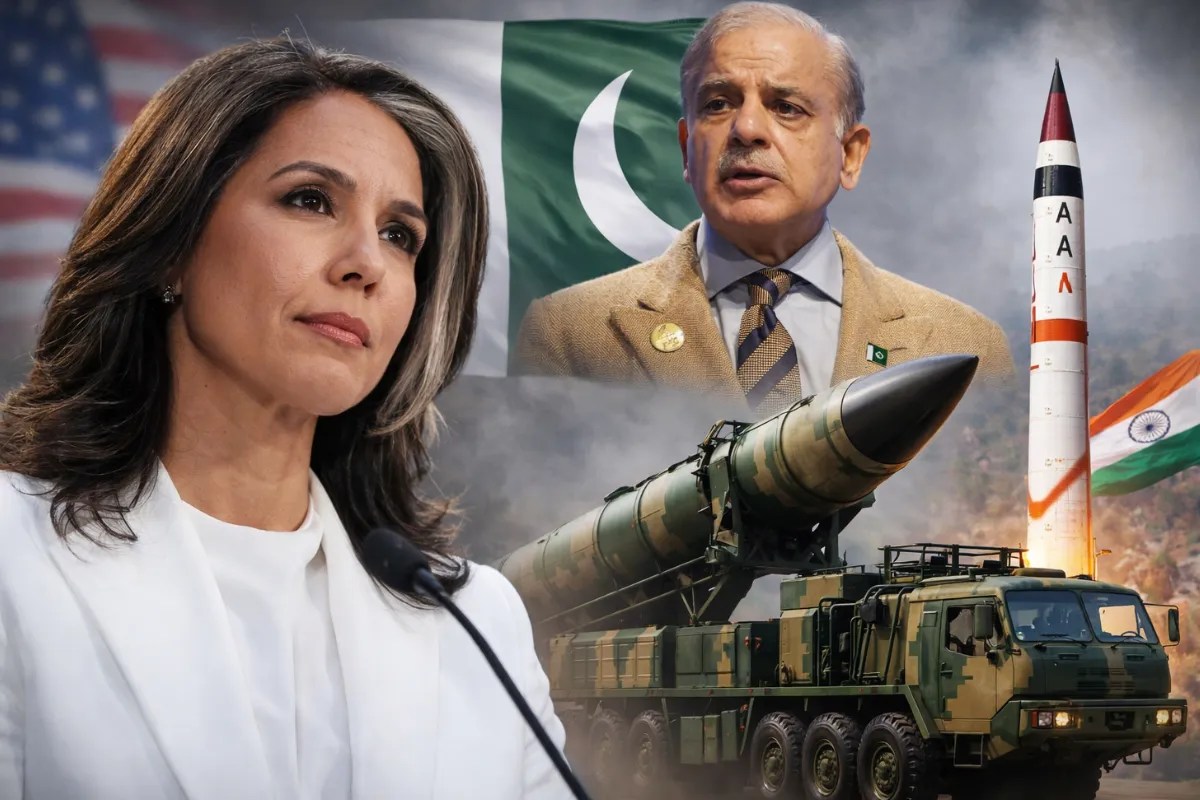
The appointment of Tulsi Gabbard as the Director of National Intelligence (DNI) has sent a seismic shock through the corridors of the "Five Eyes" alliance and beyond. While domestic debates often center on her past political affiliations or her departure from the Democratic Party, the international intelligence community is grappling with a much more concrete problem. They are looking at her history of rhetoric regarding state-sponsored terrorism and her skepticism of established intelligence assessments. This is not about hurt feelings in diplomatic circles. It is about the mechanical flow of classified data that keeps global security systems operational.
Pakistan’s recent sharp reaction to Gabbard’s past statements—specifically those linking the country to the protection of high-profile terrorists—highlights a friction point that will define her tenure. When a prospective DNI has a documented history of calling out specific nations for their proximity to extremist groups, the diplomatic "business as usual" approach evaporates. Pakistan’s attempt to frame her views as influenced by Indian narratives is a standard defensive maneuver, but it underscores a deeper anxiety. They fear a US intelligence apparatus that no longer prioritizes the delicate balancing act of the South Asian "frontline ally" status.
The Architecture of Suspicion
The DNI does not just read reports. The role oversees 18 different agencies, including the CIA and the NSA, and manages the National Intelligence Program budget. When Gabbard assumes this mantle, she becomes the ultimate gatekeeper of what the President sees every morning. Foreign intelligence services, particularly those in Islamabad, are now performing a frantic audit of their own cooperation levels with Washington.
The concern isn't just about what Gabbard thinks. It is about how the career professionals within the CIA and DIA will react to her leadership. We are looking at a potential "intelligence freeze" where human sources on the ground in volatile regions might go quiet, fearing that a shift in political direction at the top could expose their identities or nullify their efforts. Intelligence is a currency built on the stability of the recipient. If the recipient is viewed as unpredictable or ideologically driven in a way that contradicts decades of established groundwork, the currency devalues.
Breaking the South Asia Status Quo
For decades, the United States has maintained a "transactional" relationship with Pakistan. Washington provided military aid and a degree of diplomatic cover; in exchange, Islamabad provided logistical access to Afghanistan and periodic cooperation against specific Al-Qaeda targets. Gabbard has publicly characterized this relationship as a betrayal of American interests. She has frequently pointed to the fact that Osama bin Laden was found a short distance from a Pakistani military academy as evidence that the partnership is fundamentally flawed.
This isn't just "tough talk" from a politician anymore. As DNI, she will have access to the "raw" data—the intercepted communications and satellite imagery—that either confirms or refutes these long-standing suspicions. If she chooses to declassify or pivot intelligence priorities toward investigating state-sponsored actors more aggressively, the geopolitical map of South Asia will be redrawn. Pakistan’s defense, which often involves accusing the US of being swayed by Indian lobbying, falls flat when the person in charge of the data has a track record of military service and a stated disdain for "regime change" wars and murky alliances.
The Five Eyes Fragility
Beyond the immediate firestorm in South Asia, the broader "Five Eyes" community—comprising the US, UK, Canada, Australia, and New Zealand—is watching with bated breath. This alliance relies on the absolute certainty that shared intelligence will be handled with professional clinicality, stripped of political bias. Gabbard’s previous skepticism regarding intelligence assessments on Syria and her meetings with foreign leaders like Bashar al-Assad have created a trust deficit before she even walks through the door at Langley.
Technical Risks of Information Silos
If partner agencies in London or Canberra believe that their sensitive methods could be compromised or misinterpreted by a DNI who views the "Deep State" as an adversary, they will stop sharing. This isn't a theory; it's a protocol.
- Source Protection: If a foreign agency believes a DNI might use intelligence to settle political scores, they will withhold the "metadata" that proves the source's credibility.
- Operational Security: Joint operations against cyber-threats from state actors require total synchronization. Disagreement at the top levels of the DNI can lead to fatal delays in responding to active exploits.
The Reality of Intelligence Polarization
We are entering an era where intelligence is no longer seen as a neutral set of facts provided to policymakers. It is becoming a battlefield in itself. Gabbard represents a movement that views the intelligence community not as a shield, but as a potential weapon used by the "establishment" to manufacture consent for foreign interventions. While her supporters see this as a necessary housecleaning, the professionals in the field see it as the dismantling of a vital early-warning system.
The tension between Gabbard and the agencies she is set to lead will likely manifest in "slow-rolling." This is a classic bureaucratic tactic where information is provided to the leader, but in such a high volume or with such heavy redactions that it becomes unactionable. Gabbard will need to prove she can manage the internal culture of these agencies while simultaneously convincing foreign partners that the US remains a reliable repository for the world's most dangerous secrets.
The Technology of Trust
In the modern landscape, intelligence isn't just about spies in trench coats. It’s about Signal Intelligence (SIGINT) and Geospatial Intelligence (GEOINT).
$$I = f(S, C, A)$$
In this simplified conceptual model, Intelligence (I) is a function of Source reliability (S), Collection capability (C), and Analytical objectivity (A). If any of these variables are compromised by political friction or international distrust, the final product—the intelligence that prevents a terrorist attack or a nuclear escalation—fails.
The "A" in that equation—Analytical objectivity—is what Pakistan is currently attacking. By claiming Gabbard is biased, they are attempting to preemptively discredit any future intelligence reports that might highlight their internal security failures. They are betting that the internal friction within the US government will be so high that the DNI will be too busy fighting her own staff to focus on foreign state-sponsorship of terror.
A New Doctrine of Accountability
If Gabbard succeeds, she could usher in a doctrine of "radical transparency" within the intelligence community. This would involve a more rigorous questioning of the assumptions that lead to war. However, the path to that transparency is littered with the remains of previous attempts to reform the system. The intelligence community is a self-healing organism that tends to eject foreign bodies that try to change its DNA.
The immediate challenge will be the first major international crisis that occurs on her watch. Whether it is a flare-up in the Kashmir region, a cyber-attack on the power grid, or a move by a nuclear-armed state, the world will see exactly how much "intelligence" is left in the National Intelligence apparatus. The "Five Eyes" will be looking for stability. Pakistan will be looking for a way to maintain its relevance. And the career officers at the CIA will be looking for a leader they can trust not to burn their sources for a headline.
The friction we see today is just the beginning of a fundamental realignment of how the United States gathers and utilizes information about its enemies and its "frenemies" alike. The global security architecture is being stress-tested in a way it hasn't been since the end of the Cold War.
Check the security clearance protocols and the statutory requirements for the DNI to understand the legal limits of this new era.