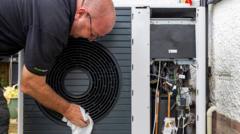
The push for residential electrification has hit a wall of physical reality and predatory pricing. While policy advocates paint a picture of a seamless transition to carbon-neutral heating, the average homeowner faces a fragmented market where "green" technology often comes with a "gold" price tag. A heat pump is not a furnace substitute; it is a fundamental shift in how a building interacts with thermodynamics. For those looking for the bottom line, a standard air-source heat pump installation currently ranges from $12,000 to $25,000, while high-end geothermal systems can easily eclipse $50,000. These figures often exclude the hidden costs of electrical panel upgrades and the mandatory envelope sealing required to make the technology actually work when the temperature drops.
The Mechanics of Moving Heat
To understand why these units cost more than a traditional gas furnace, one must stop thinking of them as heaters. They are transport machines. A heat pump uses a refrigerant cycle to extract thermal energy from the outside air—even in sub-zero temperatures—and move it indoors.
The process relies on a compressor, an expansion valve, and two heat exchangers. In the winter, the outdoor coil acts as an evaporator, absorbing heat from the environment. The compressor then raises the pressure and temperature of the refrigerant before it travels to the indoor coil, where it releases that heat into the home. It is a brilliant bit of engineering that defies the intuition of anyone who has ever stood in a freezing wind. Because the system is moving heat rather than creating it through combustion, it can achieve efficiencies of 300% to 400%. For every unit of electricity put in, you get three to four units of heat out.
But this efficiency is fragile. It depends entirely on the delta—the difference between the outdoor temperature and the desired indoor temperature. As that gap widens, the physics get harder, the compressor works longer, and the "cheap" heat starts to look very expensive on a utility bill.
The Contractor Markup Crisis
The hardware itself—the condensers and air handlers manufactured by giants like Carrier, Daikin, or Mitsubishi—accounts for only a fraction of the total invoice. The rest is a volatile mix of labor, specialized tooling, and what many industry insiders call the "Rebate Tax."
Since the passage of significant federal and state incentives, many HVAC installers have adjusted their quotes upward to absorb the value of the tax credits. It is a classic case of market distortion. When the government offers a $2,000 credit, the quote magically rises by $1,800. This isn't just cynical speculation; it is a documented trend in markets where subsidy transparency is low. Homeowners end up subsidizing the contractor's margin rather than lowering their own capital expenditure.
Furthermore, the skill gap is massive. Installing a gas furnace is relatively straightforward: hook up the gas line, the flue, and the ducting. A heat pump requires precise refrigerant charging and an understanding of "Manual J" load calculations. Most contractors skip the math and "oversize" the unit. This is a fatal error. An oversized heat pump "short-cycles," turning on and off rapidly, which wears out the compressor and fails to dehumidify the air. You end up with a $20,000 system that leaves your house feeling clammy in the summer and uneven in the winter.
The Thermal Envelope Trap
Installing a heat pump in a drafty, 1950s ranch house without upgrading the insulation is a recipe for financial disaster. This is the part of the sales pitch that most companies omit. Because heat pumps deliver air at a lower temperature than the scorching 120-degree output of a gas furnace, they rely on a steady, consistent flow of warmth. If your windows are leaking and your attic is under-insulated, the heat pump will never catch up.
You cannot buy your way out of poor building science. If you spend $20,000 on a top-tier cold-climate heat pump but ignore the $5,000 worth of air sealing needed in your crawlspace, the unit will trigger its "emergency heat" strips. These are essentially giant toaster wires inside your air handler. They are 100% efficient, which sounds good until you realize your heat pump was supposed to be 300% efficient. Your electric bill will triple overnight.
Ground Source versus Air Source
The debate usually centers on air-source units because they are easier to retrofit. However, the real investigative "why" leads us to geothermal, or ground-source heat pumps. These systems use the constant 55-degree temperature of the earth to exchange heat.
Geothermal is the gold standard of HVAC. It is immune to the outdoor air temperature. Whether it is -20°F or 100°F outside, the machine thinks it is a mild spring day. But the "how" of geothermal involves drilling hundreds of feet into the bedrock or digging massive trenches in the yard. The "why" people don't do it is simple: the upfront cost is staggering. Even with a 30% federal tax credit, the payback period can stretch to fifteen or twenty years. It is a long-term play for those who plan to die in their current home, not for the mobile professional who moves every seven years.
The Refrigerant Pivot
The industry is currently in the middle of a forced migration. Older refrigerants like R-410A are being phased out in favor of R-454B and R-32, which have lower global warming potential. This shift is driving up equipment costs again. Parts for older systems are becoming more expensive, and technicians are being forced to invest in new recovery tanks and sensors.
For the consumer, this means buying a heat pump today might feel like buying a laptop right before a major processor update. You are caught in a cycle of planned obsolescence mandated by environmental policy. If you buy a system today, ensure the contractor is certified for the new A2L "mildly flammable" refrigerants. If they look at you blankly when you ask about A2L, find a different contractor.
The Cold Climate Myth
For a decade, the narrative was that heat pumps don't work in the North. That is now objectively false, but with a caveat. Modern "Hyper-Heat" or "Extrol" systems can maintain nearly full capacity down to 5°F and continue operating at 70% efficiency down to -13°F. They work. They are used in Norway and Maine with great success.
The problem isn't the technology; it's the infrastructure. In extreme cold, the outdoor unit must undergo a "defrost cycle" to melt the ice that forms on the coils. During this time, the system briefly stops heating the house or pulls heat from the house to melt the outdoor ice. Without a properly designed backup system—either a small gas furnace for "dual fuel" operation or high-output electric strips—there will be a twenty-minute window where the temperature in your living room begins to sag.
Why the Math Rarely Adds Up
If you are switching from natural gas to a heat pump to save money, you will likely be disappointed. In most parts of North America, natural gas remains the cheapest way to move a BTU of heat into a room. The "savings" only manifest if you are switching from expensive propane, heating oil, or old-fashioned electric baseboard heaters.
The real motivation for a heat pump should be twofold: superior comfort through constant air movement and the elimination of indoor combustion. Removing gas lines reduces the risk of carbon monoxide and simplifies the home's mechanical footprint. But as an investment? The ROI is often negative when compared to a high-efficiency gas furnace and a standard AC unit.
Demand a Load Calculation
Before signing a contract, demand a Manual J calculation. If a contractor walks into your home, looks at your existing furnace, and says, "Yep, looks like a three-ton unit," walk them to the door. They are guessing with your money. A real pro will measure your windows, check your insulation levels, and use software to determine exactly how much heat your home loses in the winter. Only then can you choose a system that won't bankrupt you through inefficiency or premature failure.
Get three quotes, but don't just compare the bottom number. Look at the SCOP (Seasonal Coefficient of Performance) and the HSPF2 (Heating Seasonal Performance Factor). These are the real metrics of how much your winter will cost.
Invest in the air sealing first. If you don't fix the holes in the bucket, it doesn't matter how expensive the pump is that's filling it.