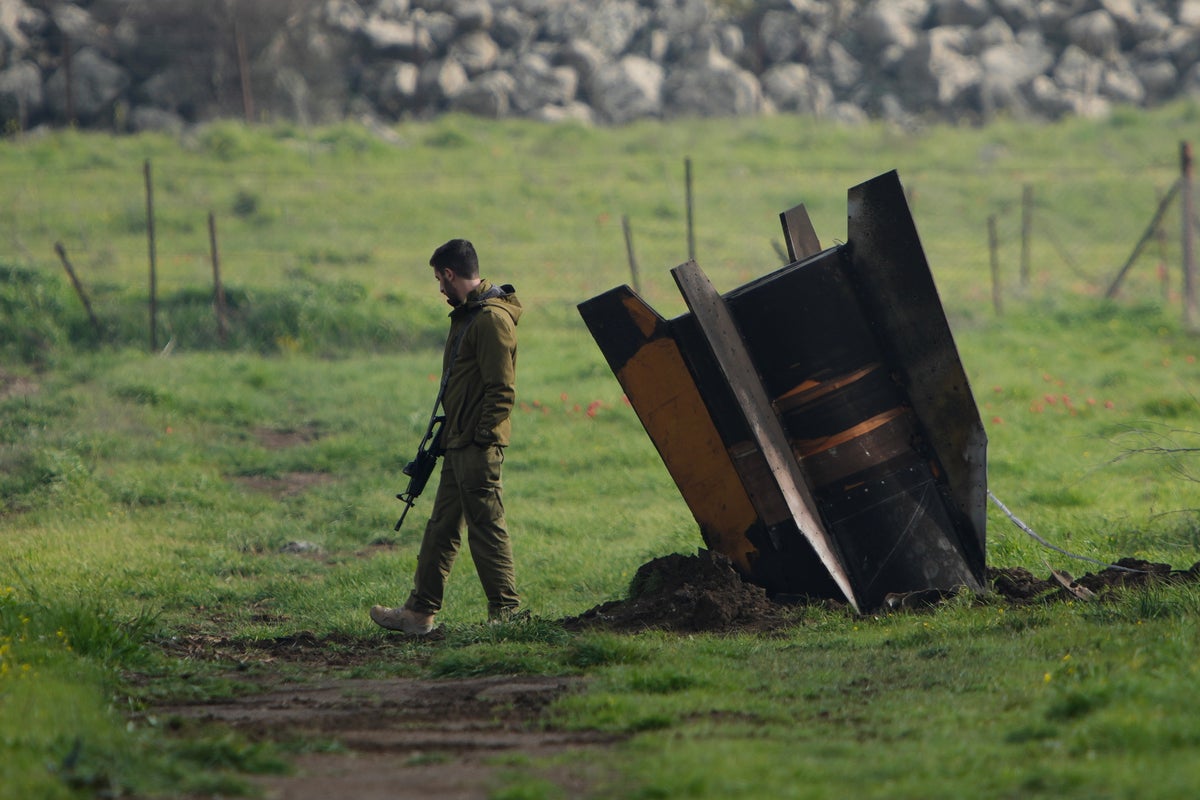
The tea is still hot when the sirens don't go off. That is the most unsettling part of the new ballistic reality. In the old films of the Blitz, there was always the mechanical wail, the frantic dash to the Underground, and the heavy, rhythmic thrum of bombers. But modern physics has outrun the speed of sound. If a medium-range ballistic missile were launched from the dusty plains of western Iran toward the glass towers of Canary Wharf, the first sign of its arrival wouldn't be a noise. It would be a silent, shimmering streak across the ionosphere, a kinetic visitor traveling at five times the speed of sound.
Distance used to be a physical fortress. For decades, the geography of the Middle East felt like a world away from the pubs of Manchester or the quiet suburbs of Surrey. We looked at maps and saw thousands of miles of desert, mountain, and sea acting as a buffer. That buffer has evaporated. Iran’s missile program, once a collection of shaky, short-range scuds, has matured into a sophisticated arsenal of "Fattah" and "Khorramshahr" variants. These are not just weapons; they are mathematical certainties. They possess the range—up to 2,500 kilometers and stretching—to put European capitals, and potentially the United Kingdom, within a crosshair that previously only reached Baghdad or Tel Aviv.
Consider a person like David. He’s a hypothetical civil servant in Whitehall, the kind of man who worries about pension yields and whether he remembered to take the recycling out. He sits at his desk, unaware that 3,500 miles away, a solid-fuel engine is being tested that can bridge the gap between his morning coffee and his lunch break. When we talk about "security architecture," we are really talking about David’s right to finish his sandwich in peace.
The shift is atmospheric. It’s the realization that the UK is no longer a spectator in distant proxy wars but a potential node in a global, interconnected grid of strike zones. This isn't about a sudden declaration of war. It is about the "threshold of threat." When a nation possesses the ability to touch your doorstep from a different continent, the way you speak to them changes. The way you defend your skies changes.
The Calculus of the Stratosphere
To understand why this feels different, we have to look at the mechanics of the flight path. A standard cruise missile hugs the earth, dodging hills and hiding from radar. They are deadly, but they are slow. Ballistic missiles are different. They punch through the atmosphere, entering the blackness of space before gravity and high-precision guidance systems pull them back down in a terrifying, vertical plunge.
This is the "new phase" the analysts are whispering about. It’s not just about the distance; it’s about the difficulty of the catch. Imagine trying to hit a bullet with another bullet while both are traveling in a vacuum. The Royal Navy’s Type 45 destroyers and the land-based radar arrays in Yorkshire are marvels of engineering, but they were designed for a different era of threat. We are currently watching a high-stakes race between the sword and the shield, and the sword has recently grown much longer.
British defense officials aren't just worried about a rogue launch. They are worried about the "gray zone." This is the psychological weight of knowing that a technical mishap or a sudden escalation in the Strait of Hormuz could result in a kinetic event in the North Sea. It changes the cost of diplomacy. It makes every statement issued by the Foreign Office carry a weight that wasn't there ten years ago.
The Human Cost of High-Altitude Physics
If you walk through the streets of London today, the threat feels invisible. There are no sandbags. No blackouts. Yet, the vulnerability is documented in white papers and committee rooms. The UK’s integrated review of defense and foreign policy has had to pivot sharply. We used to worry about "dirty bombs" in suitcases; now we worry about Mach 5 reentry vehicles.
Let’s look at Sarah, a fictional engineer working on satellite communications in the Midlands. Her work is vital to the UK’s GPS and telecommunications infrastructure. In a world where Iranian missiles can reach the edges of Europe, Sarah’s workplace becomes a strategic target. The "front line" is no longer a trench in a foreign field. It is the server room in a nondescript office building in Slough. It is the power grid substation in the Scottish Highlands.
The emotional core of this issue isn't hate or even political rivalry. It is the loss of the "Home Front" as a sanctuary. For centuries, the British Isles relied on the English Channel to keep the horrors of continental and global strife at bay. But the Channel is nothing to a missile that spends half its journey in the exosphere.
The Ghost in the Machine
There is a certain vulnerability in admitting that our technology might not be enough. For a long time, the West relied on a "technological edge." We assumed our sensors were sharper, our computers faster. But the democratization of missile technology has been ruthless. Through a combination of indigenous innovation and shadowy tech transfers, Iran has bypassed decades of traditional development.
They have learned how to use "maneuverable reentry vehicles" (MaRVs). These are warheads that don't just fall; they dance. They shift their path as they descend, making it almost impossible for traditional interceptors to predict where they will be in the next three seconds. It’s a game of celestial chess where the board is the size of a hemisphere.
Why does this matter to the person catching the bus in Birmingham? Because defense costs money. Real money. To protect UK cities against this specific brand of threat, the government must decide between building new hospitals or commissioning multi-billion-pound BMD (Ballistic Missile Defence) systems. Every time a new missile silo is dug in the Iranian desert, the invisible price of bread in a London supermarket edges up, tied to the soaring costs of national insurance and defense spending.
The Weight of the Unseen
We often mistake silence for safety. Because we don't see the missiles on our evening news every night, we assume they aren't there. But the people whose job it is to watch the screens at RAF Fylingdales see them. They see the tests. They see the telemetry. They live in a world where the distance between "peace" and "catastrophe" is measured in a fifteen-minute flight window.
This is the hidden cost of the modern age. We have traded the physical boundaries of the past for a digital and ballistic interconnectedness that we aren't entirely prepared for. The anxiety isn't loud. It’s a low-frequency hum in the background of our geopolitical life.
It is the realization that the world has shrunk. The "far away" has moved in next door. We are no longer protected by the curve of the earth or the vastness of the oceans. We are protected only by the fragility of treaties and the flickering lights of interceptor computers.
The sun sets over the Thames, reflecting off the glass of the Shard and the Gherkin. People are heading home, thinking about dinner, their children’s homework, or the weekend football scores. High above them, in the thin, cold air where the atmosphere gives way to the void, the paths are already mapped. The coordinates are known. The only thing keeping the sky empty is a thin thread of human restraint, pulled tighter than it has been in a generation.
A single bird crosses the darkening sky, a tiny speck against the vast blue. It flies without knowing that the space it occupies is now a corridor for something much faster, much heavier, and infinitely more indifferent to the life below.