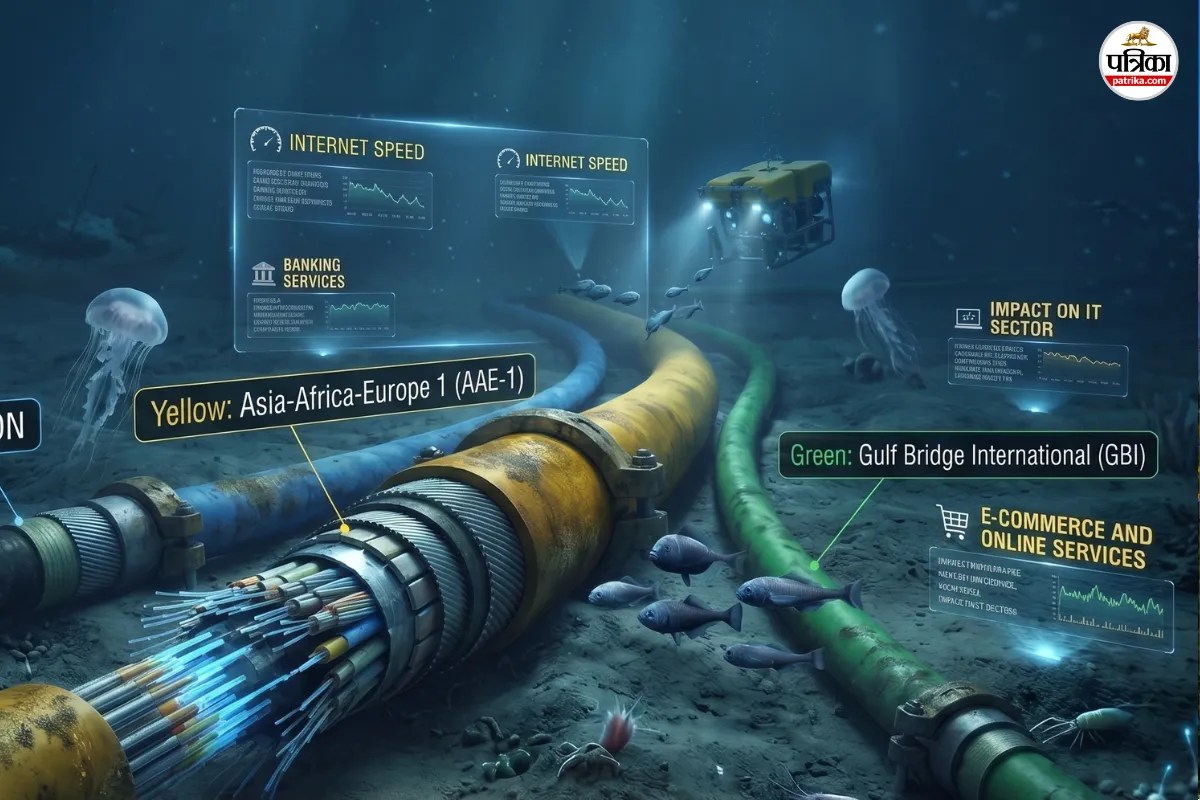
The Strait of Hormuz is widely recognized as a thermal trigger for global oil prices, but a far more fragile commodity flows through its depths. Data. While the world watches tankers, the real vulnerability for India lies in the bundles of fiber-optic glass resting on the seabed. If these cables are severed, India’s digital economy does not just slow down; it hits a wall. Over 95% of India's international data traffic travels via undersea cables, and a significant portion of the high-capacity lines connecting Mumbai to Europe and the Middle East pass through the narrow, shallow, and increasingly volatile waters of the Persian Gulf and the Arabian Sea. This is not a hypothetical concern. It is a structural failure in how we have built our connection to the rest of the planet.
The Shallow Water Trap
Geography has gifted the Strait of Hormuz a strategic importance that is now becoming a digital liability. Unlike the deep Atlantic trenches, the waters around the Gulf are relatively shallow. This makes the "subsea" cables remarkably accessible. In deep water, cables are safe from almost everything except seismic shifts. In the shallow approaches to the Middle East, they are at the mercy of every dragging anchor, every bottom-trawling fishing net, and every state actor with a basic submersible and a grudge.
When a cable is cut in the Mediterranean or the Red Sea, traffic is rerouted. But the sheer volume of Indian data funneling through the Gateway of Mumbai means that there are very few "clean" paths left that do not cross through these geopolitical flashpoints. We have concentrated our digital nervous system into a handful of narrow maritime corridors.
Beyond Accidental Damage
Industry insiders often point to ship anchors as the primary cause of cable breaks. While true, this narrative ignores the rise of "gray zone" warfare. Cutting a cable is the ultimate deniable attack. It requires no missiles, leaves no radiation, and can be blamed on a rogue merchant vessel or a localized earthquake. For a nation like India, which has staked its future on being the world’s back office, the loss of connectivity is equivalent to a physical blockade.
Consider the financial sector. The National Stock Exchange and various UPI-linked banking backbones rely on low-latency connections to global servers. A 200-millisecond delay caused by rerouting traffic through inferior satellite links or congested overland paths across Asia would trigger chaos in automated trading and cross-border settlements. This isn't just about losing access to social media; it’s about the sudden evaporation of liquidity.
The Myth of Satellite Redundancy
There is a common misconception that Starlink or similar Low Earth Orbit (LEO) constellations can save a nation if the cables go dark. They cannot. A single fiber-optic strand can carry more data per second than an entire fleet of first-generation satellites. Satellites are a localized solution for rural connectivity, not a replacement for the massive pipes required to run a nation of 1.4 billion people. If the subsea cables in the Hormuz region are compromised, there is no "Plan B" that maintains current speeds. We would be pushed back to the digital equivalent of the late 1990s overnight.
The Chennai Mumbai Imbalance
India’s internal data architecture exacerbates the risk. Mumbai handles the lion's share of West-bound traffic. This creates a single point of failure for the country's connection to London, Marseille, and New York. While Chennai serves as the gateway to Singapore and the East, the bulk of our corporate and governmental data is western-centric.
The concentration of landing stations in Mumbai means that a targeted disruption in the Arabian Sea doesn't just affect Maharashtra; it cripples the IT hubs in Bengaluru, Hyderabad, and Pune. We have built a massive skyscraper of an economy but left only two or three narrow doors at the ground floor.
Strategic Autonomy and the Cable Map
The solution isn't just laying more cables; it’s about where they are laid. Currently, the "path of least resistance" for cable laying companies is to follow existing routes where permits are already established. This creates "cable graveyards" where dozens of lines are bunched together. A single poorly placed anchor can take out five cables at once.
India needs to spearhead the "Great Southern Route." This involves bypassing the traditional Red Sea and Hormuz corridors entirely, running cables down the coast of Africa and across the Indian Ocean to reach Europe. It is more expensive. It is technically more challenging due to the depths involved. However, it is the only way to decouple India’s digital survival from the whims of Persian Gulf politics.
Sovereignty over Silicon
We must also look at the ownership of these cables. Many of the lines landing on Indian shores are owned by international consortia where Indian entities have limited voting power. When a break occurs, the priority of repair is often dictated by the largest stakeholders. If a cable breaks in a conflict zone, repair ships—which are few and far between—may refuse to enter the area for weeks.
India needs its own fleet of cable-laying and repair vessels permanently stationed in the Indian Ocean. Waiting for a specialized ship to sail from Singapore or Dubai while the national economy bleeds billions of dollars per day is a policy of negligence.
The Cost of Silence
The government and the private sector have been quiet about this vulnerability because acknowledging it invites scrutiny of our infrastructure's fragility. But the silence is dangerous. Without a coordinated effort to diversify landing sites—moving beyond Mumbai and Chennai to Kochi, Vizag, and perhaps even the Andaman Islands—we remain a nation whose future can be unspooled by a single length of dragging chain.
The digital economy is not some ethereal cloud floating above us. It is a physical reality made of glass and copper, resting on the mud of the ocean floor, currently squeezed through one of the most dangerous waterways on earth.
Build the southern bypass now or prepare to explain to a billion people why the lights of the internet went out.



