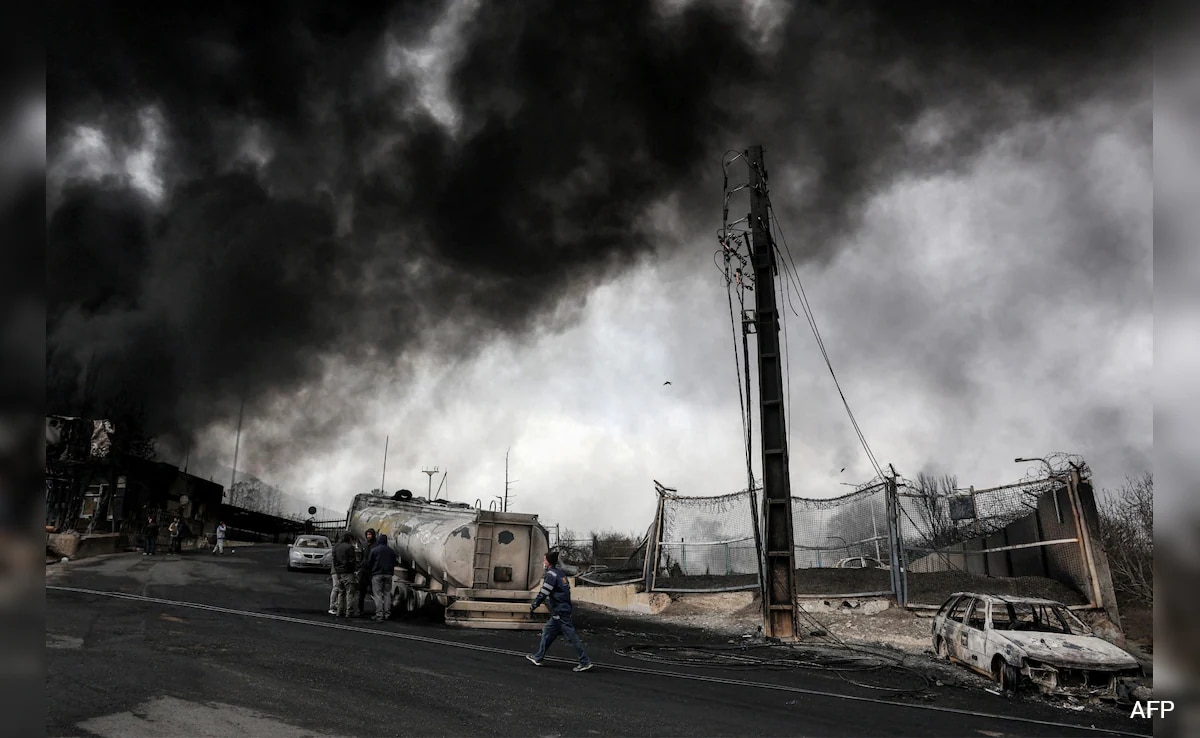
For decades, the residents of Tehran have looked at the Alborz Mountains as a barometer of their own survival. On a clear day, the jagged peaks are a reminder of the city’s rugged beauty. Most days, however, the mountains simply vanish. They are swallowed by a thick, brownish-gray veil that smells of sulfur and burnt rubber. This is not just smog. It is a slow-motion public health catastrophe that has effectively turned the Iranian capital into a laboratory for unintended chemical warfare against its own population.
While international headlines focus on uranium enrichment and regional proxies, a more immediate threat is killing Iranians in their living rooms. The air in Tehran is frequently so toxic that it exceeds World Health Organization safety limits by ten times or more. This is not an accident of geography, though the city’s bowl-like topography certainly traps the filth. It is the direct result of a desperate, sanctions-hit economy relying on "mazut"—a low-quality, high-sulfur fuel oil—to keep the lights on and the factories running. When a country can no longer sell its high-grade energy on the open market and lacks the infrastructure to refine it cleanly, it burns the dregs. The result is a domestic population breathing in the waste products of a stalled revolution.
The Mazut Trap
To understand the crisis, one must look at the bottom of the barrel. Literally. Mazut is a heavy, viscous residual fuel used in shipping and power plants. In most developed nations, its use is strictly regulated or banned near population centers because of its astronomical sulfur content. In Iran, it has become a staple.
When the winter temperatures drop, the demand for natural gas skyrockets as millions of Iranians turn up their heaters. The government faces a binary choice: let the people freeze or divert natural gas from power plants to homes. To prevent a total blackout, the state switches the power plants to mazut.
This creates a lethal feedback loop. The burning of this heavy oil releases massive quantities of sulfur dioxide ($SO_2$) and particulate matter known as $PM_{2.5}$. These particles are small enough to enter the bloodstream directly through the lungs. They don't just cause coughing; they trigger strokes, heart attacks, and systemic inflammation. For a veteran observer of Iranian industry, the shift is visible. You can see the smoke change color. It turns a darker, more sinister shade of yellow-black as the plants switch fuels.
A Failed Automotive Legacy
The sky is not only poisoned by power plants. Tehran’s streets are a graveyard for outdated technology. For years, the Iranian automotive market has been a closed loop, dominated by state-backed manufacturers like Iran Khodro and Saipa. These companies produce "zombie cars"—models based on decades-old French or Korean designs that would be illegal to sell in Europe or North America today.
The legendary Paykan may be gone, but its spirit lives on in millions of vehicles with inefficient engines and non-existent catalytic converters. When you combine these ancient engines with "Petro-um," a homegrown, low-quality gasoline produced in domestic refineries not designed for high-octane output, you get a chemical cocktail that stays at street level.
Sanctions played a role here, certainly. When international partners like Peugeot or Renault pulled out, the domestic industry lost access to modern emissions-control technology. But corruption and mismanagement are equally to blame. The state chose to protect a stagnant domestic industry rather than allow the import of cleaner, hybrid, or electric vehicles that could have relieved the pressure on the city's lungs. The result is a city of 12 million people stuck in a 1980s tailpipe.
The Economic Cost of Breath
The Iranian Ministry of Health is occasionally remarkably candid about the toll. Official figures suggest that tens of thousands of deaths annually in Iran are attributed to air pollution. In Tehran alone, the number of "clean air" days in a year can often be counted on one hand.
But the data tells only half the story. The economic drain is staggering.
- Healthcare Collapse: Hospitals are overwhelmed during "inversion" layers, where warm air traps cold, dirty air at ground level. Emergency rooms fill with children and the elderly struggling for breath.
- Lost Productivity: Schools and government offices are frequently shut down for days at a time to keep people off the streets. This isn't a vacation; it’s a desperate attempt to lower the body count.
- Brain Drain: The middle class and the intellectual elite are increasingly citing "the environment" as a primary reason for emigration. If you can’t breathe the air, you can’t build a future.
This is the true cost of the "resistance economy." By prioritizing geopolitical survival over environmental standards, the leadership has mortgaged the health of the next three generations.
The Geography of Inequality
Not all of Tehran breathes the same air. The city is tilted, both literally and figuratively. The wealthy reside in the northern districts, higher up the slopes of the Alborz, where the air is marginally thinner and slightly cleaner. The working class and the poor live in the southern districts, closer to the industrial belts and the heavy traffic of the central bazaar.
In the south, the air is thick enough to taste. It tastes of metal and sulfur. Chronic respiratory issues are not a "risk" here; they are a standard part of childhood. This geographical divide creates a simmering resentment. When the government issues a "stay at home" order, the affluent can hunker down with high-end air purifiers. The day laborers in the south must still go out into the haze to earn a living.
The Infrastructure Illusion
There is a common misconception that Iran lacks the technical skill to fix this. That is false. Iran has some of the finest engineers in the Middle East. The problem is a lack of capital and a shift in priorities.
Modernizing a single refinery to produce Euro-5 standard gasoline costs billions of dollars. Renewing the bus fleet with electric vehicles requires international supply chains that are currently severed. The government has tried to implement "odd-even" driving days based on license plate numbers, but the wealthy simply buy two cars—one with an odd plate and one with an even one.
The state has also invested in a massive metro system, which is genuinely impressive and moves millions of people. But it is a bandage on a sucking chest wound. The metro cannot offset the millions of two-stroke motorcycles that swarm the streets like locusts, emitting more pollutants than a dozen modern sedans combined.
The Silence of the Scientists
Environmental activism in Iran is a dangerous profession. In recent years, several prominent environmentalists have been arrested and accused of espionage. The message from the security apparatus is clear: you can talk about the weather, but do not talk about the systemic failures that make the weather lethal.
This crackdown has stifled the very expertise needed to solve the crisis. When researchers are afraid to map the exact movement of pollutants or point out which specific IRGC-linked factories are the worst offenders, the policy-making process becomes a guessing game. You cannot fix what you are not allowed to measure.
The Reality of Chemical Inhalation
To call this "smog" is a polite fiction. It is a slow-motion chemical exposure. Sulfur dioxide reacts with the moisture in the human lung to form a mild sulfuric acid. Nitrogen oxides ($NO_x$) irritate the airways and contribute to the formation of ground-level ozone, a powerful oxidant.
In a traditional war, these chemicals would be classified as agents of mass destruction if delivered via artillery. In Tehran, they are delivered via the commute. The long-term effects on the Iranian genome, on cancer rates, and on cognitive development in children are currently being documented in real-time. This is an unplanned experiment in how much poison a human population can tolerate before the social fabric frays.
The "Tehran Cough" is now a permanent feature of the urban experience. It is a dry, hacking sound heard in every cafe and office. It is the sound of a city's lungs scarring.
The Path to a Clear Sky
The solution is not a mystery, but it is expensive and politically painful.
- De-linking the Power Grid from Mazut: This requires a massive investment in renewable energy—ironic for a country with some of the highest solar potential in the world—and an end to the "free" energy subsidies that encourage waste.
- Ending the Automotive Monopoly: Opening the market to fuel-efficient imports would force domestic manufacturers to innovate or die.
- Regional Cooperation: Dust storms from Iraq and Saudi Arabia exacerbate the local pollution. No amount of internal reform will work without a regional environmental pact.
The current trajectory is unsustainable. A state can survive many things—sanctions, protests, even war—but it cannot survive the literal suffocation of its heart. The mountains are still there, behind the gray wall. Whether the next generation will be able to see them, or even breathe long enough to reach them, depends on a fundamental pivot in how the Iranian state values the lives of its citizens over the survival of its machines.
Check the air quality index on your phone the next time you hear a report about Iranian "strength." If the number is over 150, the country is currently losing its most important war.
Ask me to analyze the specific respiratory health data emerging from Tehran's southern districts.