The Cold Reality of a Warm Hearth
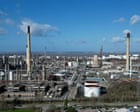
Rain slicked the pavement outside the Stanlow oil refinery in Cheshire, a sprawling industrial cathedral of steel and steam that provides roughly a sixth of Britain’s road fuel. Inside the warmth of a nearby terrace house, a woman named Sarah—let’s call her that for the sake of every person currently staring at a rising utility bill—turned up her thermostat by a single degree. To Sarah, the refinery is a silhouette on the horizon, a symbol of national infrastructure and the mundane necessity of keeping the lights on.
She doesn’t see the money. Nobody does.
We think of oil as a physical substance, a viscous black liquid pumped from the earth and funneled through pipes. But in the modern age, oil is a ghost. It is a series of ledger entries, a flicker of digits on a screen in a glass tower thousands of miles away. While Sarah worries about the cost of a full tank of petrol, a silent migration of debt is happening behind the scenes, moving through the cracks of international law like smoke through a keyhole.
This is not a story about pipes. It is a story about the sleight of hand required to keep a refinery running when the world’s geopolitics catch fire.
The Debt That Traveled East
At the heart of this narrative sits the Essar Group, a titan of industry owned by the billionaire Ruia brothers. They own Stanlow. They are the gatekeepers of that sixth of the UK's fuel supply. But even titans have creditors.
Before the world changed in February 2022, Essar’s UK arm owed hundreds of millions of dollars to Russian banks. Specifically, VTB Bank and Sberbank. These weren't just lenders; they were the financial bedrock of the Russian state. When tanks rolled across the Ukrainian border, those banks became radioactive. Sanctions descended like a guillotine. Suddenly, owing money to a sanctioned Russian entity wasn't just a business headache—it was a potential legal catastrophe that could paralyze a refinery vital to the British economy.
Imagine you owe a debt to a neighbor who has suddenly been banned from every shop in town. If you hand him cash over the fence, you’re breaking the law. If you don't pay him, your own credit might collapse.
Essar found itself in a financial pincer movement. The refinery needed to stay open. The British government needed the fuel. But the Russian debt was a ticking time bomb buried in the balance sheet.
The Art of the Offshore Shuffle
What happened next is a masterclass in the gray zones of global finance. It involves a journey from the industrial heart of England to the sun-drenched, secretive corridors of the British Virgin Islands (BVI) and Cyprus.
Documents revealed a sophisticated maneuver. The debt—roughly $400 million—wasn't simply paid back. That would have triggered the very sanctions Essar needed to avoid. Instead, the loans were moved. They were transferred from the UK-based refinery company to a different branch of the family tree: a subsidiary based in the BVI, a jurisdiction where the reach of certain UK sanctions felt much more like a suggestion than a command.
Consider a magician on a stage. He holds a red ball in his right hand. He closes his fist, whispers a word, and opens it to show the ball has vanished, only to reappear in his left pocket. The ball still exists. The debt didn't evaporate. It just moved to a pocket where the inspectors weren't allowed to reach.
By shifting these Russian loans to an offshore entity, the refinery’s direct books were scrubbed clean of the Russian stain. It allowed the lights to stay on at Stanlow. It kept the fuel flowing to Sarah’s car and the trucks that stock the grocery stores. But it raised a haunting question about the efficacy of global sanctions: if a debt can simply be reassigned to a tropical island, do the rules actually exist?
The Human Cost of High Finance
We often speak of sanctions as "surgical strikes" against an economy. We imagine they target only the elite, the oligarchs with their superyachts and their penthouses in Belgravia. But sanctions are more like weather systems. They change the atmosphere for everyone.
The "invisible stakes" here aren't just about whether a billionaire pays back a bank. They are about the integrity of a system that we are all forced to trust. When a major national asset like an oil refinery utilizes offshore loopholes to manage Russian debt, it creates a sense of profound vertigo for the average citizen.
Sarah, paying her taxes and following the rules, sees her cost of living spike because of global instability. Meanwhile, the entities providing her fuel are navigating a different reality entirely—one where boundaries are fluid and "prohibited" is a term subject to creative interpretation.
The refinery workers in Cheshire go to work every day, donning their high-vis vests and monitoring the pressure valves. They are the physical reality of the business. They deal with heat, grease, and the roar of the machinery. Their lives are grounded in the tangible. Yet, the survival of their workplace depended on a digital paper trail winding through tax havens they will likely never visit. This disconnect between the physical labor of energy production and the ethereal world of offshore finance is where the modern soul begins to ache.
The Moral Friction of Necessity
There is a defense to be made, of course. It is the defense of pragmatism.
If Stanlow had collapsed under the weight of sanctioned debt, the UK would have faced a fuel crisis of staggering proportions. Queues at the pumps. Empty shelves. A blow to the GDP that would have felt like a physical assault. The move to shift the debt could be framed as a rescue mission—a necessary bypass surgery to keep the heart of British transport beating.
But this brings us to the core of the friction. Is it better to bypass the law to save the economy, or to uphold the principle at the risk of the people?
The British government found itself in a delicate dance. They needed the refinery. They also needed to appear tough on the Kremlin. By allowing—or perhaps simply failing to prevent—the offshore migration of these loans, they accepted a compromise. It was a silent agreement that some entities are simply too big to be bound by the same gravity that pulls on the rest of us.
The complexity of these arrangements is designed to be exhausting. It is meant to make the reader turn away, to mutter "it’s just business" and move on. But we cannot afford to move on. When we look at the diagrams of subsidiaries and the flowcharts of debt assignments, we are looking at the architecture of our own world.
The Paper Trail to Nowhere
In the British Virgin Islands, there are no refineries. There are no smokestacks. There are only filing cabinets.
In those cabinets lie the fates of European energy security. The "Russian loans" moved through these folders like ghosts. The money originally came from the coffers of banks inextricably linked to a war effort. Even if the debt is moved to a sunny island, the origin of that capital remains unchanged. It is blood-wealth, repurposed through the alchemy of corporate restructuring.
The Ruia family has navigated these waters for decades. They are survivors of the highest order, masters of the pivot. Their ability to move $400 million through the eye of a needle is a testament to their skill—and a glaring indictment of the loopholes that define our global financial order.
We are told that the world is more connected than ever. That is a lie. The world is fragmented. There is the world of the citizen, bound by the laws of their land, and there is the world of the global corporation, which exists in the spaces between those laws.
The Lingering Vapor
The rain hasn't stopped in Cheshire. The flares from the Stanlow chimneys still flicker against the gray sky, a constant reminder of the power required to move a nation.
We want to believe that the things we depend on—the fuel in our cars, the warmth in our homes—are part of a transparent, ethical chain. We want to believe that when our leaders announce sanctions, those sanctions have teeth. But the story of the refinery and its wandering debt suggests a more cynical truth.
Sanctions are a wall built of bricks, but the bricks are not mortared together. There are gaps. There are spaces just wide enough for a billion-dollar loan to slip through if it’s dressed in the right paperwork.
Sarah turns off the light and goes to bed, unaware that the warmth in her radiators was secured by a frantic, offshore shell game. She sleeps in a house heated by the ghost of a Russian loan, filtered through a Caribbean breeze, and delivered by a company that knows exactly how to vanish when the spotlight gets too bright.
The refinery remains. The debt remains. Only the names on the folders have changed.
In the end, the most powerful thing in the world isn't oil. It’s the ability to make the obvious disappear.