The air inside the Völklingen Ironworks used to taste like soot and sweat. It was a thick, metallic tang that settled in the back of your throat and stayed there for decades. For over a century, this massive skeleton of pipes and furnaces in Germany’s Saarland region was a cathedral of industry. It was a place where fire met ore to forge the backbone of the modern world. Then, in 1986, the fires went out. The silence that followed wasn't peaceful; it was heavy.
When a site like this is added to the UNESCO World Heritage list, it is often a death sentence disguised as an honor. We preserve the stones, but we lose the spirit. The machinery becomes a ghost, a hollow reminder of a time when the Earth shook under the weight of production. But something strange is happening in the shadows of these rusted giants. The rust is blooming.
The Ghost in the Machine
Walking through the sintering plant today feels like trespassing on the set of a post-apocalyptic film. Huge, weathered conduits snake overhead like the arteries of a titan. In its heyday, thousands of men swarmed these walkways, their lives governed by the unrelenting rhythm of the blast furnace. It was dangerous, loud, and dirty. It was also the heartbeat of a community. When the works closed, the heart stopped.
Traditional preservationists would have you look at the technical prowess of the "Roheisen" production. They would point to the 19th-century engineering and the scale of the charging gallery. But facts are cold. They don't capture the vertigo you feel looking up at the 45-meter-high furnaces. They don't explain why a group of artists would choose to spend months inside a freezing, damp industrial ruin to paint, sculpt, and build.
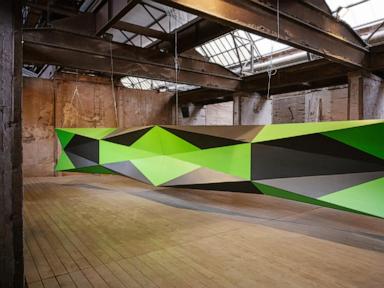
The "UrbanArt Biennale" has transformed this graveyard into a gallery. It isn't a clean, white-walled gallery where you whisper and keep your hands behind your back. It is a riot. Over eighty artists from around the world have descended upon the site, treating the decaying iron as a canvas. They aren't just decorating a corpse; they are performing a resuscitation.
Where Street Art Meets Smelting
Consider a hypothetical artist—let’s call her Elena. Elena doesn't work with oil on canvas. She works with light, spray paint, and the physics of crumbling concrete. When she enters the "Paradiso"—the former coking plant—she isn't looking for a flat surface. She is looking for the way the light hits a rusted valve at 4:00 PM. She sees a story in the grime.
This isn't about graffiti in the way most people understand it. This is about the dialogue between the ephemeral and the eternal. Street art, by its nature, is temporary. It fades, it gets painted over, it disappears. The Ironworks, conversely, were built to last forever. By putting "temporary" art on "permanent" monuments, the project forces us to confront the reality of change.
The contrast is jarring. You might see a massive, hyper-realistic mural of a human eye staring out from a wall that once shielded workers from molten slag. You might find a delicate sculpture made of recycled plastic sitting inside a chamber that used to reach temperatures of $1200^{\circ}C$. The heat is gone, replaced by a different kind of energy.
The Invisible Stakes of Memory
Why does this matter? Why not just tear it down or keep it as a pristine museum?
Because a city that forgets its labor is a city that loses its soul. If we turn the Völklingen Ironworks into a sterile park with neat little placards, we lie about what happened there. We forget the exhaustion. We forget the pride. By allowing artists to "interfere" with the site, UNESCO and the site managers are admitting that the history of the place is still being written.
The stakes are found in the eyes of the former steelworkers who still live in the town. For them, the works aren't a "World Heritage Site." They are the place where their fathers died or where they earned the money to buy their first home. When they see a world-renowned artist from New York or Paris honoring their workspace, the narrative shifts. Their labor is no longer an obsolete relic; it is the foundation for something beautiful.
The transition from "Industrial Giant" to "Cultural Hub" is often clumsy. Usually, it involves a gift shop and a cafe. Here, it involves a confrontation with the scale of human ambition. You feel small next to the furnaces, not because of the machinery, but because of the sheer volume of human will required to keep them burning for 113 years.
The Geometry of Decay
There is a specific beauty in things that are falling apart. Architects call it "ruin porn," but that feels too cynical for what’s happening in Saarland. It’s more like an ecological succession of the mind.
Nature is already reclaiming the site. Moss grows in the cracks of the Ore Shed. Birch trees sprout from the tops of the water towers. The artists are simply the latest species to inhabit the ecosystem. They use the rust. They don't scrape it away; they integrate it.
One installation uses the acoustics of the Blower House—a hall so vast it could swallow a cathedral. In the past, the roar of the machines was deafening. Now, an artist might use a single, looping cello note that bounces off the steel walls, creating a haunting resonance that mimics the ghost of the industrial hum. It makes you realize that silence isn't the absence of sound; it's the presence of what's missing.
Resisting the Polish
We live in an age of the "polished." Everything is filtered, smoothed, and digitized. Our cities are increasingly becoming identical clusters of glass and steel. In this context, the Völklingen Ironworks is a slap in the face. It is jagged. It is stained. It is unapologetically heavy.
The artists involved in the current exhibition understand this. They aren't trying to make the ironworks "pretty." They are trying to make it loud again. They are using vibrant oranges, deep blues, and structural interventions to draw the eye to the parts of the site we might otherwise overlook—the rivets, the stains, the scars of a century of fire.
It forces a question: what do we value? If we only value the new, we are constantly living in a state of disposal. If we only value the old as it was, we are living in a tomb. The middle ground—the "Third Space"—is where the art lives. It’s the moment when a visitor stops looking at their phone and realizes they are standing in the throat of a beast that once fed the world.
A New Kind of Pilgrimage
Travel used to be about seeing the "perfect." People went to the Louvre or the Colosseum to see the pinnacles of civilization. But there is a growing movement toward the "authentic," even when that authenticity is scarred.
The people visiting the ironworks now aren't just history buffs. They are photographers, urban explorers, and families. They come because they want to feel something that isn't manufactured. You can’t fake the scale of a blast furnace. You can’t simulate the smell of damp iron and time.
As you walk through the "Dark Coasts" of the lower levels, the temperature drops. The light becomes a luxury. It is here, in the bowels of the plant, that the art feels most subversive. A neon light flickering in a pitch-black corridor isn't just an installation; it’s a heartbeat.
The iron hasn't changed. The $Fe$ molecules are the same ones that were forged in the heat of the furnace decades ago. What has changed is our relationship to it. We no longer see it as a tool for production, but as a vessel for meaning.
The Final Shift
The shift is ending. Not the shift of the workers, which ended in 1986, but the shift of the site's identity. It has successfully moved from a place of "doing" to a place of "being."
The artists will eventually pack up their tools. Some of the murals will flake away. The wind will continue to howl through the pipes of the charging gallery. But the ironworks will never be silent again. Once you have seen a place through the eyes of a visionary, you can never go back to seeing it as just a pile of scrap metal.
The iron is cold, but the story is white-hot. It is a story of survival, not of the machinery, but of the human impulse to create something out of the wreckage. We are a species that cannot help but leave our mark. We did it with soot and fire in 1873, and we are doing it with paint and light today.
The rusted skeleton stands against the German sky, no longer a monument to what we used to be, but a testament to what we can become when we stop trying to bury the past and start dancing with it.
The fires are out, but the glow remains.