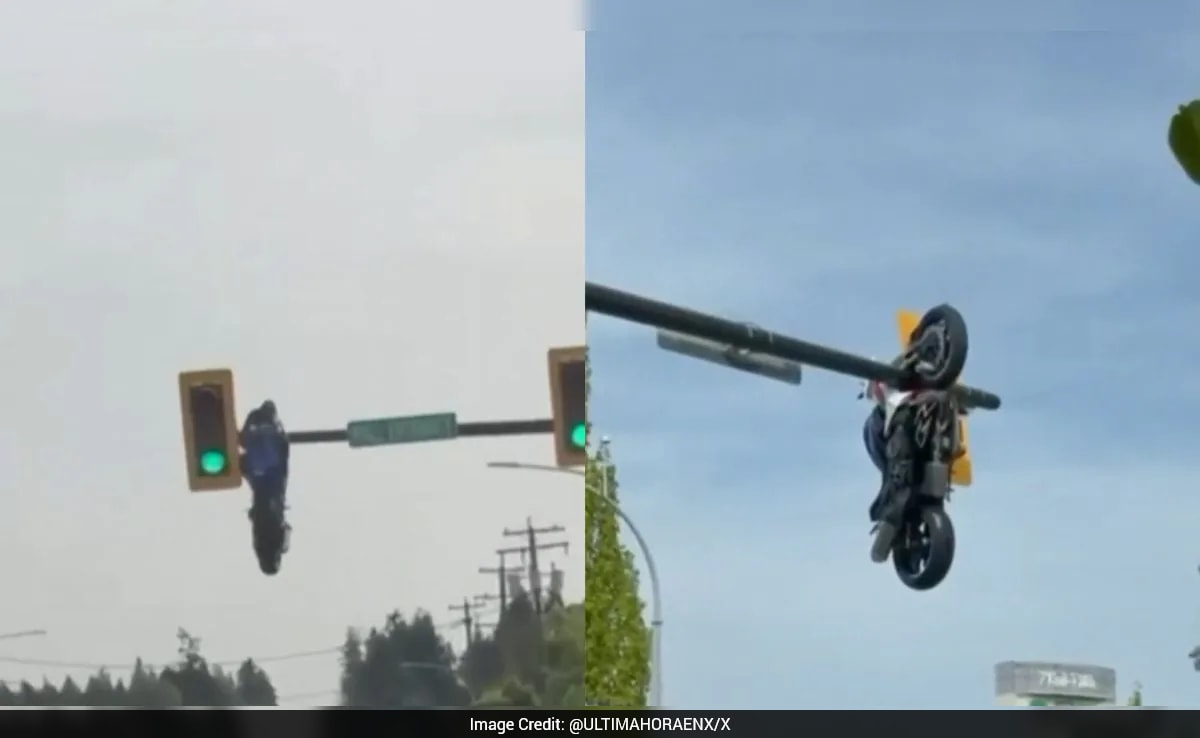
The suspension of a motorcycle from a high-altitude traffic signal structure represents a rare intersection of extreme kinetic energy transfer and specific structural engineering failure points. While standard collision reporting focuses on the narrative of the rider’s injury, a rigorous analysis must prioritize the Mechanical Vector Exchange: how a lateral ground-level movement converts into a vertical displacement sufficient to overcome gravitational pull and snag a vehicle ten to fifteen feet above the asphalt. This event in Canada provides a definitive case study in high-velocity energy redirection and the structural vulnerabilities of urban intersection hardware.
The Triad of Kinetic Conversion
To understand how a motorcycle achieves verticality following a collision, we must quantify three distinct variables: the Approach Velocity ($v_i$), the Fulcrum Efficiency, and the Tensile Snag Factor.
- Velocity Thresholds: For a standard 200kg motorcycle to reach a height of 4 meters (the approximate height of a municipal traffic light arm), it requires a minimum upward vertical velocity component ($v_y$) dictated by the conservation of energy. Ignoring air resistance, $mgh = \frac{1}{2}mv^2$ suggests a launch speed exceeding 32 km/h in the vertical direction alone. Given that the initial vector is horizontal, the total impact speed must be significantly higher to account for energy lost to friction, deformation, and the primary collision.
- The Fulcrum Mechanism: A vehicle does not simply "bounce" upward. This displacement requires a ramp or a rotational pivot. In urban collisions, this is often provided by the bumper of a secondary vehicle or the angled geometry of a concrete median. When the front tire meets a rigid, low-profile obstacle, the rear of the bike acts as a lever, converting forward momentum into a pitch-over rotation.
- Centripetal Snagging: The final positioning—hanging from the light—indicates that the vehicle's frame, footpegs, or chain assembly acted as a mechanical hook. This suggests the vehicle was in a state of high-angular velocity (tumbling) when it intersected with the horizontal mast arm of the traffic signal.
Structural Integrity of Traffic Mast Arms
Traffic signals are designed to withstand significant wind loads and the static weight of signal heads, but they are not rated for the dynamic, high-impulse impact of a 400-pound projectile. The fact that the light remained standing while supporting the motorcycle reveals specific tolerances in Canadian civil engineering standards.
Shear Bolt Dynamics
Most modern traffic poles utilize Frangible Bases. These are designed to shear off when struck at the base to prevent the pole from acting as a rigid "unmovable object" that kills motorists. However, when the impact occurs at the horizontal arm (the mast), the physics change. The arm acts as a cantilevered beam. The torque ($\tau$) applied by a motorcycle hanging at the end of a 20-foot arm is calculated by $\tau = rF$, where $r$ is the distance from the pole and $F$ is the weight of the bike.
The structural survival of the signal indicates that the "Dead Load" safety factor of the arm—typically designed to handle heavy ice accumulation and wind pressure—was sufficient to temporarily hold the vehicle's mass. This creates a secondary hazard: Harmonic Oscillation. The weight of the hanging motorcycle introduces a frequency that the pole was never damped to handle, risking a delayed structural collapse of the entire assembly onto the recovery teams below.
Biophysical Impact and Rider Ejection
The survival of the rider in such an extreme vertical displacement event is governed by the Ejection Timing Window. In many high-side or "vaulting" crashes, the rider is separated from the machine within the first 50 milliseconds of impact.
- Deceleration Trajectory: If the rider remains attached to the bike during the ascent, the G-forces experienced during the "snag" at the top of the arc would likely be fatal due to internal organ shearing.
- Decoupled Ballistics: The "best-case" scenario for survival—though still resulting in critical injury—is a decoupling where the bike travels upward and the rider is projected forward and away from the rigid structure.
- Impact Surface Variability: Survival in these instances depends less on the "safety gear" and more on the angle of incidence upon landing. A rider falling from a height of 10 feet onto asphalt faces a high probability of axial loading injuries to the spine.
Operational Limitations of Urban Recovery
The presence of a vehicle suspended in the "dead zone" above an intersection creates a unique logistical bottleneck for emergency responders. Standard heavy-duty tow trucks are designed for lateral pulls; they lack the vertical lift capability or the finesse required to disengage a snagged frame without causing a secondary fall.
The Recovery Protocol
- Electrification Clearance: Before physical contact, the municipal power grid must be de-energized. Traffic lights carry 120V to 240V circuits; a metallic motorcycle frame bridging the gap between a signal housing and the mast arm can energize the entire vehicle.
- Aerial Platform Stabilization: Fire departments must utilize "Bucket Trucks" or aerial ladders to secure the vehicle with straps before the tension on the mast arm is released.
- Forensic Trajectory Analysis: For investigators, the "Hang Point" is a data goldmine. The specific height and angle of the snag allow accident reconstructionists to backtrack the exact velocity and angle of the primary impact with a margin of error of less than 5%.
Urban Infrastructure as a Kinetic Filter
This incident highlights a flaw in "Passive Safety" designs of modern cities. Our streets are designed for 2D crashes—side-swipes, rear-ends, and head-ons. We have installed guardrails and energy-absorbing water barrels at ground level. However, we have zero "3D Mitigation."
As vehicle speeds in urban corridors continue to fluctuate and motorcycle power-to-weight ratios increase, the likelihood of "Aerial Incursion" grows. The "Three Pillars of Urban Kinetic Defense" currently only address the first two:
- Pillar 1: Speed Regulation (Prevention)
- Pillar 2: Ground-Level Energy Absorption (Mitigation)
- Pillar 3: Vertical Obstacle Shielding (Non-Existent)
The lack of shielding on horizontal mast arms means that any vehicle that becomes airborne—whether through a "ramp" effect or a high-speed tumble—finds no energy-absorbing material on the structures it is most likely to hit. The result is a rigid, high-impulse stop that either shears the infrastructure or, as seen here, captures the vehicle in a precarious state of potential energy.
Strategic Recommendation for Municipal Risk Assessment
City planners and transportation engineers must transition from a "Static Load" mindset to a "Dynamic Impact" model for all overhead signage. The current standards are insufficient for the rising frequency of high-energy urban collisions.
Immediate action requires a two-pronged approach:
- Implementation of Deflection Geometry: Redesigning the cross-section of traffic mast arms from a circular or octagonal shape to a "V" or "D" shape to encourage projectile deflection rather than mechanical snagging.
- Stress-Test Re-certification: Intersections identified as high-speed corridors must have their signal structures re-evaluated for "Sudden Point Load" capacity. If a structure cannot support the weight of a hanging vehicle, it must be reinforced or fitted with a breakaway mast arm to prevent the entire pole from collapsing into traffic.
The suspension of a motorcycle ten feet in the air is not a "freak accident"; it is a predictable outcome of high-velocity physics meeting rigid, unshielded overhead infrastructure. Engineering the "Vertical Crash" is the next requirement for urban safety evolution.