The Volatility of Presence: Decoding the Taiwan Strait Airspace
The sudden reduction in People’s Liberation Army (PLA) sorties within Taiwan’s Air Defense Identification Zone (ADIZ) during periods of high-intensity US kinetic action in the Middle East is rarely a coincidence of logistics. It is a calculated recalibration of strategic bandwidth. While casual observers might attribute these fluctuations to weather or routine maintenance cycles, a structural analysis reveals a sophisticated interplay between global theater prioritization and the conservation of operational readiness.
When the United States military executes strikes against Iranian-backed assets, the global security architecture shifts from a steady-state posture to an active-response phase. For the Central Military Commission (CMC) in Beijing, this shift triggers a specific set of logic gates regarding the utility of aerial incursions. Meanwhile, you can find similar stories here: The Cold Truth About Russias Crumbling Power Grid.
The Three Pillars of Aerial Posturing
To understand the decline in sorties, one must categorize the objectives of PLA flights into three distinct pillars. Each pillar responds differently to a shift in US focus toward another theater.
- Operational Conditioning and Data Collection: Constant flights allow the PLA to map Taiwan's radar signatures, response times, and pilot fatigue thresholds. This is a long-term data acquisition project.
- Psychological Attrition: The persistent presence aims to normalize the threat, gradually eroding the alert-readiness of the Republic of China Air Force (ROCAF).
- Geopolitical Signal Transmission: Sorties serve as a visible, non-kinetic signal to the United States and regional allies.
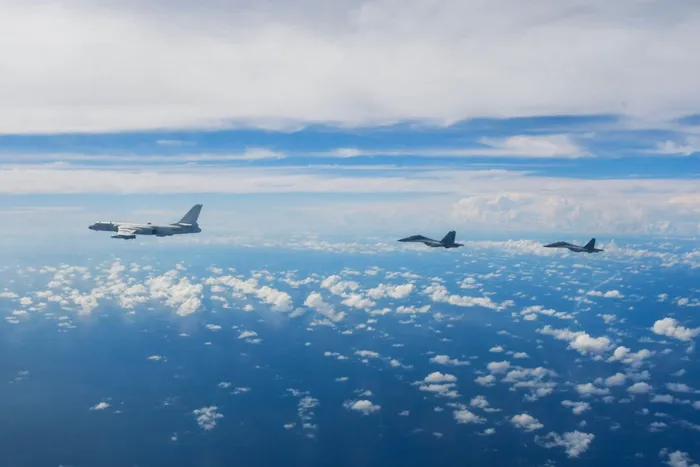
When US kinetic action occurs in the Middle East, the "Geopolitical Signal Transmission" pillar undergoes a significant change in its cost-to-benefit ratio. If the US is already fully engaged in a high-stakes kinetic environment, the marginal signaling value of an extra 20 J-16 sorties near the median line drops. Conversely, the risk of a miscalculation or an unintended escalation increases during a period of high US combat alertness. To explore the bigger picture, check out the excellent article by TIME.
The Strategic Bandwidth Bottleneck
The decision to scale back flights is not an admission of weakness; it is an exercise in strategic bandwidth management. In any military organization, high-level command and control (C2) resources are finite. Monitoring a US strike campaign against Iranian assets requires the full attention of intelligence and satellite assets that might otherwise be allocated to supervising the tactical details of Taiwan-centric maneuvers.
The Signal-to-Noise Ratio in Global Posturing
A concentrated US military action creates a high-noise environment. For China to effectively "signal" through air power, it requires the adversary to have the bandwidth to receive and interpret that signal exactly as intended. If the Pentagon is focused on battle damage assessments (BDA) in Yemen or Iraq, a standard mass-sortie event in the Taiwan Strait might be ignored or, worse, misinterpreted as a secondary front opening.
Beijing’s tactical pause or reduction likely serves as a "wait-and-see" protocol. By lowering the kinetic temperature in the Taiwan Strait while the US is occupied elsewhere, the PLA avoids a situation where they are forced into a reactive cycle they did not initiate. This reflects a preference for controlled escalation over opportunistic chaos.
The Operational Cost Function of Maintenance and Readiness
Every hour of flight time for an airframe like the J-20 or the H-6K involves a heavy maintenance-to-flight-hour ratio. If the current global geopolitical climate suggests that a major confrontation is less likely in the Pacific because the US is bogged down in the Middle East, there is no immediate utility in burning through the airframe life of front-line fighters.
This is the Readiness Conservation Principle. If the strategic objective (unification or regional dominance) is long-term, the preservation of peak operational capacity for a more "optimal" window is the logical choice. A surge in activity during a US-Middle East conflict would only be rational if the intent was to seize a brief window of distraction to launch a full-scale operation—an event that carries a threshold of risk far beyond routine ADIZ incursions.
Inter-Theater Synchronization and Intelligence Reallocation
The reduction in flight volume likely correlates with a reallocation of signals intelligence (SIGINT) and electronic intelligence (ELINT) assets. When US forces engage in live combat, they utilize specific communication protocols, electronic warfare suites, and satellite link-ups that are rarely seen during peacetime drills.
For the PLA, the priority shifts from flying circles around Taiwan to "listening" to how the US conducts its strikes. This intelligence-gathering opportunity is far more valuable than a routine flight. The decreased sortie count in the Taiwan Strait may simply be the visual byproduct of a shift in focus toward the Western Pacific's listening posts and satellite surveillance of US carrier strike group movements and communication bursts related to the Middle East operations.
The Bottleneck of Tactical Ambiguity
A core risk in maintaining high sortie volumes during another nation's active conflict is the loss of tactical ambiguity. The PLA's current strategy relies on being "predictably unpredictable." If they maintain high activity while the US is in a combat mindset, they risk a "tripwire" event.
The ROCAF's response protocols are also heightened during global instability. A ROCAF pilot, aware of the global tension, may be more prone to a kinetic reaction than they would be during a standard Tuesday afternoon in a peaceful month. The PLA’s reduction in flights is a mechanism to lower the probability of an accidental engagement that neither Beijing nor Washington is currently prepared to escalate into a full-scale war.
Structural Logic of the Tactical Pause
This phenomenon can be broken down into a logical framework:
- Variable A: US Kinetic Engagement (Middle East).
- Variable B: PLA Command Bandwidth.
- Variable C: Intelligence Collection Priority.
- Variable D: Risk of Unintended Escalation.
If A increases, D increases significantly. To mitigate D while maximizing C, the military reduces the frequency of B’s tactical output (sorties) to allow for higher focus on strategic observation.
Strategic Recalibration: The Path Forward
The observation that PLA flights drop when the US strikes elsewhere provides a clear blueprint for future monitoring. The correlation suggests that China views its regional air activity not as an isolated military exercise, but as a component of a global chess match.
The next logical step for analysts and defense planners is to monitor the composition of the flights that do remain. Are they primarily long-range ISR (Intelligence, Surveillance, and Reconnaissance) platforms? If the volume drops but the percentage of ELINT-capable aircraft rises, it confirms the shift from harassment to observation.
Monitoring the turnaround time of these airframes following a period of inactivity will also reveal the true state of PLA logistics. A rapid surge in flights immediately after the US concludes its Middle East operations would indicate that the reduction was indeed a "readiness hold" rather than a genuine change in policy.
Planners should anticipate that any future US engagement in a third theater—be it the Middle East or Eastern Europe—will create a temporary "vacuum of presence" in the Taiwan Strait. This is not a sign of de-escalation; it is a strategic repositioning of assets into a high-readiness, high-observation state, preparing for the moment when the US reorients its focus back to the Pacific.