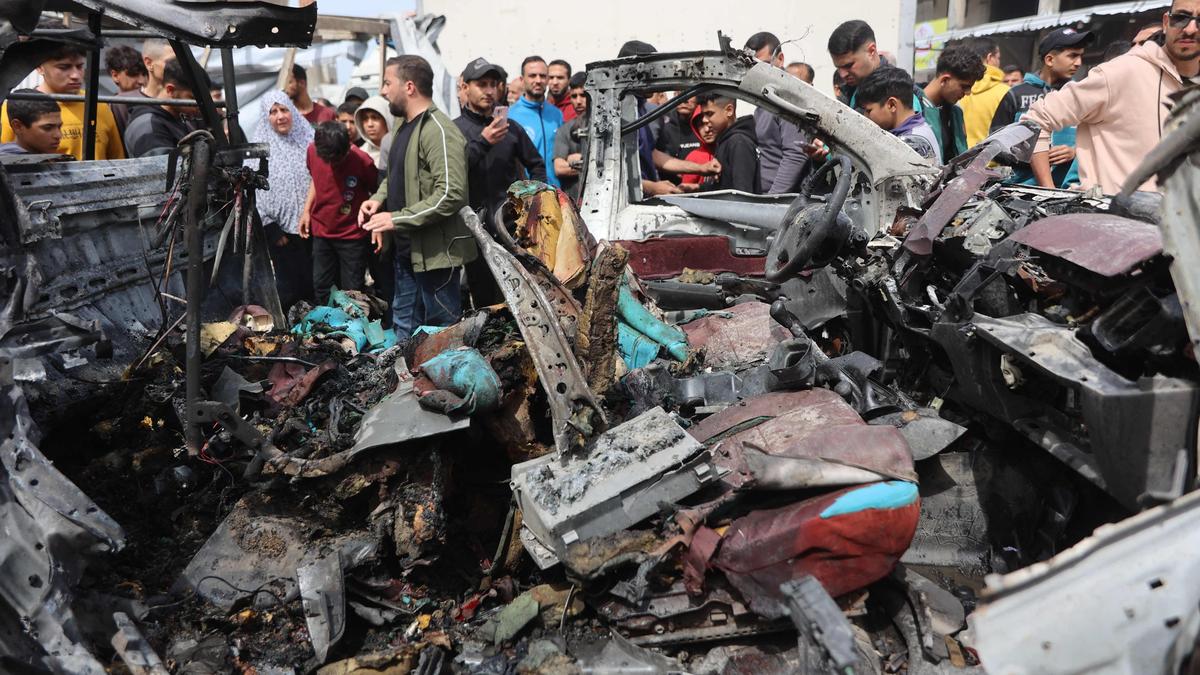
The operational reality of urban warfare in Gaza has shifted from a sequence of isolated military engagements into a systemic failure of civilian protection mechanisms. When a civil defense agency reports the deaths of ten individuals, including a toddler, following targeted strikes, the event serves as a data point for a broader analysis of Kinetic Friction. This concept describes the gap between intended military precision and the actual physical degradation of the civilian environment. The lethal outcome of these strikes is not merely an incident of bad luck; it is the predictable result of three converging structural variables: high-density demographic saturation, the collapse of secondary emergency infrastructure, and the shrinking geography of "deconfliction" zones.
The Triad of Urban Mortality Risk
Analyzing the casualty figures provided by the Gaza Civil Defence requires a breakdown of why specific strikes result in high fatality rates among non-combatants. The lethality of an airstrike in a dense urban grid is governed by the Volume of Effect (VoE).
- Primary Kinetic Energy: The immediate blast radius where overpressure causes instantaneous structural failure and biological trauma.
- Secondary Fragmentation: The conversion of building materials—concrete, glass, and rebar—into projectiles. In Gaza, the prevalence of unreinforced masonry increases the secondary fragmentation yield significantly.
- Tertiary Systemic Failure: The death of survivors due to the inability of first responders to access the site within the "Golden Hour." When civil defense teams are targeted or restricted by active fire, the mortality rate of those trapped under rubble increases exponentially.
The death of a toddler in this context highlights the failure of the Minimum Age of Vulnerability metric. Children have lower physiological thresholds for blast overpressure and a higher surface-area-to-mass ratio, making them more susceptible to secondary fragmentation that an adult might survive.
The Civil Defence Operational Constraint Model
The Gaza Civil Defence operates under a set of constraints that effectively neutralize their ability to mitigate high-casualty events. We can map these constraints as a Depleting Resource Function.
- Material Depletion: The systematic destruction of heavy machinery—bulldozers, excavators, and hydraulic lifts—means that rescue operations are performed manually. Manual extraction increases the time-to-rescue by a factor of ten, often exceeding the survival window for individuals with crush syndrome.
- Communication Blackouts: The intermittent loss of telecommunications prevents the efficient dispatch of units. This leads to a "blind response" strategy where units move toward smoke plumes rather than specific coordinates, wasting fuel and time.
- Personnel Attrition: As rescuers themselves become casualties, the institutional knowledge of the city’s underground utility maps and structural weaknesses disappears. This creates a feedback loop: fewer rescuers lead to more civilian deaths, which increases the psychological and logistical burden on the remaining force.
The reports of 10 deaths in recent strikes indicate that the Strike-to-Casualty Ratio (SCR) is climbing. This suggests that targets are increasingly located in multi-family dwellings where the structural density is highest.
The Geography of Deconfliction and the Density Trap
A core fallacy in the current conflict narrative is the existence of "Safe Zones." From a strategic standpoint, these zones create a Density Trap. By concentrating large populations into smaller geographic footprints (such as Al-Mawasi or specific blocks in central Gaza), the risk of "collateral" damage from a single kinetic event rises.
If a strike occurs near the boundary of a designated safe zone, the high population density ensures that the Circular Error Probable (CEP)—the radius within which 50% of projectiles will land—is almost guaranteed to overlap with civilian shelters. The logic of displacement intended to save lives inadvertently maximizes the casualty yield of any tactical error or intelligence failure.
Structural Integrity and the Long-Tail Mortality Rate
The fatalities reported by Gaza’s emergency services represent only the immediate kinetic impact. A rigorous analysis must account for the Delayed Fatality Coefficient. Many individuals reported as "wounded" in these strikes will eventually succumb to infections or complications due to the destruction of the healthcare supply chain.
- The Sterile Environment Deficit: Without clean water or antiseptic supplies, minor shrapnel wounds become septic.
- Energy Scarcity: The lack of electricity for ventilators and incubators turns manageable injuries into terminal cases.
- The Rubble Burden: It is estimated that thousands remain missing under collapsed buildings. These are statistically dead but uncounted, leading to an underreporting of the true lethality of the campaign by approximately 15% to 20% based on historical precedents in similar urban sieges (e.g., Mosul, Aleppo).
The Intelligence-Kinetic Disconnect
The execution of strikes resulting in the deaths of children suggests a breakdown in the Targeting Lifecycle. In theory, military intelligence evaluates a target based on the military advantage versus the expected civilian loss. However, when the environment is as volatile as Gaza, the data used for these calculations is often stale.
The "Time-Sensitive Target" (TST) protocol often bypasses the more rigorous civilian impact assessments required for static targets. If a target is moving through a residential area, the decision to strike is made in seconds. This creates a Verification Gap where the presence of non-combatants, such as the toddler mentioned in the reports, is either ignored or categorized as an "acceptable" variance in the pursuit of a high-value target.
Tactical Necessity vs. Strategic Erosion
The continued use of high-yield explosives in residential blocks achieves immediate tactical goals—the elimination of specific combatants or infrastructure—but it accelerates Strategic Erosion. Each strike that results in a high civilian-to-combatant ratio delegitimizes the operational framework of the attacking force on the international stage and hardens the resistance of the local population.
From an analytical perspective, we see a shift from Targeted Interdiction to Area Denial. By rendering large swaths of the city uninhabitable through structural demolition, the environment itself becomes a weapon. This displacement triggers a secondary wave of mortality driven by exposure, malnutrition, and the rapid spread of waterborne diseases like Hepatitis A and Cholera, which thrive in the absence of waste management systems.
The civil defense’s inability to manage these 10 deaths is a harbinger of a total system collapse. When the state’s primary emergency response mechanism can no longer provide basic extraction services, the social contract dissolves, and the population enters a state of permanent hyper-vulnerability.
Future stability operations will require a complete overhaul of the Deconfliction Protocol (DP). The current "humanitarian pause" model is insufficient for the scale of structural damage. Effective mitigation would require the introduction of neutral, third-party heavy engineering teams equipped with specialized seismic sensors and thermal imaging to identify survivors beneath the 37 million tons of debris currently estimated to be in the Gaza Strip. Without this technical intervention, the death toll will continue to be driven not by the initial blast, but by the weight of the environment itself.