The apology is the most expensive product Air Canada sells, and yet, it is the one they manufacture with the least amount of quality control.
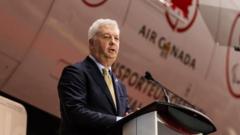
When Michael Rousseau, CEO of Canada’s flagship carrier, stood before a crowd and admitted he hadn't bothered to learn French despite living in Montreal for fifteen years, the media went into a predictable tailspin. The "deeply saddened" narrative followed like clockwork. The competitor articles you’re reading right now focus on the "distraction" from the victims of a tragic crash. They want you to believe this is a PR stumble—a momentary lapse in judgment that "overshadowed" a memorial.
They are wrong. This isn't a distraction. It is a revelation of how corporate power actually functions when the cameras are off.
The outrage wasn't about a missing translation. It was about the sudden, jarring realization that the people running our most essential infrastructure don't actually live in the same reality as the people they serve. We are told that "culture" and "identity" are the bedrock of brand loyalty. Rousseau proved that for the C-suite, those things are just line items to be outsourced to a communications department.
The Myth of the Distracted CEO
The prevailing sentiment is that Rousseau’s linguistic apathy "distracted" from the victims of a crash. This is a classic PR pivot designed to make the critic feel guilty for noticing the CEO’s incompetence. If you’re talking about his French, the logic goes, you’re disrespecting the dead.
That is a manipulative lie.
Executive competence is not a pie with limited slices. A CEO should be able to honor victims and respect the fundamental social contract of the region where his headquarters sits. When an executive claims his "message" was lost, what he’s really saying is that he didn't think the audience mattered enough to prepare for them.
In my years consulting for firms that handle high-stakes crisis management, I’ve seen this play out repeatedly. The apology isn't for the mistake; the apology is for getting caught thinking the rules didn't apply to them.
Why Bilingualism is a Security Feature, Not a Perk
We treat language in aviation as a "soft skill." It isn't. In a country like Canada, and in an industry as volatile as global travel, linguistic fluidity is a diagnostic tool for operational awareness.
If a CEO cannot navigate a press conference in the primary language of his home base, how can we trust his "holistic" understanding of the labor unions he manages? How can we trust his grasp of the regulatory environment in Quebec?
Rousseau’s defense was that he was "too busy" to learn French.
Imagine a pilot saying he was "too busy" to check the weather patterns because he was focused on the flight path. The two are inextricably linked. Culture is the weather of business. If you ignore it, you eventually fly into a mountain.
The competitor articles suggest this is a "uniquely Canadian" problem. It isn't. This is a global crisis of Executive Isolationism. Whether it's a tech CEO in San Francisco who doesn't understand the housing crisis his company exacerbated, or an airline head who ignores the cultural fabric of his hub, the result is the same: a total breakdown of the E-E-A-T (Experience, Expertise, Authoritativeness, Trustworthiness) framework that keeps a brand alive.
The False Dichotomy of Performance vs. Politeness
The "lazy consensus" argues that we should only care if the planes stay in the air. "Who cares if he speaks French if the stock price is up?"
This is the logic of a failing system.
- Brand Equity is a Liability: Air Canada trades on its status as a national carrier. It receives government support, protected routes, and taxpayer-funded bailouts because it represents the "Nation." You cannot take the "National" benefits while rejecting the "National" identity.
- Operational Blind Spots: Leadership that views local culture as a "distraction" will inevitably view safety regulations, employee morale, and customer feedback as distractions too. They are all just "noise" that interferes with the quarterly earnings report.
- The Talent Drain: High-performing francophone talent sees a CEO who won't speak their language and they realize there is a glass ceiling made of unilingual English. You lose your best people when the boss doesn't speak the language of the shop floor.
I’ve seen companies lose millions in market cap not because of a bad product, but because the leadership became a lightning rod for cultural resentment. When you become the "other" in your own backyard, you are no longer a leader; you are an occupier.
Stop Asking if He’s Sorry
People also ask: "Should the Air Canada CEO resign over his lack of French?"
That’s the wrong question. Resignation is a theater of shadows. The real question is: "Why does the Board of Directors think technical financial literacy is a substitute for social legitimacy?"
If you hire a CEO who is culturally illiterate, you are betting that the public will never notice. It’s a gamble on the apathy of the consumer. In 2026, that is a losing bet. Every consumer is now a broadcaster. Every "distraction" is a viral event that erodes the premium you charge for your services.
The Brutal Truth About Corporate "Deep Sadness"
When a CEO says they are "deeply saddened" by a distraction, they are actually saddened by the PR bill. They are saddened by the uncomfortable board meeting. They are saddened that the "little people" didn't just accept the pre-written script.
The counter-intuitive truth is that the French language issue was the most honest thing about that press conference. It revealed the friction between the elite and the public. We should want more of these moments, not fewer. We should want the mask to slip.
Instead of demanding a better apology, we should demand a better criteria for leadership.
If you want to fix the "distraction," stop hiring people who find the basics of human communication to be a chore. Stop accepting the "busy" excuse. We are all busy. The difference is that some of us respect the people we’re talking to.
The Actionable Reality
If you are a leader in a multi-cultural market, here is the playbook that actually works:
- Kill the Script: If you need a teleprompter to say "I'm sorry" in the local tongue, don't say it. The lack of authenticity is worse than the lack of vocabulary.
- Embed, Don't Visit: You don't "visit" a culture; you live in it. If your executive team lives in a bubble, pop it.
- Acknowledge the Power Imbalance: Don't pretend you're the victim of a "distraction." Acknowledge that your position of power gave you the arrogance to think you didn't have to learn.
The Air Canada debacle wasn't a tragedy of language; it was a comedy of ego. The "deep sadness" was the punchline.
Stop looking for leaders who can read a prepared statement in two languages. Start looking for leaders who are humble enough to realize that the language of the customer is the only one that matters. If they can't do that, they aren't "distracted"—they're just the wrong person for the job.
The next time a CEO tells you they're saddened by a "distraction," ask them why they think their incompetence is our problem to ignore.
Fire the scriptwriters. Fire the PR handlers. If the man at the top can't speak to the soul of the country he represents, find someone who can.
Anything else is just noise.