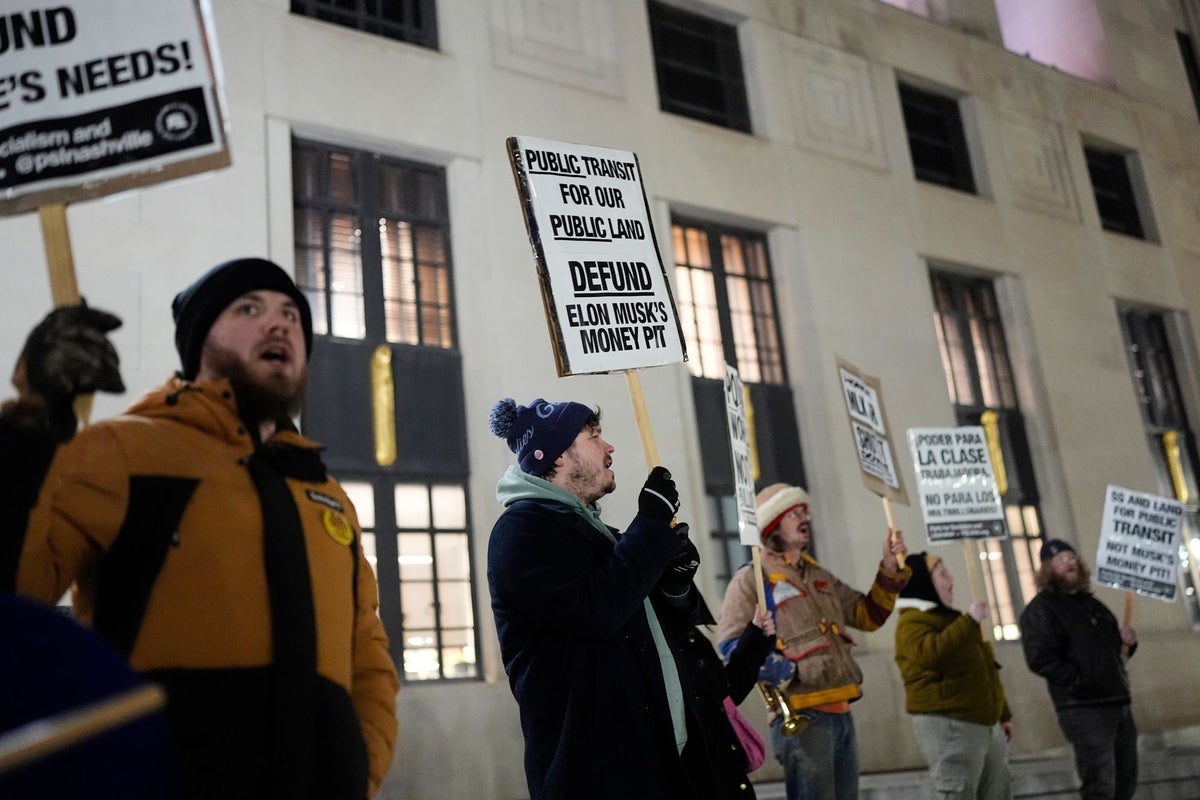
The outrage machine is at it again. Politicians are "blindsided." Lawmakers are "furious." The media is pearl-clutching over Elon Musk’s Boring Company tunnels like they’ve just discovered fire and are terrified of the smoke.
Here is the inconvenient truth: The fury isn't about safety, and it isn't about "lack of transparency." It is about the absolute terror that a private entity might actually solve a civic problem for a fraction of the cost while bypassing the bureaucratic bloat that justifies most local government salaries.
When a city official says they were "blindsided" by a tunnel proposal, they are really saying they are embarrassed. They are embarrassed that a tech company can move faster than a three-year environmental impact study that costs $50 million and results in exactly zero inches of dirt being moved.
The Cost Of Doing Nothing Is Higher Than The Risk Of Doing Something
Traditional subway systems in the United States are a fiscal suicide pact. Look at the data. The Second Avenue Subway in New York cost roughly $2.5 billion per mile. In California, the high-speed rail project has become a legendary sinkhole of taxpayer cash, with estimates ballooning past $100 billion for a track that barely exists.
Musk’s Las Vegas Loop? It cost about $47 million for the initial segment.
Critics love to point out that it’s "just Teslas in a hole." They say it lacks the capacity of a traditional train. They are right, and they are also completely missing the point. We don’t need more massive, rigid infrastructure that takes forty years to build and forty more to pay off. We need hyper-localized, scalable solutions that can be deployed before the next election cycle.
The "lazy consensus" argues that mass transit must be massive. It doesn't. Mass transit needs to be efficient. If you can move 4,500 people per hour in autonomous EVs through a $50 million tunnel, you have already outperformed every municipal bus route in the country on a dollar-for-dollar basis.
The Myth Of The Blindsided Lawmaker
Let’s dismantle this "surprise" narrative. No one digs a tunnel under a major American city without a mountain of permits. When a lawmaker claims they didn’t know it was happening, they are either lying or incompetent.
I have seen city councils spend six months debating the color of a bike lane. The idea that a boring machine—a literal multi-ton mechanical worm—showed up unannounced is a fantasy. The "fury" we see in the headlines is a calculated political maneuver. It’s a way to extract concessions, slow down progress, and ensure that "community stakeholders" (read: lobbyists and entrenched interests) get their cut of the action.
The status quo is a protection racket for slow movement.
When The Boring Company proposes a new route, it threatens the monopoly on urban movement held by transit authorities that are currently failing. These authorities don't want a solution; they want a budget increase. By framing the Loop as a dangerous or secretive "billionaire's whim," they protect their own inefficiency.
Why The "Vegas Loop" Is A Prototype Not A Product
If you judge the Wright brothers' first flight by its ability to carry 300 passengers to London, you’d call it a failure. That is exactly what critics are doing with the Las Vegas Loop.
The current iteration—human drivers in Model Xs—is a beta test. The end state isn't a taxi service; it’s an automated, high-frequency logistics network.
The Real Math of Throughput
Let $T$ be the total throughput of a transit system. In a traditional subway:
$$T = \frac{C \cdot V}{h}$$
Where $C$ is car capacity, $V$ is the number of cars, and $h$ is the headway (time between trains).
Subways have massive $C$ but terrible $h$. You wait ten minutes for a train that holds a thousand people. If you miss it, you’re stuck.
The Boring Company flip-flops the variables. They minimize $C$ (individual cars) to drastically reduce $h$ to near zero. It is point-to-point transit. No stops. No transfers. No waiting for a drunk person to get their foot out of the door at the 4th Street station.
This is the "nuance" the fury-merchants ignore: The Loop is a packet-switched network for physical space. It treats commuters like data packets. Instead of waiting for a "bus" (a large data block) to fill up, it sends individual "packets" (Teslas) as soon as they are ready.
The Safety Theater
"What if a car catches fire?"
This is the favorite line of the anti-tunnel brigade. They ignore the fact that thousands of internal combustion engine vehicles—which are essentially rolling Molotov cocktails—drive through tunnels every single day in New York, Chicago, and San Francisco.
EVs don't have fuel lines that burst. They don't have exhaust systems that leak CO into the passenger cabin. And a bored-out concrete tube is arguably the safest place to be in an earthquake.
This isn't an engineering problem. This is a PR problem for people who want you to be afraid of things you can't control.
Stop Trying to Fix Public Transit (Do This Instead)
Public transit in its current form is a 19th-century solution for a 21st-century problem. We are trying to "fix" it by throwing more billions at it.
The Boring Company isn't building a subway. It's building a 3D highway. It is the end of the "two-dimensional" urban planning trap. We have been limited to the surface for a hundred years. If we can't build up (NIMBYs) and we can't build out (sprawl), we have to go down.
The real controversy isn't that Elon Musk is "blindsiding" lawmakers. It is that he is proving how cheaply and quickly we could have been doing this for decades if the government didn't have a vested interest in the status quo.
If you want to be "furious," don't be furious at the guy with the drill. Be furious at the people who have been telling you for forty years that it’s impossible to build a tunnel for less than a billion dollars a mile. They were wrong. They knew they were wrong. And they are mad because now everyone else knows it, too.
The next time a politician says they're "blindsided," ask them how many miles of tunnel they've built this year.
None.
That's the only number that matters.
The future isn't a train you wait for; it's a hole in the ground that lets you go where you want, when you want, without a committee meeting to decide your route.
The dirt is moving. Get out of the way.