The air in Beijing during mid-May has a particular weight to it. It is the season when the willow catkins drift through the streets like silent, summer snow, coating the gray pavement of Chang'an Avenue in a deceptive softness. Underneath that softness, however, lies the hardest tectonic plate of global power.
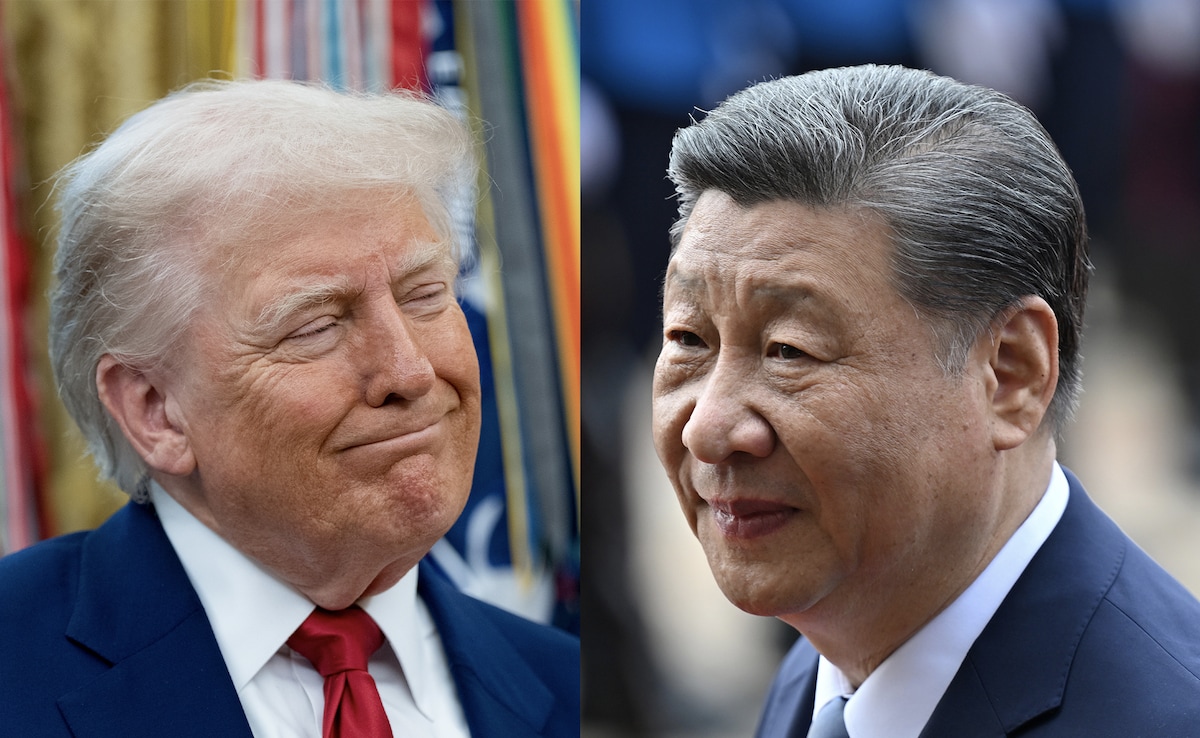
Donald Trump is heading back to the Middle Kingdom.
The confirmation came through with the clinical brevity of a state-run press release: an invitation from Xi Jinping, an acceptance, and a three-day window from May 13 to May 15. On paper, it looks like a calendar entry. In the theater of international relations, it is a high-stakes gamble where the currency isn't just trade deficits or semiconductor chips, but face.
Think of two grandmasters who have spent years trying to flip the table on one another, suddenly deciding to sit down for a quiet game of Go. The pieces haven't changed. The animosity hasn't evaporated. But the realization has set in that the room is getting too small for both of them to keep shouting.
The Ghost in the Room
To understand why this trip matters, you have to look past the scheduled banquets and the forced smiles of the diplomatic corps. You have to look at the kitchen tables in Ohio and the factory floors in Guangdong. These are the people who actually pay for the decisions made in the gilded halls of the Great Hall of the People.
When a tariff is slapped on a steel beam or a bushel of soybeans, it isn't a "government" that bleeds. It’s the farmer who watches his silo overflow with grain he can’t sell. It’s the small business owner who realizes his margins just vanished because the cost of raw components spiked overnight. These people are the invisible guests at the May summit.
Donald Trump’s return to China is, in many ways, a return to his favorite arena. He has always viewed the world through the lens of the deal—a primal, one-on-one struggle of wills. For him, the optics of the Forbidden City aren't just a backdrop; they are the scoreboard. But this time, the scoreboard looks different than it did during his last state visit.
The world has aged. Hardened.
China is no longer just the "factory of the world." It is a titan struggling with its own internal gravity—property bubbles, a shrinking workforce, and an ambition that sometimes outpaces its reach. Across the Pacific, the United States is grappling with its own identity, caught between the desire to decouple and the reality that our economies are stitched together like a surgical graft that cannot be removed without killing the patient.
Three Days in May
The itinerary is a carefully choreographed dance. From May 13 to May 15, every movement will be analyzed by legions of intelligence officers and body language experts.
How long was the handshake?
Did they share a private meal, or was it a cold, televised affair?
On the first day, expect the pomp. There is a specific kind of theater that Beijing excels at—the red carpets that seem to stretch for miles, the military bands playing with a precision that feels almost robotic, the sense of ancient history being used as a shield. Trump enjoys this. He understands the power of the spectacle.
But by day two, the walls close in.
The real work happens in the small rooms. This is where the talk of "global stability" stops and the talk of "market access" begins. Imagine the tension in a room where the two most powerful men on earth are discussing the South China Sea while their aides frantically check the latest ticker symbols on their phones.
There is a psychological element here that most analysts miss. Both men are performers. Both men are deeply concerned with their legacy. Xi wants to be the man who restored China to its rightful place at the center of the universe. Trump wants to be the man who fixed the "broken" system of global trade. These two visions do not easily coexist.
The Invisible Stakes
We often talk about geopolitics as if it’s a game of Risk played on a colorful map. It’s much messier. It’s about the cost of an iPhone. It’s about the stability of the dollar. It’s about whether or not the next generation of artificial intelligence is programmed with Western values or authoritarian ones.
Consider a hypothetical engineer in Shenzhen. She has spent the last decade building a career in a tech sector that is now being choked by export controls. Now, consider a truck driver in Pennsylvania. He’s seen his cost of living skyrocket and blames "the system" for his shrinking paycheck.
These two individuals will never meet. They don't speak the same language. Yet, their entire lives are being reshaped by what happens in Beijing between May 13 and May 15. If the talks go well, there might be a thawing—a slow, cautious reopening of the arteries of commerce. If they go poorly, the chill will be felt in every shipping container crossing the Pacific.
The stakes are not just economic. They are existential. We are watching the messy, painful process of two superpowers trying to find a "new normal" in a world that refuses to stay still. There is no going back to the way things were in the 1990s. The era of blind engagement is dead. What replaces it is still being written, and these three days are the most important chapter we’ve seen in years.
The Art of the Possible
Critics will say this visit is just for show. They’ll argue that nothing of substance can be solved in seventy-two hours. They might be right. But in diplomacy, "the show" is often the point.
The mere fact that the invitation was extended and accepted suggests a mutual recognition of exhaustion. Both sides are tired of the constant friction. They are looking for a pressure valve. Even if no major treaty is signed, the "de-risking" of the rhetoric is a victory in itself.
The danger, of course, is the ego.
When you put two personalities of this magnitude in a room, the risk of a misunderstanding is high. One misplaced comment, one perceived slight, and the progress of months can be undone in seconds. It is a tightrope walk over a canyon filled with nuclear-tipped missiles and trade wars.
But there is also an odd sort of chemistry between Trump and Xi. Despite their ideological differences, they share a certain "strongman" DNA. They both understand power in its rawest form. They both view the world as a series of competitions to be won. There is a begrudging respect there—the kind two veteran boxers have for each other after fifteen rounds in the ring.
Beyond the Handshake
As the plane touches down at Beijing Capital International Airport, the world will be watching. We will see the photos of them walking through the ancient courtyards of the palace. We will hear the prepared statements about "mutual cooperation" and "constructive dialogue."
But listen to what isn't said.
Watch for the subtle shifts in policy that follow. Does the rhetoric on Taiwan soften? Does the flow of fentanyl precursors slow down? Does the U.S. ease up on some of the more aggressive tech bans? These are the real metrics of success.
The "human element" of this story isn't just about the two leaders. It’s about the 1.4 billion people in China and the 330 million people in America who are strapped into the backseat of this car. We are all passengers. We are all watching the two drivers to see if they can navigate this sharp turn without hitting the guardrail.
The willow catkins will continue to fall in Beijing. The sun will rise over the Potomac. And for three days in May, the pulse of the planet will be measured by the footsteps of two men walking through a city built for emperors.
They are not emperors. They are men burdened by the immense, crushing weight of their own choices, trying to find a way to live in a world that is too small for a cold war and too complicated for a simple peace.
The cameras will capture the smiles. The history books will record the dates. But the truth will be found in the silence that follows the closing of the heavy, lacquered doors of the inner sanctum. Everything else is just noise.